7weber.com
GETTING STARTED
What is a Leak Check?
Once the ULPG cylinder is properly installed, it is necessary
to perform a leak check. A leak check is a reliable way to
verify that gas is not escaping after you connect the ULPG
cylinder. Weber recommends performing a thorough leak
check after assembly, as well as annually. The following
fittings should be tested:
• Where the cylinder connects to the gas hose.
• Where the gas hose connects to the regulator.
• Where the regulator connects to the burner valve.
Checking for Gas Leaks
If there is a leak from your appliance (smell of gas)
immediately attempt to turn o the cylinder valve. Remove
the appliance to a well-ventilated location away from any
ignition source. Check for leaks using soapy water. Do not
try to detect leaks using a flame.
1) Wet fittings with a soap and water solution, using a
spray bottle, brush, or rag. You can make your own soap
and water solution by mixing 20% liquid soap with 80%
water; or, you can purchase leak check solution in the
plumbing section of any hardware store.
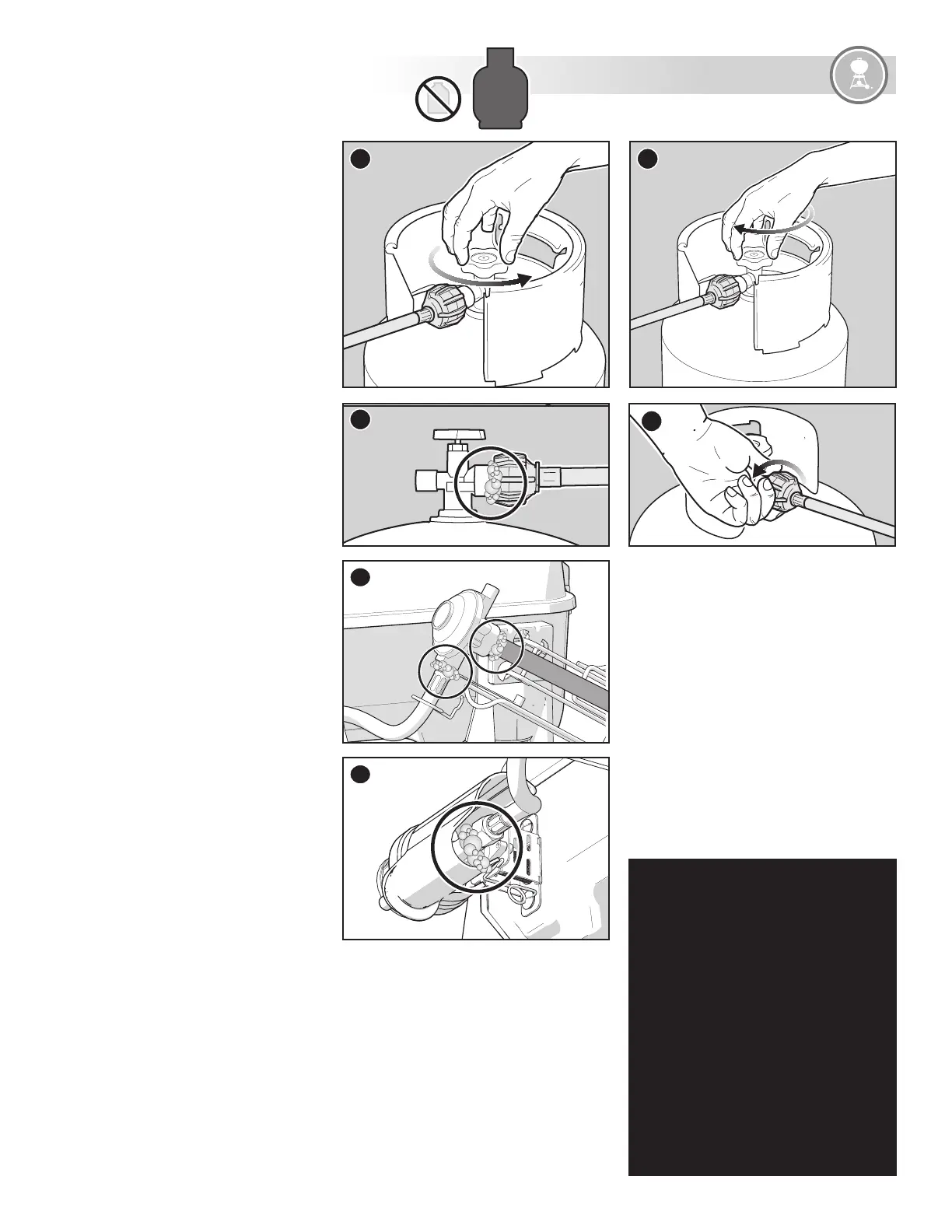
2) Slowly open gas supply by turning cylinder valve anti-
clockwise (A) while checking for bubbles.
3) If bubbles appear there is a leak:
a) If the leak is at the cylinder (B), turn o the gas.
DONOT OPERATE THE BARBECUE. Disconnect the
ULPG cylinder and return the ULPG cylinder to your
local retailer.
b) If the leak is at the regulator (C) or burner valve (D),
turn o the gas. NEVER ATTEMPT TO TIGHTEN THE
REGULATOR. DO NOT OPERATE THE BARBECUE.
If a leak is present, contact the Customer Service
Team using the contact information on our website.
4) If bubbles do not appear, leak checking is complete:
a) Turn gas supply o at the ULPG cylinder and rinse
connections with water.
NOTE: Since some leak test solutions, including soap and water,
may be slightly corrosive, all connections should be rinsed with
water after checking for leaks.
m DANGER: Do not use a flame to check for gas leaks.
Besure there are no sparks or open flames in the
area while you check for leaks.
m DANGER: Leaking gas may cause a fire or explosion.
m DANGER: Do not operate the barbecue if there is a
gas leak present.
m DANGER: If you see, smell, or hear the hiss of gas
escaping from the cylinder:
1. Move away from cylinder.
2. Do not attempt to correct the problem
yourself.
3. Call the emergency fire services.
m DANGER: Always close the cylinder valve before
disconnecting the regulator. Do not attempt to
disconnect the gas regulator and hose assembly or
any gas fitting while this barbecue is in operation.
m DANGER: Do not store a spare cylinder under or
near this barbecue. Never fill the cylinder beyond
80% full. Failure to follow these statements exactly
may result in a fire causing death or serious injury.
m This appliance is not suitable for installation or
connection to a reticulated gas supply.
Refilling or Replacing an ULPG Cylinder
Removing the ULPG Cylinder
When your ULPG cylinder needs to be refilled or replaced,
follow these instructions to remove it.
1) Confirm that the cylinder valve is fully closed. Close by
turning valve clockwise (E).
2) Unscrew gas hose coupling from the cylinder (F).
Additional Leak Check Precautions
The following fittings should be tested for gas leaks each
time an ULPG cylinder is refilled and reinstalled:
• Where the gas hose connects to the cylinder (B) and at the
regulator (C).
Follow the instructions for "Checking for Gas Leaks".
A
B
C
D
E
F


 To Next Page
 Loading...