EasyManua.ls Logo

Wedge Innovations SmartLevel - Integrated Wall Stand-Offs; Using the Sensor Module with Various Rail Lengths; Transferring the Sensor Module between Rails

Default Icon
13 pages
Print Icon
To Next Page IconTo Next Page
To Previous Page IconTo Previous Page
Loading...
Integrated
Wall
Stand
..
Qffs
Scribing
Lines
with
SmartLevel
SmartLevel's
integrated
wall
stand-offs
stabilize
the
tool
for
scribing
or
measuring
lines
on
vertical
surfaces.
To
extend
the
stand-offs,
press
and
slide
your
thumb
over
the
ribbed
portion
toward
the
top
of
the
rail.
The
stand-offs
will
pivot
out
of
their
nested
position.
The
bottom
surface
of
SmartLevel
can
now
be
easily
used
to
guide
a
pencil
or
scribe
when
drawing
or
measuring
lines.
Why
are
Smartlevel
Rails
Shaped
Like
a
Triangle?
SmartLevel
evolved
from
several
hundred
hours
of
consumer
testing
and
research
dedicated
to
developing
a
new
ergonomic
(comfort-
and
safety-oriented)
design
for
SmartLevel.
The
triangular
shape,
with
its
broad
base
and
narrow
top,
permits
SmartLevel
to
be
placed
securely
on
a
flat
surface,
preventing
the
tool
from
easily
tipping
over
or
falling,
while
its
narrow
top
makes
it
easy
to
grip.
The
groove
on
the
rail
base
allows
you
to
set
SmartLevel
more
securely
on
a
rounded
surface,
such
as
a
drainage
pipe.
And
the
beveled
ends
permit
you
to
easily
maneu-
ver
the
tool
into
tight,
angled
spots,
which
would
be
impossible
with
a
typical
rectangular
level.
Finally,
we
added
large
handholds
for
the
entire
rail
length,
allow-
ing
you
to
get
a
firm,
safe
grip
on
your
SmartLevel,
even
when
wearing
work
gloves.
16
Measuring
with
Smartlevel
.,..
Using
the
Sensor
Module
with
Various
Rail
Lengths
The
Sensor
Module
may
be
used
alone
as
a
torpedo-style
level,
or
it
can
be
transferred
and
locked
into
various
rail
handholds.
It
fits
into
any
handhold
of
the
48-
and
78-inch
rails,
but
only
into
the
center
handhold
of
the
24-inch
rail.
Longer
rail
lengths
provide
greater
accuracy
over
longer
distances
because
they
"average
out"
surface
imperfections
(knots,
blisters,
bends,
bows,
etc.).
Transferring
the
Sensor
Module
between
Rails
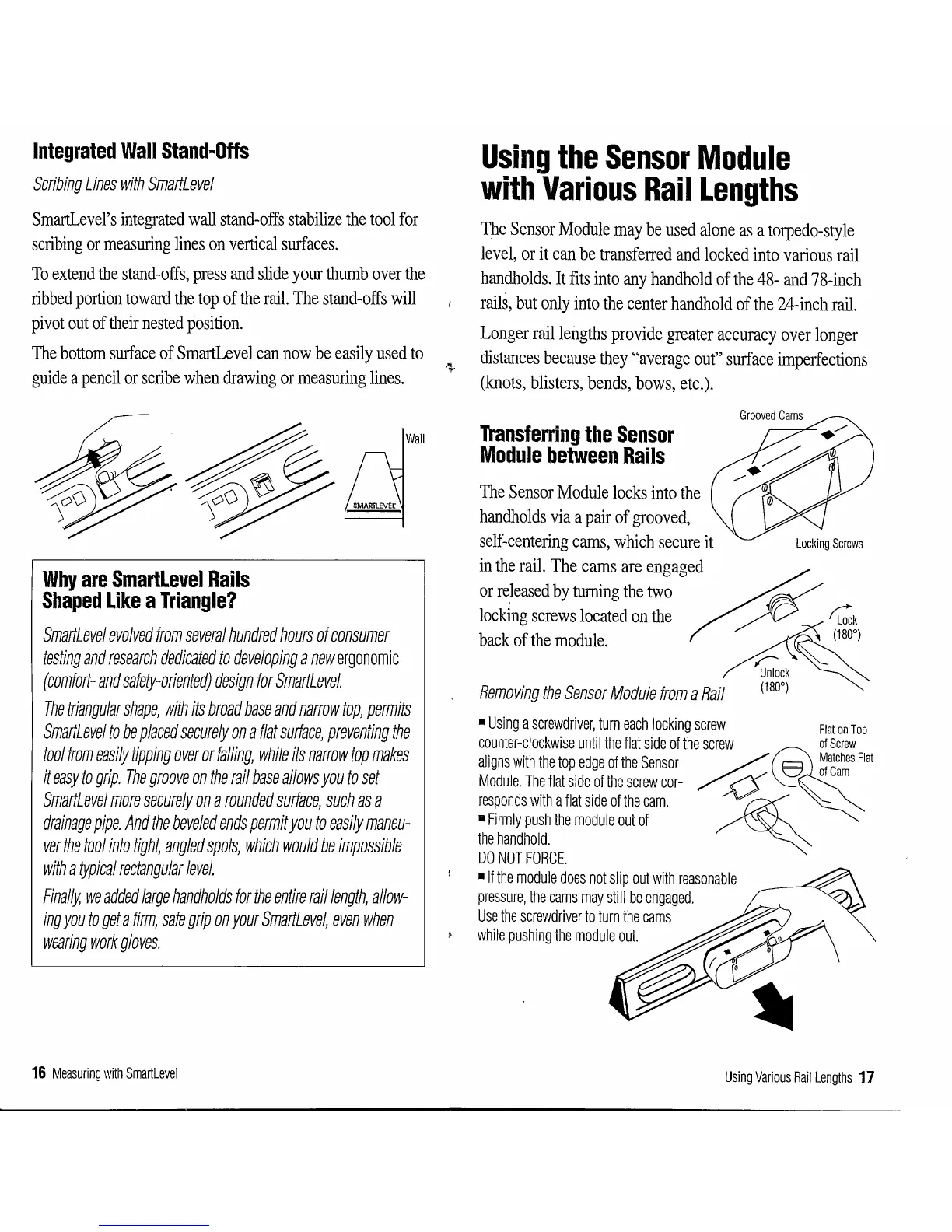
The
Sensor
Module
locks
into
the
handholds
via
a
pair
of
grooved,
self-centering
cams,
which
secure
it
in
the
rail.
The
cams
are
engage~d
or
released
by
turning
the
two
/
~
locking
screws
located
on
the
~/V
x
tL;k
(180°)
back
of
the
module.
r
Unlock
Removing
the
Sensor
Module
from
a
Rail
(1
8
oo)
Using
a
screwdriver,
turn
each
locking
screw
Flat
on
Top
counter-clockwise
until
the
flat
side
of
the
screw
of
Screw
aligns
w1th
the
top
edge
of
the
ensor
8
of
cam
. . S
~
Matches
Flat
Module.
The
flat
side
of
the
screw
cor-
~
responds
with
a
flat
side
of
the
cam.
~
Firmly
push
the
module
out
of
the
handhold.
DO
NOT
FORCE.
•If
the
module
does
not
slip
out
with
reasonable
pressure,
the
cams
may
still
be
engaged.
Use
the
screwdriver
to
turn
the
cams
while
pushing
the
module
out.
Using
Various
Rail
Lengths
17