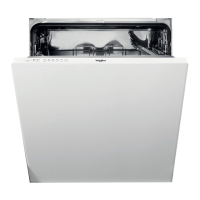
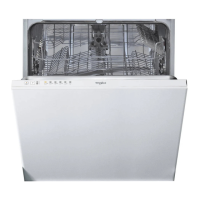
This document serves as a comprehensive guide for the Whirlpool dishwasher, covering its functions, usage, and maintenance.
Product Description
The Whirlpool dishwasher is designed for efficient dish cleaning and features a user-friendly control panel. Key components include:
- Upper rack: For delicate and light dishes such as glasses, cups, saucers, and low salad bowls. It features foldable flaps with adjustable positions to optimize crockery arrangement and safely accommodate wine glasses. The height of the upper rack can be adjusted to create more space for bulky items in the lower basket or to avoid collision with items loaded into the lower rack. This adjustment is facilitated by an Upper Rack height adjuster, allowing the rack to be lifted by holding its sides or lowered by pressing levers. It is recommended not to adjust the height when the rack is loaded.
- Cutlery rack: The third rack, specifically designed for cutlery, allows for organized placement to improve washing and drying performance. Knives and other sharp utensils should be placed with blades facing downwards. The rack's geometry also allows for small items like coffee cups to be placed in the middle.
- Lower rack: Suitable for pots, lids, plates, and salad bowls. Large plates and lids should be placed at the sides to prevent interference with the spray arm. The lower rack includes tip-up supports that can be used vertically for plates or horizontally for pans and salad bowls.
- Spray arms (upper and lower): These arms distribute water during the wash cycle.
- Filter Assembly: Located at the bottom of the dishwasher, it collects food residues.
- Salt reservoir: Used to prevent limescale formation on dishes and machine components.
- Detergent and Rinse Aid dispensers: For automatic dispensing of cleaning agents.
- Control panel: Features buttons for power, program selection, delay, multizone, turbo, power clean, and tablet settings, along with indicator lights for salt, rinse aid, program number, remaining time, and delay.
First Time Use
Before initial use, remove stoppers and elastic elements from the racks.
Filling the Salt Reservoir:
The salt reservoir prevents limescale. It must always be filled and the water hardness set correctly. The reservoir is in the lower part of the dishwasher. The SALT REFILL indicator light on the control panel signals when refilling is needed. To fill, remove the lower rack, unscrew the cap, position the funnel, and pour approximately 1 kg of salt. Ensure the cap is tightly screwed to prevent detergent from entering. It is recommended to add salt before starting a wash cycle.
Setting Water Hardness:
The water softener's effectiveness depends on the correct water hardness setting, which can be obtained from your local water supplier. The factory setting is for average (3) hardness. To adjust:
- Switch on and then off the appliance using the ON/OFF button.
- Hold button P for 5 seconds until a beep is heard.
- Switch on the appliance. The current selection level number and salt indicator light will flash.
- Press button P to select the desired hardness level according to the Water Hardness Table.
- Switch off the appliance.
After this, run a program without loading, using only dishwasher-specific salt. The SALT REFILL indicator light will turn off. Failure to fill the salt container can damage the water softener and heating element.
Filling the Rinse Aid Dispenser:
Rinse aid aids dish drying. The RINSE AID REFILL indicator light signals when refilling is needed. To fill:
- Open dispenser B by pressing and pulling up the tab on the lid.
- Carefully pour rinse aid up to the maximum (110 ml) notch, avoiding spills. Clean any spills immediately.
- Press the lid down until it clicks shut. Never pour rinse aid directly into the tub.
Adjusting Rinse Aid Dosage:
If drying results are unsatisfactory, adjust the rinse aid quantity:
- Switch the dishwasher on and then off using the ON/OFF button.
- Press button P three times until a beep is heard.
- Switch on the appliance. The current selection level number and rinse aid indicator light will flash.
- Press button P to select the desired rinse aid quantity (1-4 levels).
- Switch off the appliance.
Setting to ZERO (ECO) means no rinse aid will be supplied, and the LOW RINSE AID indicator light will not illuminate. Adjust to a lower number (1-2) for bluish streaks, or a higher number (3-4) for water drops or limescale marks.
Filling the Detergent Dispenser:
To open, use device A. Introduce detergent into dry dispenser B. For pre-washing, place detergent directly inside the tub. Refer to the Programs Table for the correct quantity. Compartment B shows the maximum quantity of liquid or powder detergent for each cycle. Remove any detergent residues from the edges and close the cover until it clicks. The dispenser opens automatically during the program. If using all-in-one detergents, activate the TABLET button for optimal washing and drying.
Programs Table
The dishwasher offers various programs tailored for different soiling levels and item types:
- Eco 50°: Standard program for normally soiled crockery, optimized for energy and water consumption.
- 6th Sense 50-60°: For normally soiled dishes with dried food residues. It senses soiling levels and adjusts the program duration accordingly, indicated by an animation on the display.
- Intensive 65°: Recommended for heavily soiled crockery, especially pans and saucepans (not for delicate items).
- Daily 50°: Everyday cycle for normally soiled crockery, ensuring optimal cleaning in a shorter time.
- Silent 50°: Suitable for night-time operation, ensuring optimum performance.
- Rapid 30' 50°: For lightly soiled dishes with no dried food residues (ideal for 2 place settings).
- Cristal 45°: For delicate items sensitive to high temperatures, such as glasses and cups.
- PreWash: For crockery to be washed later, no detergent needed.
- Sanitizing 65°: For normally or heavily soiled crockery with an additional antibacterial wash.
- Self-Clean: Maintenance program using hot water to clean the dishwasher interior.
Program durations and consumption values are estimates and can vary based on factors like water temperature, load, and selected options. To reduce consumption, run the dishwasher only when full.
Options and Functions
- Delay: Delays the program start time from 1 to 12 hours. Press the DELAY button repeatedly to increase the delay. The timer counts down once the door is closed. To adjust or cancel, press the button repeatedly until the desired setting is reached or the indicator light switches off. Cannot be set once a wash cycle has started.
- Multizone: For half loads, saving water, electricity, and detergent. Select a program, then press the MULTIZONE button. The indicator light illuminates, and the chosen rack symbol appears on the display. By default, the appliance washes dishes in all racks. To wash only a specific rack, press the button repeatedly to select lower, upper, or cutlery rack only. Remember to load only the selected rack and reduce detergent accordingly.
- Turbo: Reduces main program duration while maintaining washing and drying performance. Activate by pressing the TURBO button after program selection.
- Power Clean: Provides intensive wash in the lower rack using additional power jets, recommended for pots and casseroles. Activate by pressing the POWER CLEAN button.
- Tablet (Tab): Optimizes program performance for all-in-one tablet detergents (containing rinse aid, salt, and detergent). Activate if using tablets; keep off for powder or liquid detergents.
- Operation Indicator: An LED light projected on the floor indicates dishwasher operation. Modes include disabled, light on for a few seconds then off during cycle and flashing at end, or light on during cycle and flashing at end (default). If delayed start is set, the light is on for the countdown duration. The light turns off when the door is opened. To select a mode, switch on, hold button P until a letter appears, press P to cycle through modes, then hold P to confirm.
Daily Use
- Check Water Connection: Ensure the dishwasher is connected and the tap is open.
- Switch On: Open the door and press the ON/OFF button.
- Load Racks: Arrange crockery as described in "Loading the Racks."
- Fill Detergent Dispenser: Add detergent according to the Programs Table.
- Choose Program and Customise Cycle: Select the appropriate program with button P and desired options.
- Start: Close the door. A beep indicates the program has started.
- End of Wash Cycle: Beeps and a flashing cycle number on the display indicate completion. Open the door, press ON/OFF, and wait a few minutes before unloading to avoid burns, starting with the lower rack.
The machine automatically switches off during extended inactivity to minimize electricity consumption. If crockery is lightly soiled or pre-rinsed, reduce detergent amount.
Modifying a Running Program: If a wrong program was selected and has just begun, open the door (beware of hot steam!), press and hold ON/OFF to switch off. Switch on, select new program and options, then close door.
Adding Extra Crockery: Without switching off, open the door (beware of hot steam!) and place crockery inside. Close the door, and the cycle resumes from where it was interrupted.
Accidental Interruptions: If the door opens or there's a power cut, the cycle stops. It resumes from the interruption point once the door is closed or power is restored.
Advice and Tips
Tips:
- Remove food residues and empty glasses before loading. No pre-rinsing under running water needed.
- Arrange crockery firmly, with openings facing downwards and concave/convex parts obliquely for proper water flow.
- Ensure lids, handles, trays, and frying pans do not obstruct spray arm rotation.
- Place small items in the cutlery basket.
- Place very soiled dishes and pans in the lower basket for stronger water sprays.
- After loading, ensure spray arms can rotate freely.
Hygiene:
To prevent odors and sediment, run a high-temperature program at least once a month with a teaspoon of detergent and no load to clean the appliance.
Unsuitable Crockery:
- Wooden crockery and cutlery.
- Delicate decorated glasses, artistic handicraft, and antique crockery with non-resistant decorations.
- Synthetic materials not withstanding high temperatures.
- Copper and tin crockery.
- Crockery soiled with ash, wax, lubricating grease, or ink.
- Glass decorations and aluminum/silver pieces may change color or fade. Some crystal objects may become opaque over time.
Damage to Glass and Crockery:
- Use only dishwasher-safe glasses and porcelain.
- Use a delicate detergent.
- Collect glasses and cutlery as soon as the wash cycle ends.
Loading the Racks
Cutlery Rack:
Designed for cutlery, arranged as shown in the figure for better washing and drying. Knives and sharp utensils should have blades facing downwards. The middle area can hold small items like coffee cups.
Foldable Flaps with Adjustable Position:
Side foldable flaps on the upper rack can be positioned at three heights to optimize crockery arrangement. Wine glasses can be placed safely by inserting stems into slots. Incline flaps for better drying. To change inclination, pull up the flap, slide it, and position as desired.
Lower Rack:
For pots, lids, plates, salad bowls, etc. Large plates and lids should be placed at the sides to avoid obstructing the spray arm. The lower rack has tip-up supports for vertical plate arrangement or horizontal placement of pans and salad bowls.
Upper Rack:
For delicate and light dishes: glasses, cups, saucers, low salad bowls.
Adjusting the Height of the Upper Rack:
The upper rack's height can be adjusted to accommodate bulky crockery in the lower basket or to maximize space by using tip-up supports. To adjust, lift the rack by its sides without pressing levers until it's stable in the upper position. To lower, press levers A at the sides and move the basket down. Do not adjust height when loaded or on one side only.
Power Clean in Lower Rack:
Power Clean uses special water jets in the rear to intensively wash heavily soiled items. To use:
- Adjust the Power Clean area (G) by folding down the rear plate holders.
- Load pots and casseroles vertically, inclined towards the power water jets.
Activate POWER CLEAN on the panel.
The lower rack also has a Space Zone, a pull-out support for upright storage of frying pans or baking pans.
Care and Maintenance
Cleaning the Filter Assembly:
Regularly clean the filter assembly to prevent clogging and ensure proper wastewater flow. The assembly consists of three filters that remove food residues. The dishwasher must not be used without filters or if they are loose. After several washes, clean the filters under running water with a non-metallic brush:
- Turn cylindrical filter A anti-clockwise and pull it out (Fig 1).
- Remove cup filter B by exerting slight pressure on side flaps (Fig 2).
- Slide out stainless-steel plate filter C (Fig 3).
- Inspect the trap and remove food residues. Do not remove the wash-cycle pump protection (black detail) (Fig 4).
After cleaning, replace the filter assembly correctly for efficient operation.
Cleaning the Spray Arms:
Food residue can encrust and block spray arm holes. Check and clean them periodically with a small non-metallic brush. To remove the upper spray arm, turn the plastic locking ring anti-clockwise. Replace it with the side having more holes facing upwards. The lower spray arm can be removed by pulling it upwards.
Cleaning the Water Inlet Hose:
If water hoses are new or unused for a long time, let water run until clear and free of impurities before connecting. This prevents blockages and damage to the dishwasher.
Troubleshooting
If the dishwasher is not working properly, consult the following list before contacting Service Centre:
Dishwasher won't start or respond to commands:
- Possible Causes: Not plugged in properly, power outage, door not closed, not responding to commands.
- Solutions: Insert plug, dishwasher starts automatically on power return, push door until it clicks, switch off/on appliance and reset program.
Dishwasher won't drain:
- Possible Causes: Wash cycle not finished, drain hose bent, sink drain pipe blocked, filter clogged.
- Solutions: Wait for cycle to finish, check drain hose (see Installation Instruction), clean sink drain pipe, clean filter (see Cleaning the Filter Assembly).
Dishwasher makes excessive noise:
- Possible Causes: Dishes rattling, excessive foam.
- Solutions: Arrange crockery correctly (see Loading the Racks), check detergent dosage/suitability, reset dishwasher by pressing DRAIN button and run new program without detergent.
Dishes are not clean:
- Possible Causes: Crockery not arranged properly, spray arms obstructed, wash cycle too gentle, excessive foam, rinse aid cap not shut, filter soiled/clogged, no salt.
- Solutions: Arrange crockery correctly (see Loading the Racks), select appropriate wash cycle (see Programs Table), check detergent dosage/suitability, ensure rinse aid cap is closed, clean filter assembly (see Care and Maintenance), fill salt reservoir (see Filling the Salt Reservoir).
Contacting After-Sales Service:
Provide the codes from the rating plate (left or right side inside the door) when contacting After-Sales Service. The phone number is in the warranty booklet or on the Whirlpool website.



 To Next Page
 General