EasyManua.ls Logo

White 310 - Adjusting Thread Tensions

Default Icon
39 pages
Print Icon
To Next Page IconTo Next Page
To Previous Page IconTo Previous Page
Loading...
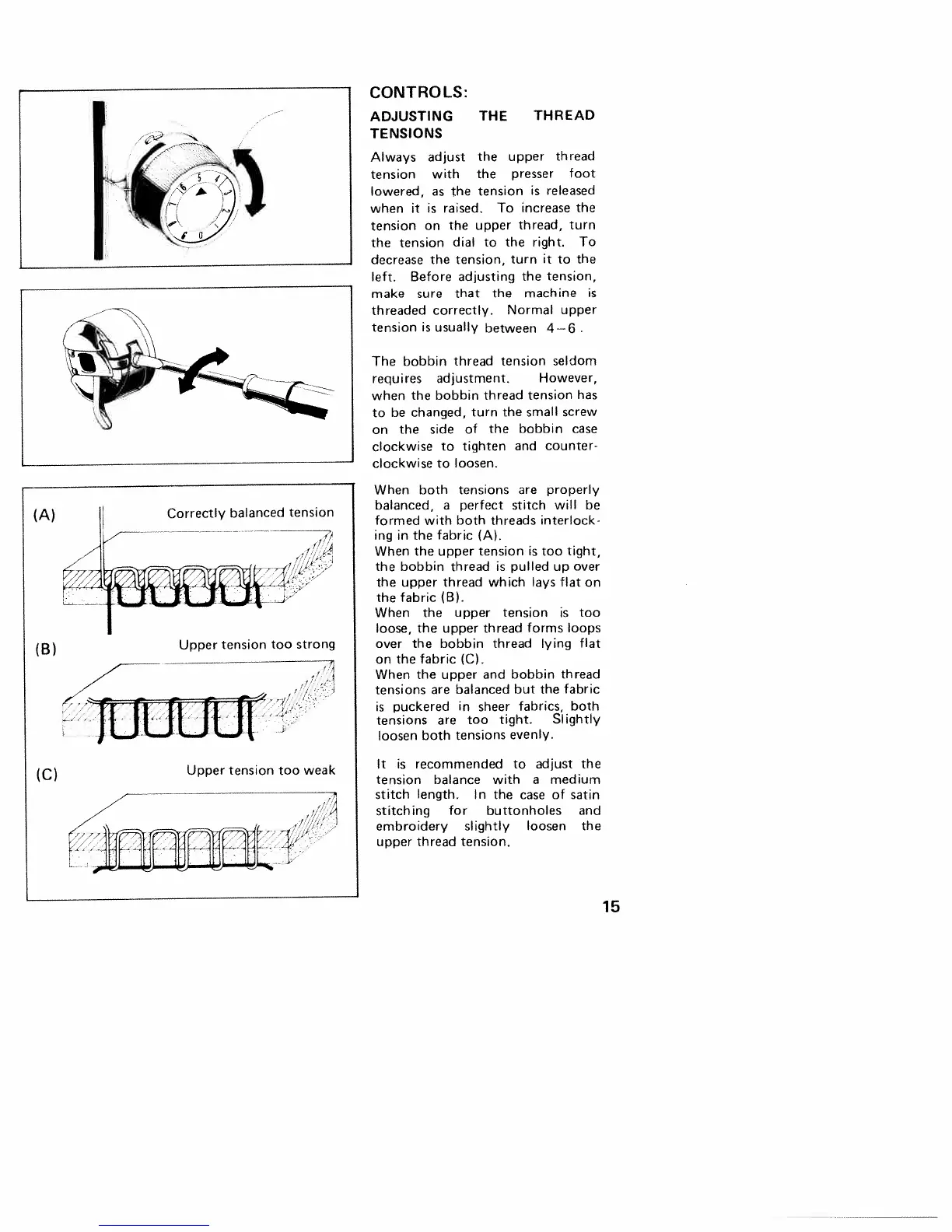
CONTROLS:
ADJUSTING
THE
THREAD
TENSIONS
Always
adjust
the
upper
thread
tension
with
the
presser
foot
lowered,
as
the
tension
is
released
when
it
is
raised.
To
increase
the
tension
on
the
upper
thread,
turn
the
tension
dial
to
the
right.
To
decrease
the
tension,
turn
it
to
the
left.
Before
adjusting
the
tension,
make
sure
that
the
machine
is
threaded
correctly.
Normal
upper
tension
is
usually
between
4—6
The
bobbin
thread
tension
seldom
requires
adjustment.
However,
when
the
bobbin
thread
tension
has
to
be
changed,
turn
the
small
screw
on
the
side
of
the
bobbin
case
clockwise
to
tighten
and
counter
clockwise
to
loosen.
When
both
tensions
are
properly
balanced,
a
perfect
stitch
will
be
formed
with
both
threads
interlock
ing
in
the
fabric
(A).
When
the
upper
tension
is
too
tight,
the
bobbin
thread
is
pulled
up
over
the
upper
thread
which
lays
flat
on
the
fabric
(B).
When
the
upper
tension
is
too
loose,
the
upper
thread
forms
loops
over
the
bobbin
thread
lying
flat
on
the
fabric
(C).
When
the
upper
and
bobbin
thread
tensions
are
balanced
but
the
fabric
is
puckered
in
sheer
fabrics,
both
tensions
are
too
tight.
Slightly
loosen
both
tensions
evenly.
It
is
recommended
to
adjust
the
tension
balance
with
a
medium
stitch
length.
In
the
case
of
satin
stitching
for
buttonholes
and
embroidery
slightly
loosen
the
upper
thread
tension.
Correctly
balanced
tension
Upper
tension
too
strong
Upper
tension
too
weak
15

Related product manuals