EasyManua.ls Logo

White 310 - Applications of the Stitches; Straight Stitch: Seams; Basting;Topstitching; Darning

Default Icon
39 pages
Print Icon
To Next Page IconTo Next Page
To Previous Page IconTo Previous Page
Loading...
SECTION
V
STRAIGHT
STITCH:
SEAMS
r
r
L.
The
normal
stitch
length
for
most
fabrics
is
between
2—3
but
the
length
chosen
should
depend
on
the
fabric
and
area
of
usage,
Usually,
heavier
fabrics
require
longer
stitches
and
lighter
weight
fabrics
require
shorter
stitches,
For
curved
seams
and
bias
cut
areas
use
a
shorter
stitch
length
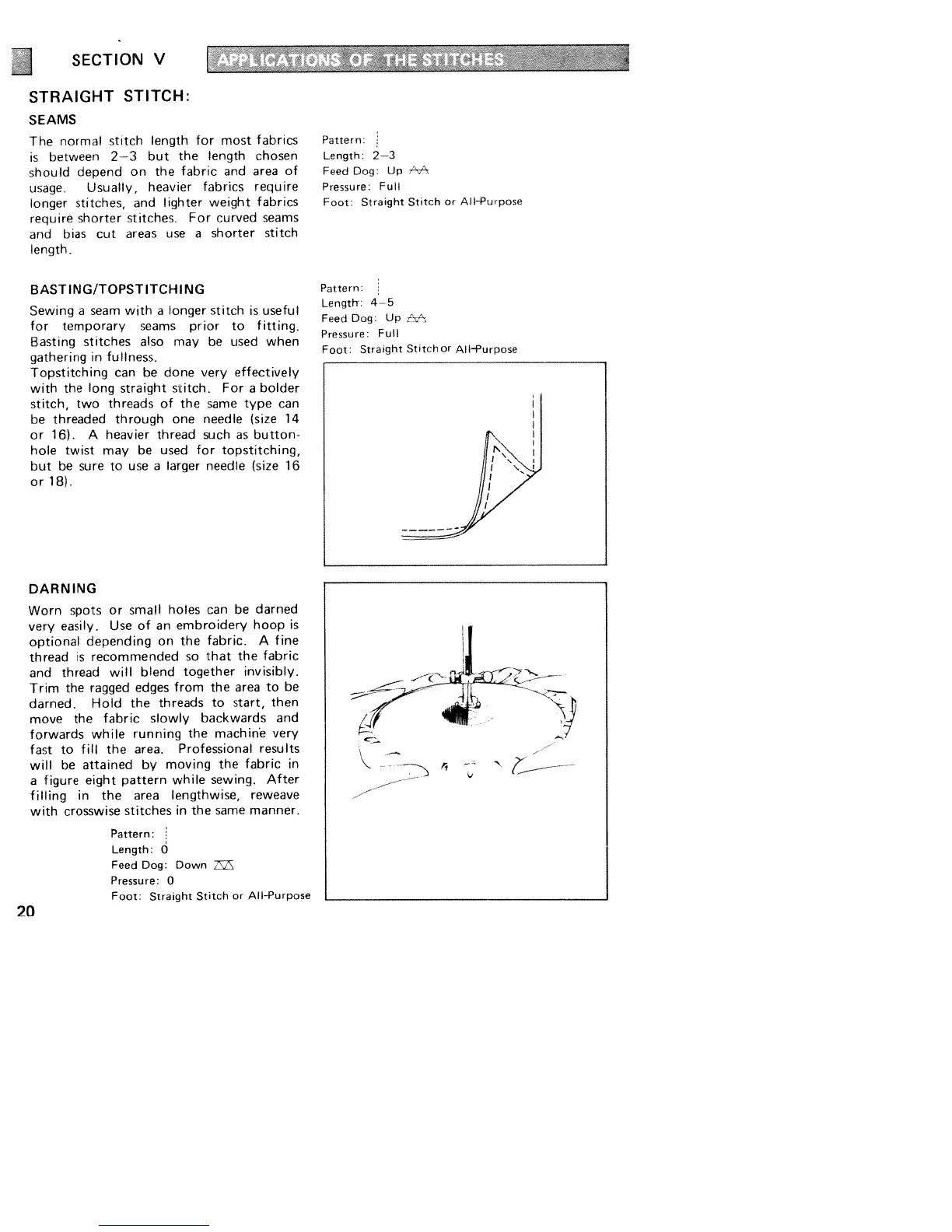
BASTING/TOPST
ITCH
ING
Sewing
a
seam
with
a
longer
stitch
is
useful
for
temporary
seams
prior
to
fitting.
Basting
stitches
also
may
be
used
when
gathering
in
fullness.
Topstitching
can
be
done
very
effectively
with
the
long
straight
stitch.
For
a
bolder
stitch,
two
threads
of
the
same
type
can
be
threaded
through
one
needle
(size
14
or
16>.
A
heavier
thread
such
as
button
hole
twist
may
be
used
for
topstitching,
but
be
sure
to
use
a
larger
needle
(size
16
or
18).
DARNING
Worn
spots
or
small
holes
can
be
darned
very
easily.
Use
of an
embroidery hoop
is
optional
depending
on
the
fabric.
A
fine
thread
is
recommended
so
that
the
fabric
and
thread
will
blend
together
invisibly.
Trim
the
ragged
edges
from
the
area
to
be
darned.
Hold
the
threads
to
start,
then
move
the
fabric
slowly
backwards
and
forwards
while
running
the
machin
very
fast
to
fill
the
area.
Professional
results
will
be
attained
by
moving
the
fabric
in
a
figure
eight
pattern
while
sewing.
After
filling
in
the
area
lengthwise,
reweave
with
crosswise
stitches
in
the
same
manner.
Pattern:
Length:
0
Feed
Dog:
Down
Pressure:
0
Foot:
Straight
Stitch
or
AP-Purpose
Pattern,
Length:
2—3
Feed
Dog:
Up
Pressure:
Full
Foot:
Straight
Stitch
or
All-Purpose
Pattern:
Length:
4
5
Feed
Dog.
Up
Pressure:
Full
Foot:
Straight
Stitchor
All—Purpose

Related product manuals