EasyManua.ls Logo

White 445 - Cloth Guide; Zigzag Sewing; Adjusting Thread Tension; Needle Position Control

Default Icon
24 pages
Print Icon
To Next Page IconTo Next Page
To Previous Page IconTo Previous Page
Loading...
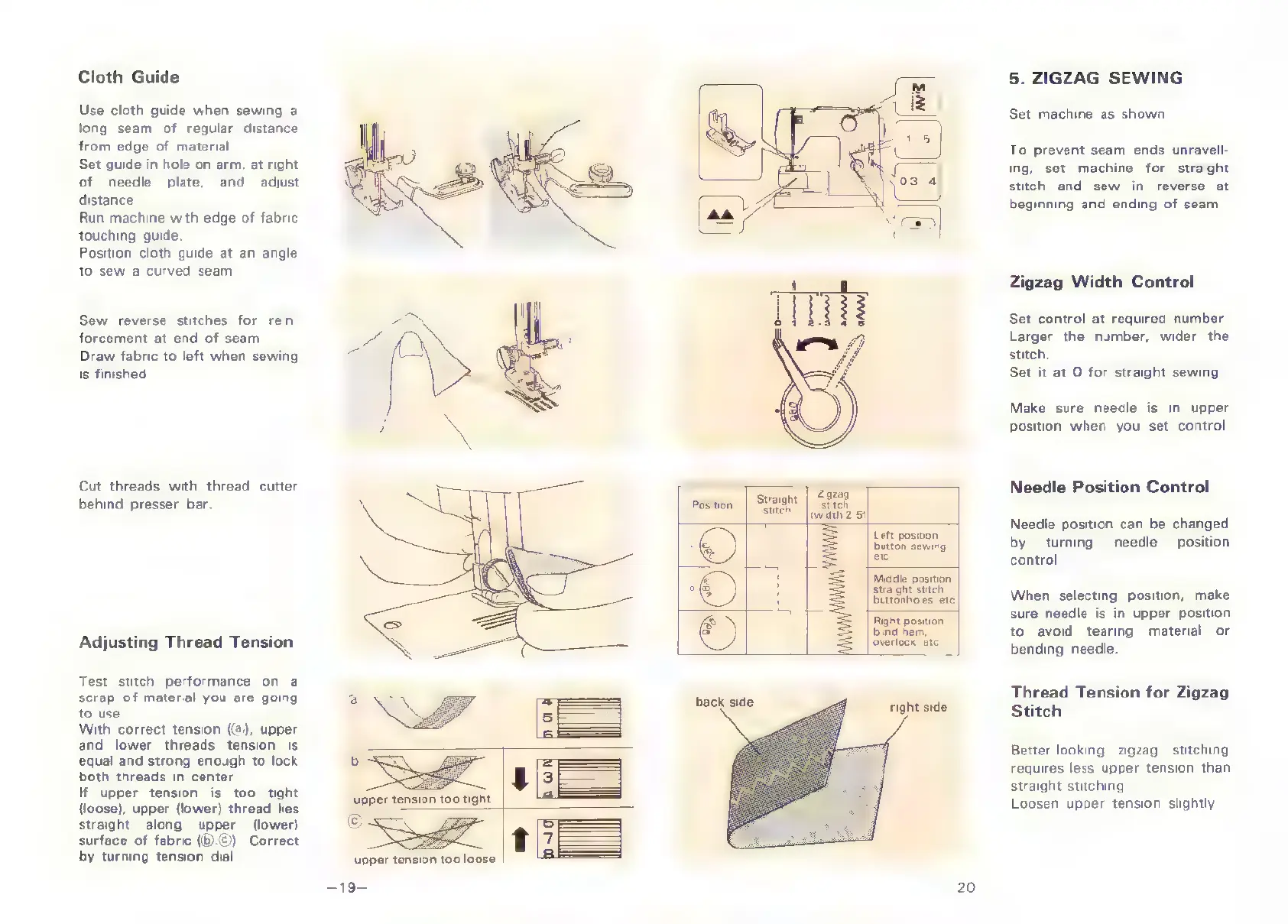
Cloth
Guide
Use
cloth
guide
when
sewing
a
long
seam
of
regular
distance
from
edge
of
material.
Set
guide
in
hole
on
arm,
at
right
of
needle
plate,
and
adjust
distance.
Run
machine
with
edge
of
fabric
touching
guide.
Position
cloth
guide
at
an
angle
то
sew
a
curved
seam.
Sew
reverse
stitches
for
rein-
forcement
at
end
of
seam.
Draw
fabric
to
left
when
sewing
is
finished
Cut
threads
with
thread
cutter
behind
presser
bar.
Adjusting
Thread
Tension
Test
stitch.
performance
on
a
scrap
of
material
you
are
going
to
use
With
correct
tension
((2),
upper
and
lower
threads
tension
is
equal
and
strong
enough
to
lock
both
threads
in
center.
If
upper
tension
is
too
tight
(loose),
upper
(lower)
thread
lies
straight
along
upper
(lower)
surface
of
fabric
(0).(©)).
Correct
by
turning
tension
dial
Straight
jag
inch
(width
2.5)
Left
position:
button
sewing,
etc.
Middle
position:
straight
stitch,
buttonholes,
etc.
1
1
П
П
i
Right
position:
blind
hem,
overlock,
etc.
©
upper
tension
too
loose
—19-
back
side
20
5.
ZIGZAG
SEWING
Set
machine
as
shown.
To
prevent
seam
ends
unravell-
ing,
set
machine
for
straight
stitch
and
sew
in
reverse
at
beginning
and
ending
of
seam.
Zigzag
Width
Control
Set
control
at
required
number.
Larger
the
number,
wider
the
stitch.
Set
it
at
O
for
straight
sewing.
Make
sure
needle
is
in
upper
position
when
you
set
control.
Needle
Position
Control
Needle
pi
ion
can
be
changed
by
turning
needle
position
control.
When
selecting
position,
make
sure
needle
is
in
upper
position
to
avoid
tearing
material
or
bending
needle.
Thread
Tension
for
Zigzag
Stitch
Better-looking
zigzag
stitching
requires
less
upper
tension
than
straight
stitching.
Loosen
upper
tension
slightly.

Related product manuals