EasyManua.ls Logo

White 734 - Sewing Techniques; Sewing Machine Light Operation; Preparing for Sewing; Guiding Fabric for Accurate Seams

Default Icon
22 pages
Print Icon
To Next Page IconTo Next Page
To Previous Page IconTo Previous Page
Loading...
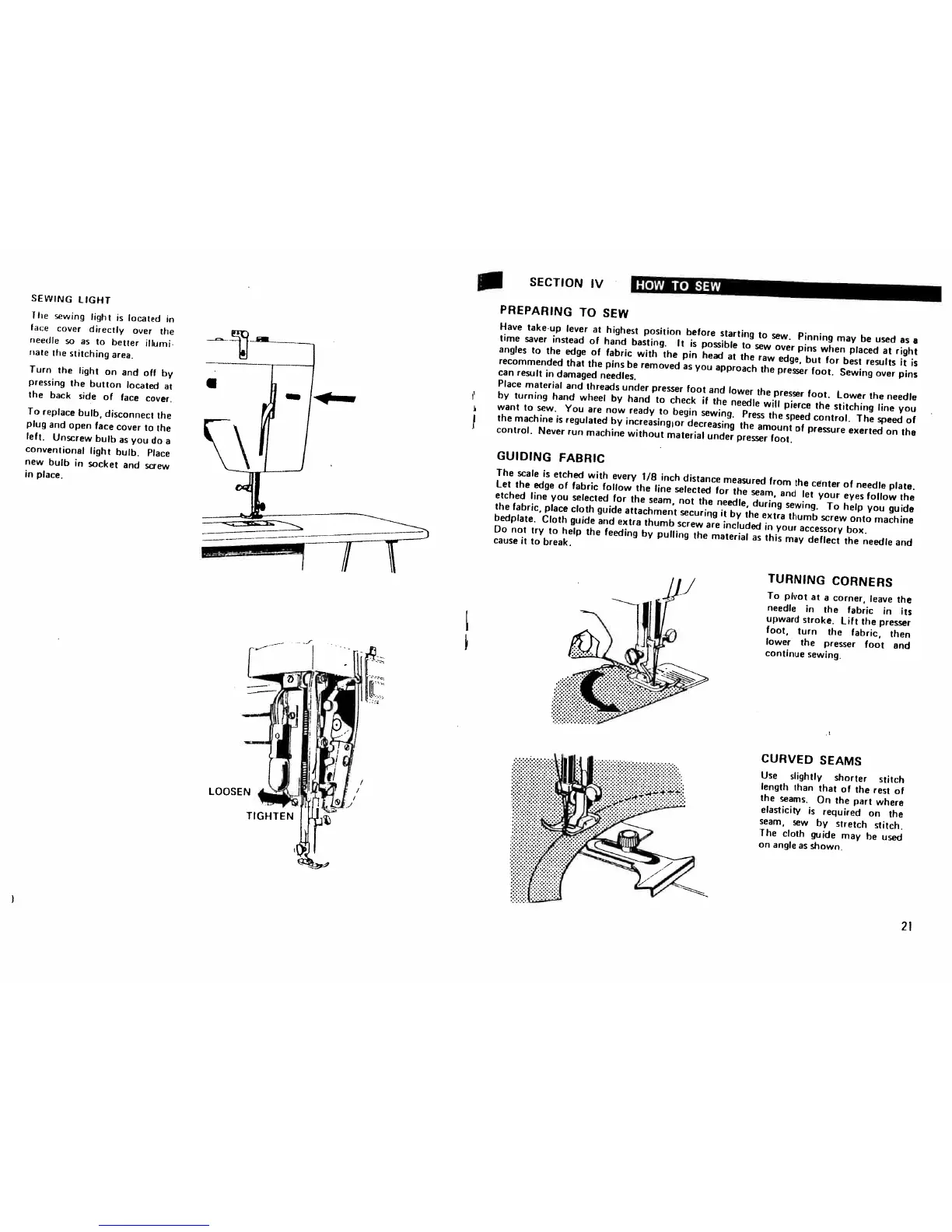
SEWING
LIGHT
The
sewing
light
is
located
in
lace
cover
directly
over
the
needle
so
as
to
better
illumi
nate
the
sutching
area.
Turn
the
light
on
and
off
by
pressing
the
button
located
at
the
back
side
of
face
cover.
To
replace
bulb,
disconnect
the
plug
and
open
face
cover
to
the
left.
Unscrew
bulb
as
you
do
a
conventional
light
bulb.
Place
new
bulb
in
socket
and
screw
in
place.
SECTION
IV
PREPARING
TO
SEW
HOW
TO
SEW
Have
take-up
lever
at
highest
position
before
starting
to
sew.
Pinning
may
be
used
as
a
time
saver
instead
of
hand
basting.
It
is
possible
to
sew
over
pins
when
placed
at
right
angles
to
the
edge
of
fabric
with
the
pin
head
at
the
raw
edge,
but
for
best
results
it
is
recommended
that
the
pins
be
removed
as
you
approach
the
presser
foot.
Sewing
over
pins
can
result
in
damaged
needles.
Place
material
and
threads
under
presser
foot
and
lower
the
presser
foot.
Lower
the
needle
by
turning
hand
wheel
by
hand
to check
it
the
needle
will
pierce
the
stitching
line
you
want
to
sew.
You
are
now
ready
to
begin
sewing.
Press
the
speed
control.
The
speed
of
the
machine
is
regulated
by
increasingor
decreasing
the
amount
of
pressure
exerted
on
the
control.
Never
run
machine
without
material
under
presser
foot.
GUIDING
FABRIC
The
scale
is
etched
with
every
1/8
inch
distance
measured
from
the
center
of
needle
plate.
Let
the
edge
of
fabric
follow
the
line
selected
for
the
seam,
and
let
your
eyes
follow
the
etched
line
you
selected
for
the
seam,
not
the
needle,
during
sewing.
To
help
you
guide
the
fabric,
place
cloth
guide
attachment
securing
it
by
the
extra
thumb
screw
onto
machine
bedplate.
Cloth
guide
and
extra
thumb
screw
are
included
in
your
accessory
box.
Do
not
try
to
help
the
feeding
by
pulling
the
material
as
this
may
deflect
the
needle
and
cause
it
to
break.
TURNING
CORNERS
To
pivot
at
a
corner,
leave
the
needle
in
the
fabric
in
its
upward
stroke.
Lift
the
presser
foot,
turn
the
fabric,
then
lower
the
presser
foot
and
continue
sewing.
CURVED
SEAMS
Use
slightly
shorter
stitch
length
than
that
of
the
rest
of
the
seams.
On
the
part
where
elasticity
is
required
on
the
seam,
sew
by
stretch
stitch.
The
cloth
guide
may
he
used
on
angle
as
shown.
LOOSEN
21

Related product manuals