EasyManua.ls Logo

White 734 - Cording and Zipper Sewing; Quilting with a Guide; Zigzag Stitch for Overcasting; Sewing with Knits

Default Icon
22 pages
Print Icon
To Next Page IconTo Next Page
To Previous Page IconTo Previous Page
Loading...
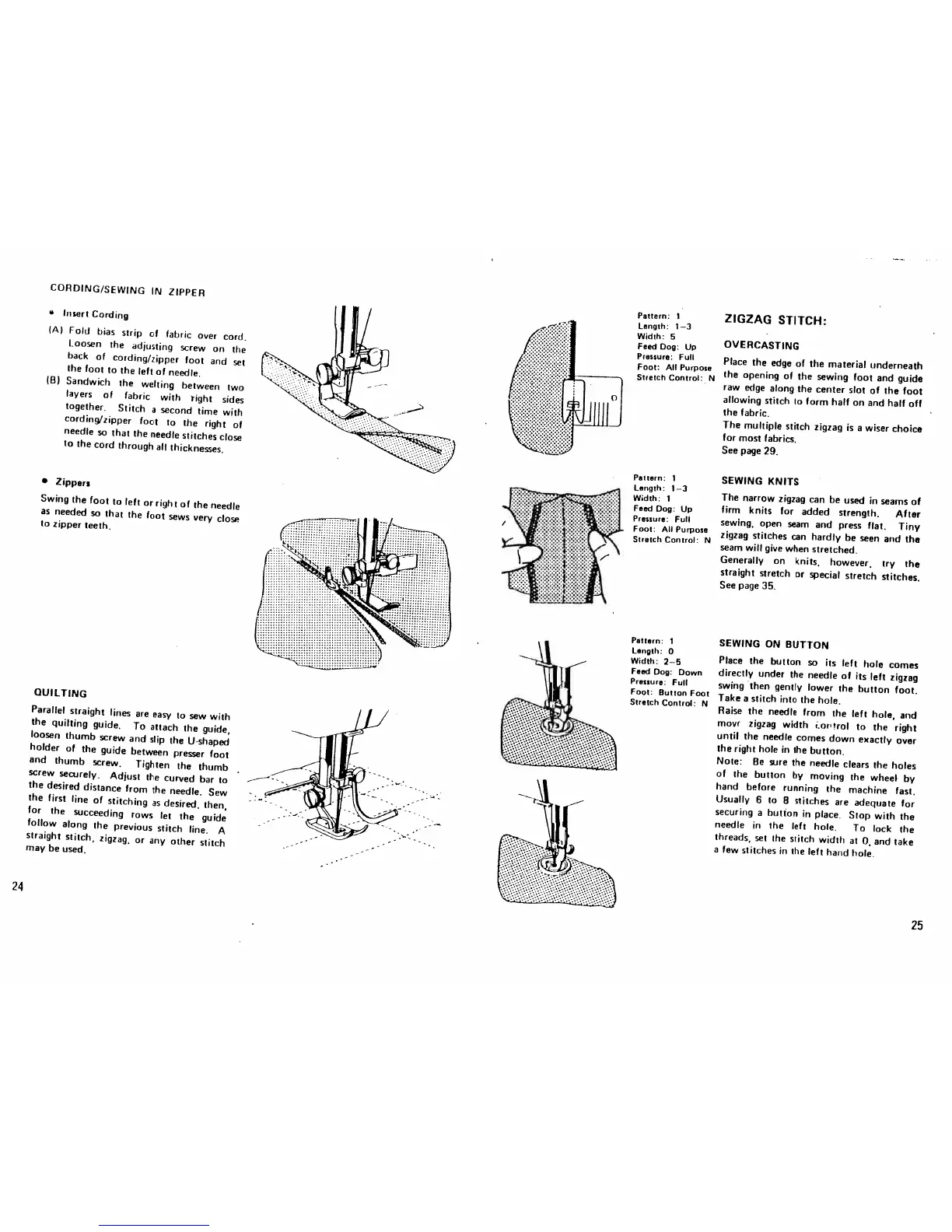
CORDING/SEWING
IN
ZIPPER
w
Insert
Cording
(A)
Fold
bias
strip
of
fabric
over
cord.
Loosen
the
adjusting
screw
on
the
back
of
cording/zipper
foot
and
set
the
foot
to
the
left
of
needle.
(B)
Sandwich
the
welting
between
two
layers
of
fabric
with
tight
sides
together.
Stitch
a
second
time
with
cordinzipper
loot
to
the
right
of
needle
so
that
the
needle
stitches
close
to
the
cord
through
all
thicknesses.
Zippers
Swing
the
foot
to
left
or
right
of
the
needle
as
needed
so
that
the
foot
sews
very
close
to
zipper
teeth.
QUILTING
Parallel
straight
lines
are
easy
to
sew
with
the
quilting
guide.
To
attach
the
guide,
loosen
thumb
screw
and
slip
the
U-shaped
holder
of
the
guide
between
presser
foot
and
thumb
screw.
Tighten
the
thumb
screw
securely.
Adjust
the
curved
bar
to
the
desired
distance
from
the
needle.
Sew
the
first
line
of
stitching
as
desired,
then,
for
the
succeeding
rows
let
the
guide
follow
along
the
previous
stitch
line.
A
straight
stitch,
zigzag,
or
any
other
stitch
may
be
used.
24
Pattern:
1
Length:
1—3
Width:
5
Feed
Dog:
UP
Pressure:
Full
Foot:
All
Purpose
Stretch
Control:
N
Pattern:
I
Length:
1—3
Width:
1
Feed
Dog:
Up
Pressure:
Full
Foot:
All
Purpose
Stretch
Control:
N
Pattern:
1
Length:
0
Width:
2—5
Feed
Dog:
Down
Pressure:
Full
Foot:
Button
Foot
Stretch
Control:
N
ZIGZAG
STITCH:
OVERCASTING
Place
the
edge
of
the
material
underneath
the
opening
of
the
sewing
foot
and
guide
raw
edge
along
the
center
slot
of
the
foot
allowing
stitch
to
form
half
on
and
half
off
the
fabric.
The
multiple
stitch
zigzag
is
a
wiser
choice
for
most
fabrics,
See
page
29.
SEWING
KNITS
The
narrow
zigzag
can
be
used
in
seams
of
firm
knits
for
added
strength.
After
sewing,
open
seam
and
press
flat.
Tiny
zigzag
stitches
can
hardly
be
seen
and
the
seam
will
give
when
stretched.
Generally
on
knits,
however,
try
the
straight
stretch
or
special
stretch
stitches.
See
page
35.
SEWING
ON
BUTTON
Place
the
button
so
its
left
hole
comes
directly
under
the
needle
of
its
left
zigzag
swing
then
gently
lower
the
button
loot.
Take
a
stitch
into
the
hole.
Raise
the
needle
from
the
left
hole,
and
mov
zigzag
width
t.or’trol
to
the
right
until
the
needle
comes
down
exactly
over
the
right
hole
in
the
button.
Note:
Be
9Jre
the
needle
clears
the
holes
of
the
button
by
moving
the
wheel
by
hand
befote
running
the
machine
fast.
Usually
6
to
8
stitches
are
adequate
for
securing
a
button
in
place.
Slop
with
the
needle
in
the
left
hole.
To
lock
the
threads,
set
the
stitch
width
at
0,
and
take
a
few
stitches
in
the
left
hand
hole.
II
25

Related product manuals