EasyManua.ls Logo

White 734 - Buttonhole Creation; Buttonhole Preparation Steps

Default Icon
22 pages
Print Icon
To Next Page IconTo Next Page
To Previous Page IconTo Previous Page
Loading...
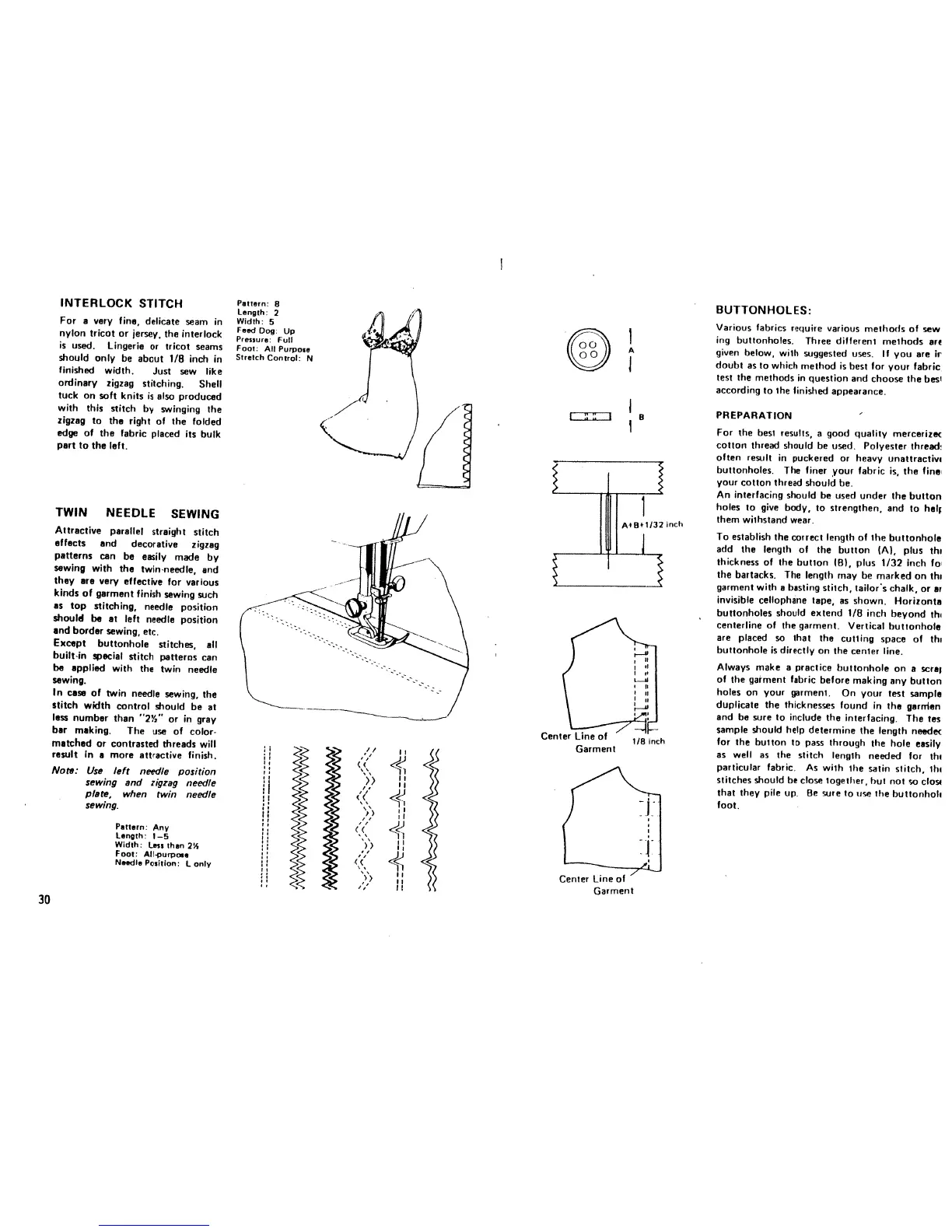
INTERLOCK
STITCH
For
a
very
fine,
delicate
seam
in
nylon
tricot
or
jersey,
the
interlock
is
used.
Lingerie
or
tricot
seams
should
only
be
about
1/8
inch
in
finished
width.
Just
sew
like
ordinary
zigzag
stitching.
Shell
tuck
on
soft
knits
is
also
produced
with
this
stitch
by
swinging
the
zigzag
to
the
right
of
the
folded
edge
of
the
fabric
placed
its
bulk
part
to
the
left.
TWIN
NEEDLE
SEWING
Attractive
parallel
straight
stitch
effects
and
decorative
zigzag
patterns
can
be
easily
made
by
sewing
with
the
twinneedle,
and
they
are
very
effective
for
various
kinds
of
garment
finish
sewing
such
as
top
stitching,
needle
position
should
be
at
left
needle
position
and
border
sewing,
etc.
Except
buttonhole
stitches,
all
built.in
special
stitch
patterns
can
be
applied
with
the
twin
needle
sewing.
In
case
of
twin
needle
sewing,
the
stitch
width
control
should
be
at
less
number
than
“2’/”
or
in
gray
bar
making.
The
use
of
color.
matched
or
contrasted
threads
will
result
in
a
more
attractive
finish.
Note:
Use
left
needle
position
sewing
and
zigzag
needle
plate,
when
twin
needle
sewing.
Pattern:
Any
length:
1—5
Wdih:
Less
than
24
Foot:
All-purpose
Needle
Position:
I
only
BUTTONHOLES:
Var,ous
fabrics
require
various
methods
of
sew
ing
buttonholes.
Three
different
methods
ar
given
below,
with
suggested
uses.
If
you
are
ir
doubt
as
to
which
method
is
best
for
your
fabric
test
the
methods
in
question
and
choose
the
besi
according
to
the
finished
appearance.
PREPARATION
For
the
best
results,
a
good
quality
mercerizec
cotton
thread
should
be
used.
Polyester
thread
often
result
in
puckered
or
heavy
unaltractivi
buttonholes.
The
finer
your
fabric
is,
the
fine.
your
cotton
thread
should
be.
An
interfacing
should
be
used
under
the
button
holes
to
give
body,
to
strengthen,
and
to
half
them
withstand
wear.
To
establish
the
correct
length
of
the
buttonhole
add
the
length
of
the
button
(A).
plus
thi
thickness
of
the
button
(B),
plus
1/32
inch
to
the
bartacks.
The
length
may
be
marked
on
thi
garment
with
a
basting
stitch,
tailor’s
chalk,
or
at
invisible
cellophane
tape,
as
shown.
Horizonta
buttonholes
should
extend
1/8
inch
beyond
!h
centerline
of
the
garment.
Vertical
buttonhole
are
placed
so
that
the
cutting
space
of
thi
buttonhole
is
directly
on
the
center
line.
Always
make
a
practice
buttonhole
on
a
scrap
of
the
gaiment
fabric
before
making
any
button
holes
on
your
garment.
On
your
test
sample
duplicate
the
thicknesses
found
in
the
garrrlen
and
be
sure
to
include
the
interfacing.
The
tes
sample
should
help
determine
the
length
needec
for
the
button
to
pass
through
the
hole
easily
as
well
as
the
stitch
length
needed
for
thi
particular
fabric.
As
with
the
satin
stitch,
tht
stitches
should
be
close
together,
hut
not
So
cfos4
that
they
pile
up.
Be
sure
to
use
the
buttonholi
foot.
Pattern:
8
Length:
2
Width:
S
Feed
Dog:
Up
Pressure:
Full
Foot:
Alt
Purpose
Stretch
Control:
N
A
nch
Center
line
of
1/8
inch
Garment
I
I
F,
‘S
(
(
I
Center
Line
of
Garment
30

Related product manuals