EasyManua.ls Logo

White 734 - Built-in Buttonhole Function; Turn-Around Buttonhole Method; Corded Buttonhole Technique

Default Icon
22 pages
Print Icon
To Next Page IconTo Next Page
To Previous Page IconTo Previous Page
Loading...
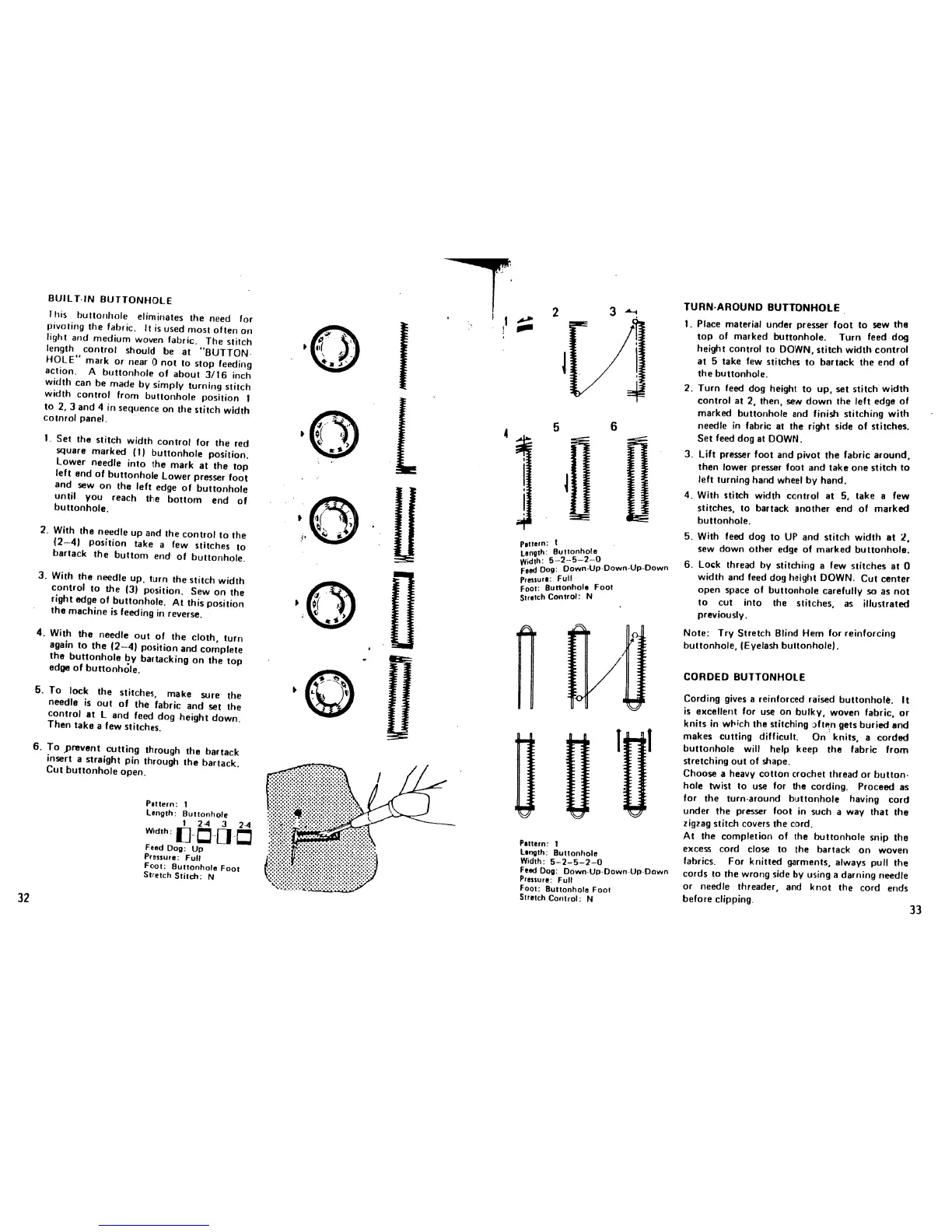
BUILT-IN
BUTTONHOLE
2
TURN-AROUND
BUTTONHOLE
I
his
buttonhole
eliminates
the
need
for
pivoting
the
fabric.
It
is
used
most
often
on
light
and
medium
woven
fabric.
The
stitch
length
control
should
be
at
“BUTTON
HOLE”
mark
or
near
0
not
to
stop
feeding
action.
A
buttonhole
of
about
3/16
inch
width
can
be
made
by
simply
turning
stitch
width
control
from
buttonhole
position
1
to
2,
3
and
4
in
sequence
on
the
stitch
width
cotnrol
panel.
1
Set
the
stitch
width
control
for
the
red
square
marked
(1)
buttonhole
position.
Lower
needle
into
the
mark
at
the
top
left
end
of
buttonhole
Lower
presser
foot
and
sew
on
the
left
edge
of
buttonhole
until
you
reach
the
bottom
end
of
buttonhole.
2.
With
the
needle
up
and
the
control
to
the
(2—4>
Position
take
a
few
stitches
to
bartack
the
buttom
end
of
buttonhole.
3.
With
the
needle
up,
turn
the
stitch
width
control
to
the
(3)
position.
Sew
on
the
right
edge
of
buttonhole.
At
this
position
the
machine
is
feeding
in
reverse.
4.
With
the
needle
out
of
the
cloth,
turn
again
to
the
(2—4)
position
and
complete
the
buttonhole
by
bartacking
on
the
top
edge
of
buttonhole.
5.
To
lock
the
stitches,
make
sure
the
needle
is
out
of
the
fabric
and
set
the
control
at
L
and
feed
dog
height
down.
Then
take
a
few
stitches.
6.
To
prevent
cutting
through
the
bartack
insert
a
straight
pin
through
the
bartack.
Cut
buttonhole
open.
Pattern;
1
Length:
Buttonhole
1
2-4
3
2-4
Width
[]
-El
-
Feed
Dog:
Up
Pressure:
Full
Foot:
Buttonhole
Foot
Stretch
Stitch:
N
,
%
•.0
‘U
1.
Place
material
under
presser
foot
to
sew
the
top
of
marked
buttonhole.
Turn
feed
dog
height
control
to
DOWN,
stitch
width
control
at
5
take
few
stitches
to
bartack
the
end
of
the
buttonhole.
2.
Turn
feed
dog
height
to
up,
set
stitch
width
control
at
2,
then,
sew
down
the
left
edge
of
marked
buttonhole
and
finish
stitching
with
needle
in
fabric
at
the
right
side
of
stitches.
Set
feed
dog
at
DOWN.
3.
Lift
presser
foot
and
pivot
the
fabric
around,
then
lower
presser
foot
and
take
one
stitch
to
left
turning
hand
wheel
by
hand.
4.
With
stitch
width
control
at
5,
take
a
few
stitches,
to
bartack
another
end
of
marked
buttonhole.
5.
With
feed
dog
to
UP
and
stitch
width
at
2,
sew
down
other
edge
of
marked
buttonhole.
6.
Lock
thread
by
stitching
a
few
stitches
at
0
width
and
feed
dog
height
DOWN.
Cut
center
open
space
of
buttonhole
carefully
so
as
not
to
cut
into
the
stitches,
as
illustrated
previously.
Note:
Try
Stretch
Blind
Hem
for
reinforcing
buttonhole,
<Eyelash
buttonhole).
CORDED
BUTTONHOLE
Cording
gives
a
reinforced
raised
buttonhole.
It
is
excellent
for
use
on
bulky,
woven
fabric,
or
knits
in
whch
the
stitching
jltssn
gets
buried
and
makes
cutting
difficult.
On
knits,
a
corded
buttonhole
will
help
keep
the
fabric
from
stretching
out
of
shape.
Choose
a
heavy
cotton
crochet
thread
or
button
hole
twist
to
use
for
the
cording.
Proceed
as
for
the
turn-around
buttonhole
having
cord
under
the
presser
foot
in
such
a
way
that
the
zigzag
stitch
covers
the
cord.
At
the
completion
of
the
buttonhole
snip
the
excess
cord
close
to
the
bartack
on
woven
fabrics.
For
knitted
garments,
always
pull
the
cords
to
the
wrong
side
by
using
a
darning
needle
or
needle
threader,
and
knot
the
cord
ends
I
L
Ii
4
5
6
2
U
Pattern:
1
Langth
Buttonhole
Width:
5—2—5—2—0
Feed
Dog;
Down-UP-Down-UP-Down
pressure:
Full
Foot:
ButtonhOle
Foot
Stretch
Control;
N
flH
unlu’
Pattern;
1
length:
Buttonhole
Width:
5—2—5—2—0
Feed
Dog:
Down-Up-Down-Up-Down
Pressure:
Full
Foot:
Buttonhole
Foot
Stretch
Control:
N
32
before
clipping.
33

Related product manuals