EasyManua.ls Logo

White 734 - Creating Thread Shanks for Buttons; Satin Stitching for Decoration; Freehand Monogramming Guide; Applique Technique

Default Icon
22 pages
Print Icon
To Next Page IconTo Next Page
To Previous Page IconTo Previous Page
Loading...
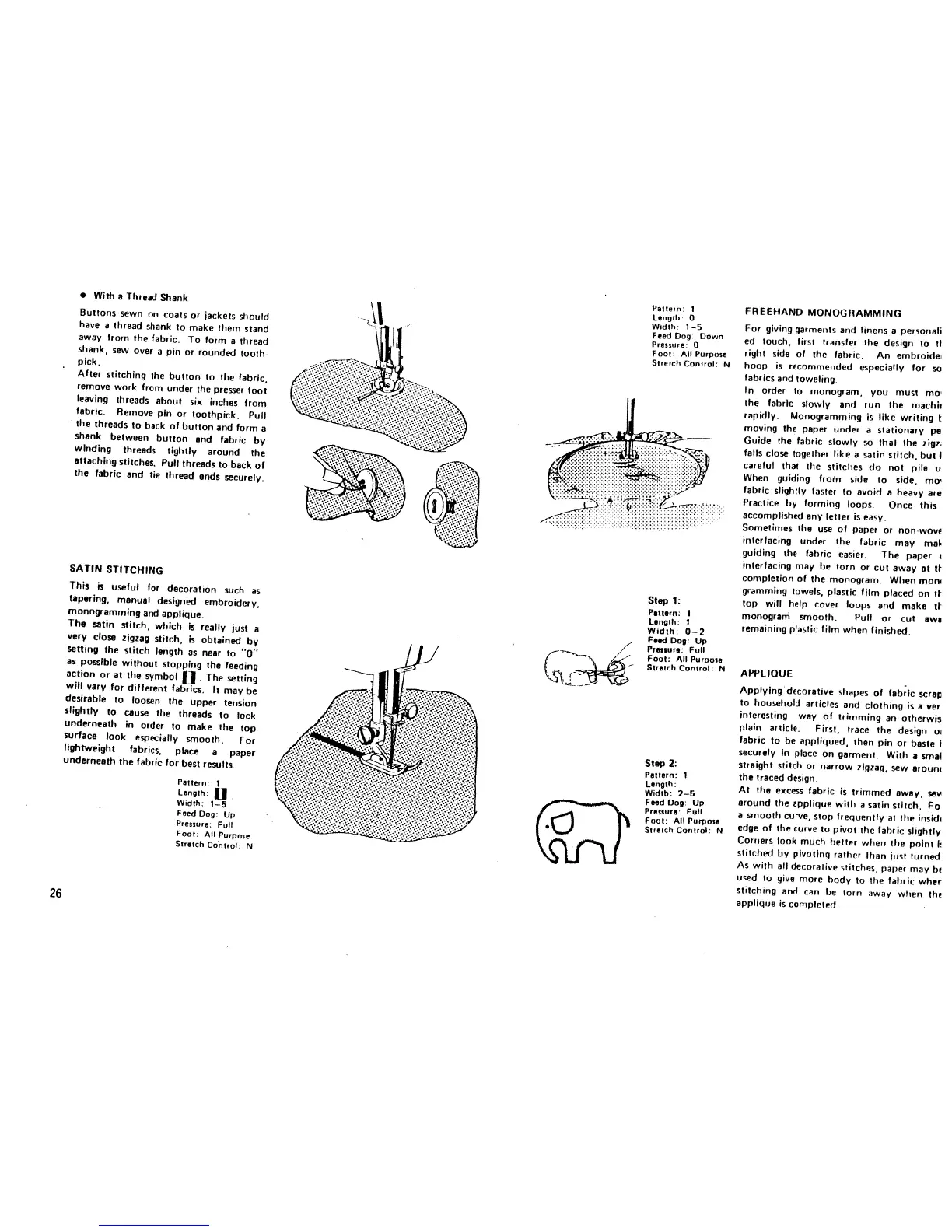
With
a
Thread
Shank
Buttons
sewn
on
coats
or
jackets
should
have
a
thread
shank
to
make
them
stand
away
from
the
fabric.
To
form
a
thread
shank,
sew
over
a
pin
or
rounded
tooth
pick.
After
stitching
the
button
to
the
fabric,
remove
work
from
under
the
presser
foot
leaving
threads
about
six
inches
from
fabric.
Remove
pin
or
toothpick.
Pull
the
threads
to
back
of
button
and
form
a
shank
between
button
and
fabric
by
winding
threads
tightly
around
the
attaching
stitches.
Pull
threads
to
back
of
the
fabric
and
tie
thread
ends
securely.
SATIN
STITCHING
This
is
useful
for
decoration
such
as
tapering,
manual
designed
embroidery,
monogramming
and
applique.
The
satin
stitch,
which
is
really
just
a
very
close
zigzag
stitch,
is
obtained
by
setting
the
stitch
length
as
near
to
“0”
as
possible
without
stopping
the
feeding
action
or
at
the
symbol
fl
.
The
setting
will
vary
for
different
fabrics.
It
may
be
desirable
to
loosen
the
upper
tension
slightly
to
cause
the
threads
to
lock
underneath
in
order
to
make
the
top
surtace
look
especially
smooth.
For
lightweight
fabrics,
place
a
paper
underneath
the
fabric
for
best
results.
Pattern:
1
Length:
[J
Width:
1—5
Feed
Dog:
Up
Pressure:
Full
Foot:
All
Purpose
Stretch
Control:
N
Paltern
1
Length
0
Width:
1-S
Feed
Dog
Down
Pressure:
0
Foot:
All
Purpose
Stretch
Control:
N
Step
1:
P.ttern:
I
Length:
1
Width:
0—2
Feed
Dog:
Up
Pressure:
Full
Foot:
All
Purpose
Stretch
Control:
N
Step
2:
Pettern:
1
Length:
Width:
2—F
Feed
Dog:
Up
Pressure:
Full
Foot:
All
Purpose
Stretch
Control:
N
FREEHAND
MONOGRAMMING
For
giving
garments
and
linens
a
personali
ed
touch,
first
transfer
the
design
to
ti
right
side
of
the
fabric.
An
embroide:
hoop
is
recommended
especiatly
for
so
fabrics
and
toweling.
In
order
to
monogram,
you
must
mo
the
labric
slowly
and
run
the
machit
rapidly,
Monogramming
is
like
writing
I
moving
the
paper
under
a
stationary
pe
Guide
the
fabric
slowly
so
that
the
iiqz
falls
close
together
like
a
satin
stitch,
but
I
careful
that
the
stitches
do
not
pile
u
When
guiding
froWn
side
to
side,
mo
fabric
slightly
faster
to
avoid
a
heavy
are
Practice
by
forming
loops.
Once
this
accomplished
any
letter
is
easy.
Sometimes
the
use
of
paper
or
non-wovt
interlacing
under
the
fabric
may
mal
guiding
the
fabric
easier.
The
paper
interfacing
may
be
torn
or
cut
away
at
t
completion
of
the
monogram.
When
moni
gramming
towels,
plastic
film
placed
on
t
top
will
help
cover
loops
and
make
t
monogram
smooth.
Pull
or
cut
ewe
remaining
plastic
film
when
finished.
APPLIQUE
Applyingdecorative
shapes
of
fabric
scrap
to
household
articles
and
clothing
is
a
ver
interesting
way
of
trimming
an
otherwis
plain
article.
First,
trace
the
design
oi
fabric
to
be
appliqued,
then
pin
or
baste
i
securely
in
place
on
garment.
With
a
sm&
straight
stitch
or
narrow
zigzag,
sew
arount
the
traced
design.
At
the
excess
fabric
is
trimmed
away,
sev
around
the
applique
with
a
satin
stitch.
Fo
a
smooth
curve,
stop
frequently
at
the
insidt
edge
of
the
curve
to
pivot
the
fabric
slightly
Corners
look
much
helter
when
the
point
i
stitched
by
pivoting
rather
than
just
turned
As
with
all
decorative
stitches,
paper
may
bt
used
to
give
more
body
to
the
fabric
wher
stitching
and
can
be
torn
away
when
tht
applique
is
completed
26

Related product manuals