WIKA Operating Instructions RTDs and Thermocouples
11208287.03 06/2010 GB/D/F/E
17
GB
8. Faults
8. Faults
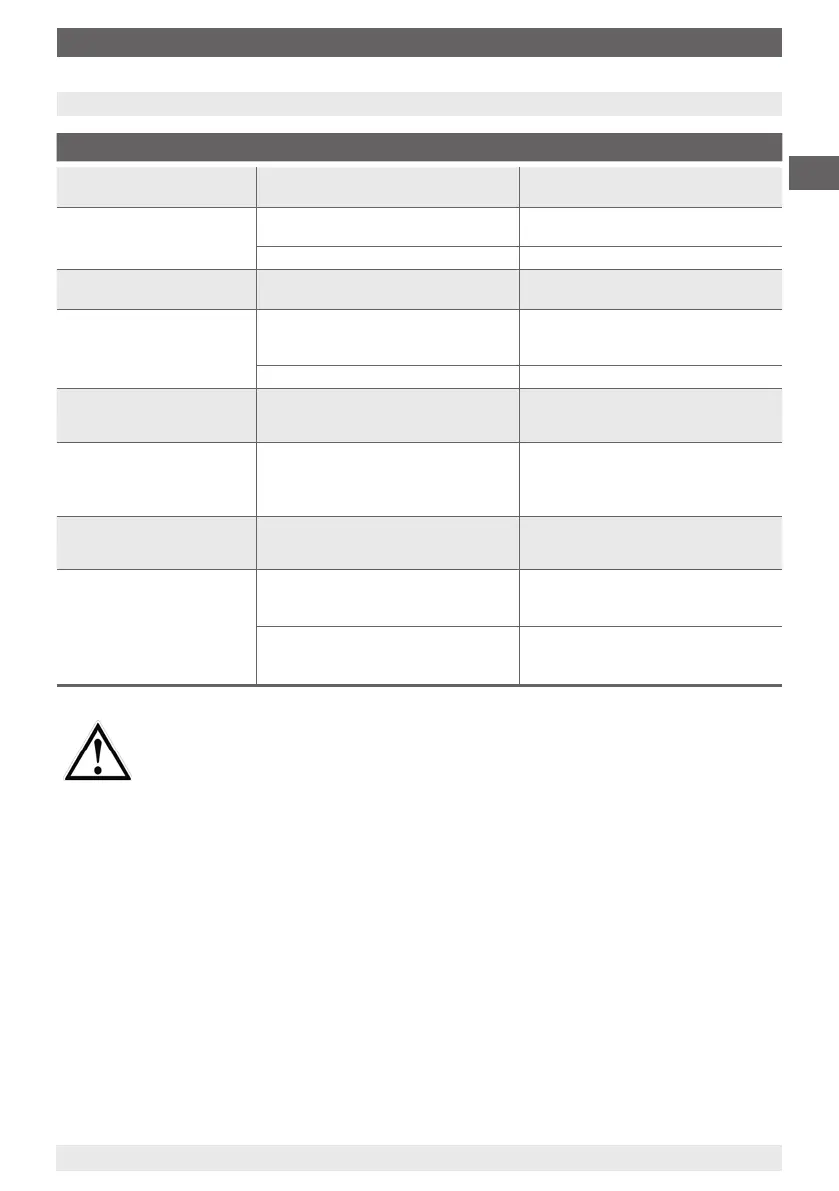
Faults Causes Measures
No signal/ line breakage
Mechanical load too high or
overtemperature
Replace probe or measuring insert
with a suitable design
Erroneous measured values
Sensor drift caused by overtempe-
rature
Replace probe or measuring insert
with a suitable design
Sensor drift caused by chemical attack
Use a design with thermowell
Erroneous measured values
(too low)
Entry of moisture into cable or measu-
ring insert
Replace probe or measuring insert
with a suitable design
Erroneous measured values
and response times too long
Wrong mounting geometry, for example
mounting depth too deep or heat
dissipation too high
The temperature-sensitive area of the
sensor must be inside the medium,
and surfaces must be isolated.
Deposits on the sensor or thermowell Remove deposits
Erroneous measured values
(of thermocouples)
Parasitic voltages (thermal voltages,
galvanic voltage) or wrong equalisation
line
Use a suitable equalisation line
Measurement signal -
"comes and goes"
Cable break in connecting cable or
loose contact caused by mechanical
overload
Replace probe or measuring insert
with a suitable design, for example
equipped with a strain relief or a
thicker conductor cross-section
Corrosion
Composition of the medium not as
expected or modied or wrong thermo-
well material selected
Analyse medium and then select a
more-suitable material or replace
thermowell regularly
Signal interference
Stray currents caused by electric elds
or earth loops
Use of screened connecting cables,
increase in the distance to motors and
power lines
Earth circuits Elimination of potentials, use of
galvanically isolated transmitter supply
isolators or transmitters
CAUTION!
If deciencies cannot be eliminated by means of the measures listed above, shut
down the instrument immediately, and ensure that pressure and/or signal are no
longer present, and secure the instrument from being put back into operation
inadvertently.
In this case, contact the manufacturer.
If a return is needed, please follow the instructions see chapter "9.2 Return".


 To Next Page