53
Wilson Audio Specialties
s e C T i O n 5 . 3 — D e P T h O f D e s i g n
terials on speaker enclosure performance. Through this effort, Wilson pioneered the
use of non-resonant materials, first with the use of mineral-filled acrylic in the WAMM
and WATT and continuing with the further development of proprietary materials for X-1
Grand SLAMM and the original WATT/Puppy. Even the best materials are not suited to
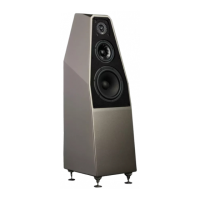
all aspects of enclosure construction. Therefore, like all Wilson loudspeakers, the Alex-
ia is constructed of several exotic materials chosen for their specific performance attri-
butes relevant to different portions of the enclosure.
Alexia is constructed using utlra-low-resonant, high-density, composites which are
then cross-braced to further reduce cabinet resonance. Each of these composites meets
and exceeds the highest of ANSI test standards for its use, while offering very tight tol-
erances, high hardness, uniform density, and dimensional stability.
Adhesive
Wilson Audio has conducted exhaustive research into the best adhesives to perma-
nently bond our speaker enclosures. This is often an overlooked element crucial to the
proper performance of a loudspeaker. Correct modulus of elasticity, coefficient of ther-
mal expansion, and natural frequency response are just a few of the important elements
of adhesives.
A highly cross-linked, thermoset adhesive is used for the construction of the en-
closure. It was also chosen for its excellent bond strength, solvent resistance, hardness,
and optimum vibrational characteristics.
Section 5.3—Depth of Design
Alexia’s compellingly authentic performance and lasting value are achieved
through careful implementation of cutting edge design and engineering and then ex-
ecuted using the highest performance materials. Wilson Audio’s use of proprietary



 To Next Page