Pag. 4
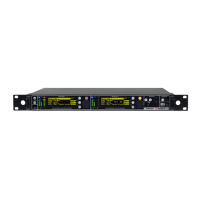
MRK960 dual true diversity receiver
•• Soware to monitor/setup units and with spectrum eld analysis
•• Ethernet 10/100 base Tx network interface for conguraon/monitor
•• Digital audio interfaces: AES/EBU (with word-clock in/out)
Oponal:
•• Ethersound
®
interface
•• Push to Talk (PTT) funcon with audio exit and GPI signals (patented)
•• Very low impedance transformer outputs
The MRK960 is a professional dual diversity receiver for wireless microphones recepon especially designed
for broadcast producon, live stages, theatres and top professional applicaons.
It’s winning performances are:
• High immunity on strong rf environment
• Huge switching bandwidth
• High audio performances and exibility thanks to the digital processors
• High reliability and durability
One of the milestones in the design of the MRK960 is high reliability: most of the circuitry of the receiver is
independent one from each other.
Here below a schemac with an overview of main receiver funcons.
Starng from the antenna inputs, each antenna could be indipendently powered from a single power regula-
tor monitored from the microcontroller.
For each antenna the RF signal is splied in the receiver 1 and in the receiver 2 (antenna A and antenna B)
with a wide band splier. In this way any one receiver could be tuned in any frequency of the switching range
(370 MHz).
Receiver 1 and 2 are true diversity receivers: each one is made of two receivers tuned on the same frequency,
hereaer called secon A and secon B. The receiver 1 secon A and the receiver 2 secon A are connected
to the antenna A, the receiver 1 secon B and the receiver 2 secon B are connected at the antenna B.
Each receiver has its own demodulated signal and its own RSSI signal (Receiver Signal Strenght Indicaon); a
microcontroller select or combine signals from secon A & B to have the best audio. The demodulated signal
ows to the digital audio processor.


 To Next Page