Need help?
Do you have a question about the Wouxun KG-UV920P and is the answer not in the manual?
Explains LCD screen parameters and their meanings, providing a useful table.
Details the components and connections on the back panel of the transceiver.
Describes the ports and connectors found on the side panels of the transceiver.
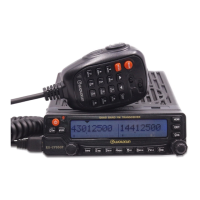
Identifies and describes the various buttons and components of the hand microphone.
Provides a step-by-step guide to making the initial broadcast with the transceiver.
Explains how to control the audio volume using the dedicated knobs on the transceiver.
Details how to change the operating frequency using VFO mode and the keypad.
Explains the automatic correction process for inputting frequency digits.
Describes how to select operating channels using the tuning knobs or keypad.
Explains how to choose between high, medium, and low transmission power levels.
Guides on how to transmit a signal using the microphone and PTT button.
Details squelch settings, display modes, and switching between VFO/MR modes.
Provides a quick reference for hotkey functions and their operations.
Outlines the menu structure and available settings for transceiver configuration.
Configures the increment step for frequency adjustments.
Selects between wide (25K) and narrow (12.5K) bandwidth for transmission.
Sets the medium output power levels (MPOW1: 20W, MPOW2: 10W).
Configures the frequency offset for repeater operations.
Sets transmission prompt tones like BOT, EOT, or BOTH.
Activates or deactivates audible beep prompts for various functions.
Selects the language for voice prompts (Chinese, English, or Off).
Enables or disables the Busy Channel Lock-out (BCL) function.
Configures mute conditions based on CTCSS, DTMF, or both.
Selects the scanning mode (Carrier Wave or Time Scanning).
Sets the maximum continuous transmission time to prevent overheating.
Sets the overtime alarm for transmission duration.
Configures settings related to transmitting Caller ID information.
Allows editing or setting individual Caller ID numbers.
Configures DTMF sidetone activation during transmission.
Selects when Caller ID is transmitted (BOT, EOT, BOTH).
Sets the color of the transmission indicator backlight.
Configures colors for standby and receiving indicator backlights.
Explains how to delete stored channels and customize their names.
Enables or disables the priority channel scanning feature.
Selects whether to use the internal or external speaker.
Configures the automatic locking of the keypad after inactivity.
Sets the CTCSS and DCS tones for receiving signals.
Sets the CTCSS and DCS tones for transmitting signals.
Controls speaker activation and PTT behavior during repeater operations.
Configures repeater modes like cross-band or simplex.
Determines whether channels are added to the scan list automatically.
Sets a timer for the transceiver to automatically power off.
Sets the frequency for single-tone pulse signaling.
Activates or deactivates the compandor function for audio clarity.
Enables or disables the overheating detection feature.
Activates or deactivates the voltage testing function.
Configures voice scrambling groups for secure communication.
Sets up CTCSS/DCS scanning for RX and TX parameters.
Adjusts the noise reduction level (Normal, Strong, Off).
Selects scan groups for selective scanning of channels.
Activates or deactivates the built-in FM radio function.
Enables or disables the remote control functionality.
Resets transceiver parameters to factory defaults (VFO or ALL).
Lists the various work modes: transceiver, cross-band repeater, repeater receiver/transmitter.
Details the LCD display for operating frequencies and master frequency indication.
Explains setting parameters, prioritizing the master frequency.
Mentions limitations on some functions in specific modes.
Allows searching data by pressing Up/Down keys.
Guides on quick operations like voice scrambler and master frequency switching.
Details hotkeys for entering frequency or channel selection modes.
Explains the hotkey for CTCSS/DCS scanning and encoding/decoding.
Explains the master frequency indication icon and its importance.
Describes how to select a channel using the hotkey.
Details settings for CTCSS/DCS encoding and decoding.
Notes on CTCSS/DCS tones, especially in repeater/cross-band modes.
Guides on selecting CTCSS or DCS and setting values.
Explains how to use the CTCSS/DCS scanner function in RX mode.
Describes how to save channels using the hotkey in VFO or channel mode.
Explains the hotkey for switching output power levels (H/M/L).
Details hotkey for switching between VFO and MR modes and display types.
Explains the hotkey for rapidly switching frequency shift directions.
Describes the hotkey for switching between single and dual display modes.
Explains the hotkey for adjusting squelch levels.
Guides on using the scanner key to initiate scanning.
Explains how to lock/unlock the keypad using the hotkey.
Details the function of the Up and Down keys for frequency/channel changes.
Configures the increment step for frequency adjustments.
Selects between wide (25K) and narrow (12.5K) bandwidth.
Sets the medium output power levels (MPOW1: 20W, MPOW2: 10W).
Configures the frequency offset for repeater operations.
Sets transmission prompt tones like BOT, EOT, or BOTH.
Activates or deactivates audible beep prompts for various functions.
Selects the language for voice prompts (Chinese, English, or Off).
Enables or disables the Busy Channel Lock-out (BCL) function.
Configures mute conditions based on CTCSS, DTMF, or both.
 General
| Output Power | 50W (VHF), 40W (UHF) |
|---|---|
| Modulation | FM |
| Weight | 1.2 kg |
| Power Supply/Voltage | 13.8V DC |
| Channel Spacing | 12.5/25 kHz |
| Operating Temperature | -20°C to +60°C |
| Type | Mobile |
| Features | CTCSS/DCS |
| Squelch | CTCSS, DCS, Carrier |

 To Next Page