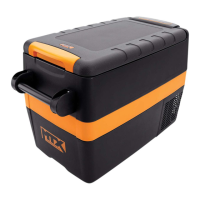
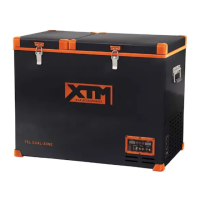
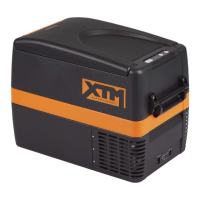
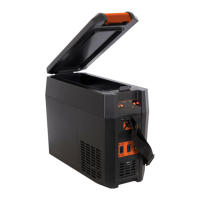
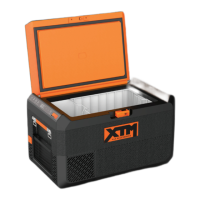
This document outlines the features, installation, operation, and maintenance of the XTM 30L Drawer Fridge, a portable cooling appliance designed for use in various vehicles.
Function Description
The XTM 30L Drawer Fridge is a portable refrigeration unit primarily designed for cooling food and beverages. It operates on DC voltage (12V or 24V) and is specifically intended for private use in cars, 4WDs, caravans, mobile homes, and campervans. The fridge features a drawer-style compartment for easy access to contents and includes compartment dividers for organization. Its core function is to maintain a set temperature, with an electronic control system that manages the compressor's operation to keep the internal cabinet within a desired range. The appliance is equipped with a multi-level battery protection system to prevent excessive discharge of the vehicle's battery when connected to a 12V or 24V DC power source. It also includes reverse polarity protection to safeguard against incorrect battery connections and short circuits.
Usage Features
The XTM 30L Drawer Fridge offers several user-friendly features for convenient operation. Upon initial connection to a DC power input, the appliance automatically switches on, and the LCD control panel displays the current cabinet temperature, battery protection setting, cooling speed, and input voltage.
- Power Control: The fridge can be turned ON or OFF using a dedicated power button on the control panel.
- Temperature Setting: Users can set the desired temperature using the "up" and "down" buttons. The display will flash while setting and then revert to showing the actual internal temperature once saved. The compressor will activate when the internal temperature rises 0.5 to 1.5 degrees above the set temperature and will run until it falls 0.5 to 1.5 degrees below the set temperature, ensuring consistent cooling.
- Temperature Scale: The temperature display can be switched between Celsius (°C) and Fahrenheit (°F) by pressing and holding the "up" and "down" buttons simultaneously for 3 seconds.
- MAX/ECO Mode: The fridge offers two operational modes: MAX and ECO. MAX mode provides maximum cooling performance, indicated by a green light, while ECO mode is designed for energy efficiency, indicated by a white light. Users can switch between these modes using a dedicated button.
- Battery Protection Setting: The fridge incorporates a multi-level battery protection system (High, Medium, Low) to prevent the vehicle's battery from over-discharging. Users can access this setting by pressing and holding the "set" button for 3 seconds and then cycle through the levels (H1, N2, L3) using the "set" button. It is recommended to set the Battery Protection to LOW when using the fridge with a DC power supply. The fridge will automatically switch off if the power source voltage falls below the set cut-out level and restart when the voltage reaches the cut-in level.
- Power Off Memory: In the event of a power cut, the fridge retains its ON/OFF status, mode, and temperature settings, resuming previous operations once power is restored.
- Power Source Flexibility: The fridge is designed to operate from a 12V or 24V DC source, such as a car cigarette lighter or a car battery. For optimal performance and efficiency, direct connection to the battery is recommended to reduce the risk of voltage drops.
- Solar Panel and Generator Compatibility: While the fridge cannot be connected directly to solar panels or generators, it is designed to work in conjunction with them via a suitable DC battery. Solar panels can recharge the battery during daylight hours, and when charging the battery with a digital or inverter type generator, a "smart battery charger" that is fully automatic, spark proof, and reverse polarity protected is recommended.
Maintenance Features
Proper maintenance ensures the longevity and efficient operation of the XTM 30L Drawer Fridge.
- Initial Cleaning: The fridge is delivered clean from the factory, but it is recommended to clean it prior to initial use.
- Regular Cleaning: The fridge should be cleaned periodically or when it becomes dirty. Both the inside and outside surfaces can be cleaned with a damp cloth. For stubborn dirt, a solution of sodium bicarbonate dissolved in lukewarm water can be used. After washing, the fridge should be rinsed with clean water and dried carefully.
- Defrosting: The fridge should be defrosted on a regular basis.
- Storage: When storing the fridge for a long period, the drawer should not be fully closed. This helps prevent the formation of mold and odors.
- Safety Precautions for Cleaning:
- Always disconnect the power cord and switch off the fridge before cleaning.
- Avoid using solvents or agents with sand or acid parts for cleaning.
- Do not use brushes, graters, or hard sharp tools to clean the fridge.
- Ensure no water drops into the seals or damages the electronics during cleaning.
- Cord Protection: The power cord should be protected from kinks, damage, and heat. It should not be wrapped around the appliance, pulled by the unit, or used as a handle.
- Ventilation: Ensure that the vents to the fridge's compressor are never obstructed to maintain proper airflow and cooling performance.
- Fuse Protection: The power input socket is fitted with a 15A blade fuse for protection. The fuse in the rear of the unit and at the supply should be checked if the fridge does not work.
- Professional Assistance: For additional queries, service, or maintenance, customers are advised to contact the After Sales Support. If the fridge experiences issues like fan fault, compressor start fault, compressor operation fault, controller overheat, or NTC sensor issues, contacting customer service is recommended.
- Disposal: At the end of its working life, the fridge should be disposed of responsibly to prevent environmental contamination. Contacting the local council for recycling options is advisable.

 Need help?
 General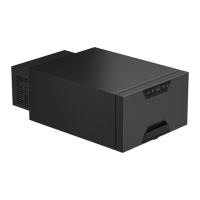

 To Next Page