11
Alignment
Introduction and Precautions
The VX-7R has been carefully aligned at the factory for
the specified performance across the specified amateur
bands. Realignment should therefore not be necessary
except in the event of a component failure. All compo-
nent replacement and service should be performed only
by an authorized VERTEX STANDARD representative,
or the warranty policy may be voided.
The following procedures cover the sometimes critical
and tedious adjustments that are not normally required
once the transceiver has left the factory. However, if dam-
age occurs and some parts are replaced, realignment may
be required. If a sudden problem occurs during normal
operation, it is likely due to component failure; realign-
ment should not be done until after the faulty compo-
nent has been replaced.
We recommend that servicing be performed only by
authorized VERTEX STANDARD service technicians,
who are experienced with the circuitry and fully
equipped for repair and alignment. Therefore, if a fault
is suspected, contact the dealer from whom the trans-
ceiver was purchased for instructions regarding repair.
Authorized VERTEX STANDARD service technicians
realign all circuits and make complete performance
checks to ensure compliance with factory specifications
after replacing any faulty components.
Those who do undertake any of the following align-
ments are cautioned to proceed at their own risk. Prob-
lems caused by unauthorized attempts at realignment
are not covered by the warranty policy. Also, VERTEX
STANDARD must reserve the right to change circuits
and alignment procedures in the interest of improved
performance, without notifying owners.
Under no circumstances should any alignment be at-
tempted unless the normal function and operation of the
transceiver are clearly understood, the cause of the mal-
function has been clearly pinpointed and any faulty com-
ponents replaced, and the need for realignment deter-
mined to be absolutely necessary.
Required Test Equipment
m RF Signal Generator with calibrated output level at 500 MHz
m Deviation Meter (linear detector)
m In-line Wattmeter with 5% accuracy at 500 MHz
m 50-ohm, 10-W RF Dummy Load
m 8-ohm AF Dummy Load
m Regulated DC Power Supply adjustable from 3 to 15 V DC,
3A
m Frequency Counter: 0.2-ppm accuracy at 500 MHz
m AF Signal Generator
m AC Voltmeter
m DC Voltmeter: high impedance
m UHF Sampling Coupler
m SINAD Meter
Alignment Preparation & Precautions
A 10-W RF dummy load and in-line wattmeter must
be connected to the main antenna jack in all procedures
that call for transmission, alignment is not possible with
an antenna. After completing one step, read the next step
to see if the same test equipment is required. If not, re-
move the test equipment (except dummy load and watt-
meter, if connected) before proceeding.
Correct alignment requires that the ambient tempera-
ture be the same as that of the transceiver and test equip-
ment, and that this temperature be held constant between
68~86°F (20~30°C). When the transceiver is brought into
the shop from hot or cold air, it should be allowed some
time to come to room temperature before alignment.
Whenever possible, alignments should be made with os-
cillator shields and circuit boards firmly affixed in place.
Also, the test equipment must be thoroughly warmed
up before beginning.
Note: Signal levels in dB referred to in the alignment proce-
dure are based on 0 dBµ=0.5 µV (closed circuit).
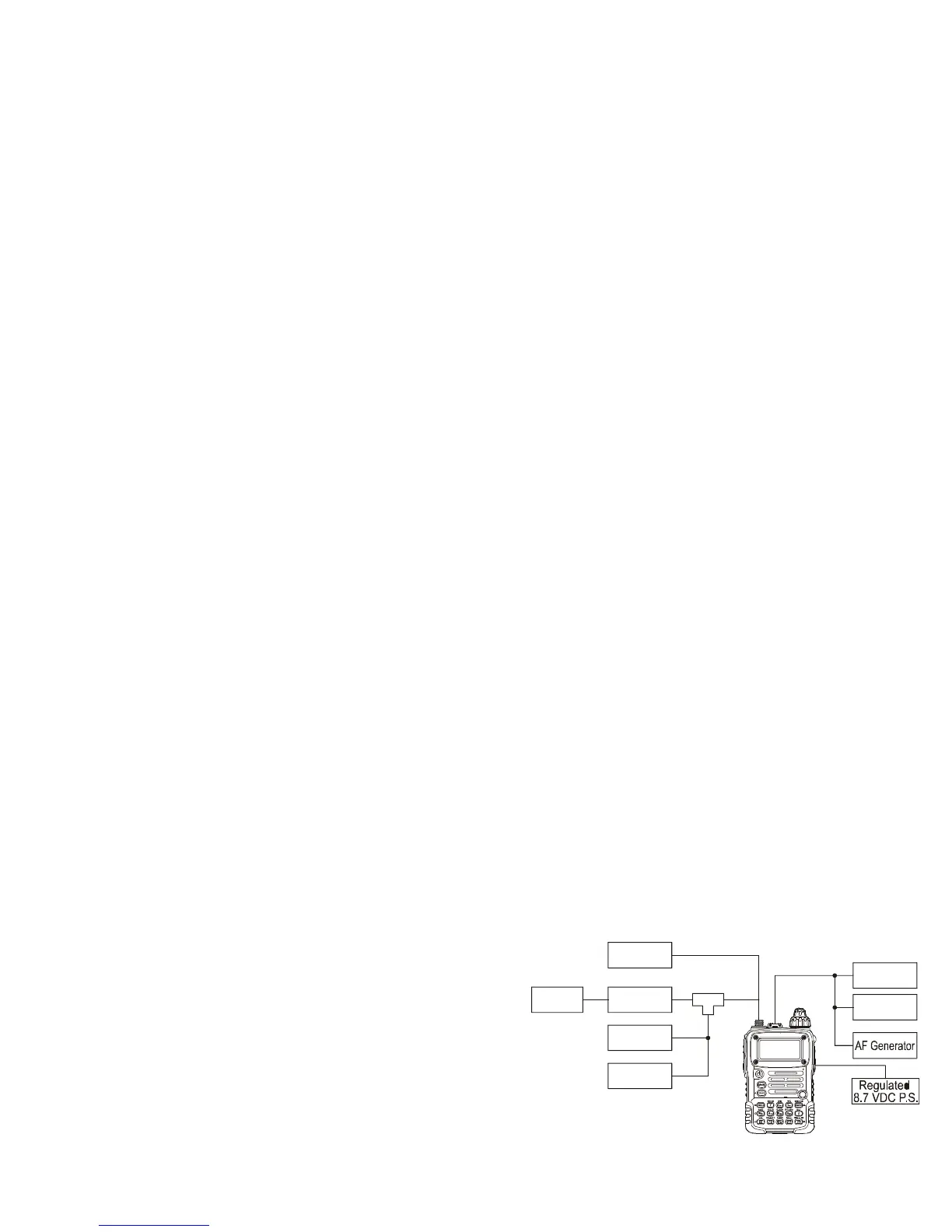
Alignment Setup
Wattmeter
In-Line
RF Load
50-ohm
Coupler
Sampling
Meter
Deviation
Counter
Frequency
Generator
RF Signal
8-ohm


 To Next Page