Operation and important riding points
5-4
1
2
3
4
5
6
7
8
9
10
11
12
clutch lever in, use the brakes to
slow the motorcycle, and continue
to downshift as necessary.
4. Once the motorcycle has stopped,
the transmission can be shifted
into the neutral position. The neu-
tral indicator light should come on
and then the clutch lever can be
released.
EWA17380
Improper braking can cause
loss of control or traction. Al-
ways use both brakes and apply
them smoothly.
Make sure that the motorcycle
and the engine have sufficiently
slowed before shifting to a low-
er gear. Engaging a lower gear
when the vehicle or engine
speed is too high could make
the rear wheel lose traction or
the engine to over-rev. This
could cause loss of control, an
accident and injury. It could also
cause engine or drive train dam-
age.
EAU64150
Recommended shift points
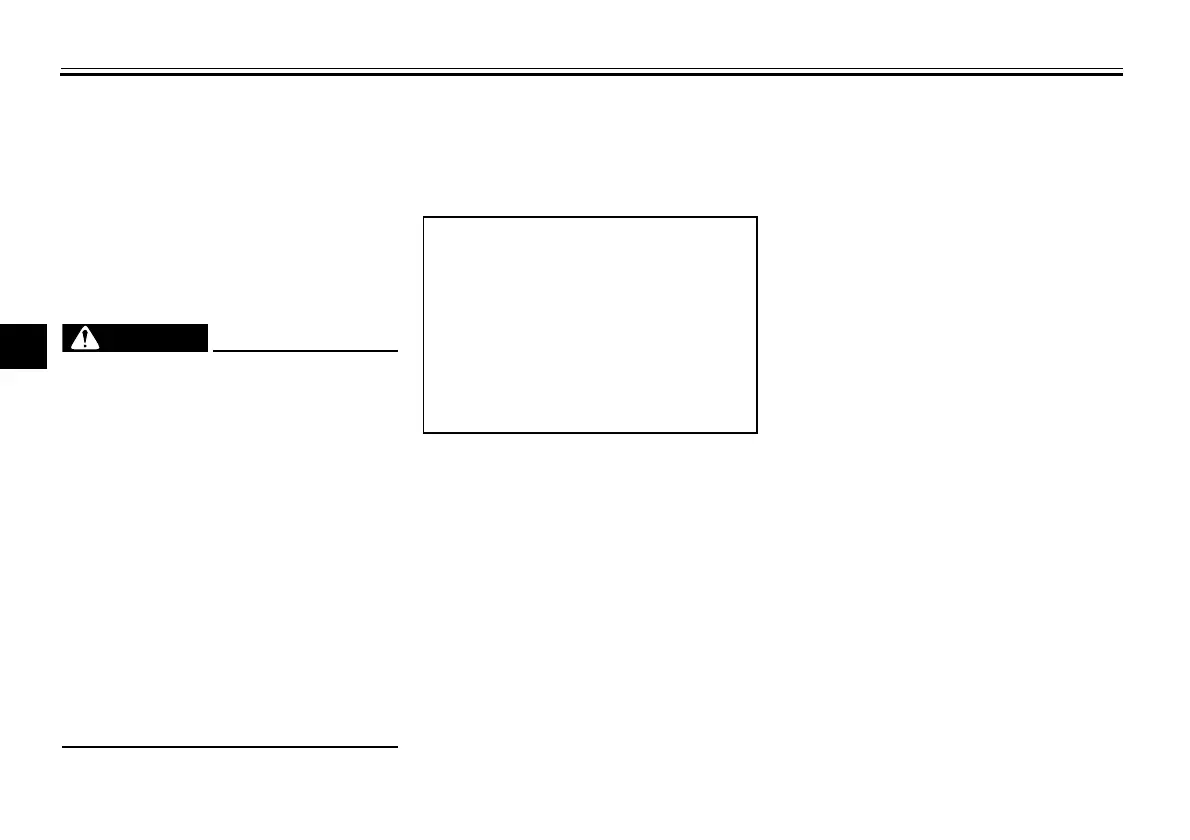
The recommended shift points during
acceleration and deceleration are
shown in the table below.
EAU16811
Tips for reducing fuel
consumption
Fuel consumption depends largely on
your riding style. Consider the following
tips to reduce fuel consumption:
Shift up swiftly, and avoid high en-
gine speeds during acceleration.
Do not rev the engine while shifting
down, and avoid high engine
speeds with no load on the engine.
Turn the engine off instead of let-
ting it idle for an extended length of
time (e.g., in traffic jams, at traffic
lights or at railroad crossings).
Shift up points:
1st 2nd: 20 km/h (12 mph)
2nd 3rd: 30 km/h (19 mph)
3rd 4th: 40 km/h (25 mph)
4th 5th: 50 km/h (31 mph)
5th 6th: 60 km/h (37 mph)
Shift down points:
6th 5th: 45 km/h (28 mph)
5th 4th: 35 km/h (22 mph)
4th 3rd: 25 km/h (16 mph)
B87-9-E0_1.book 4 ページ 2015年12月16日 水曜日 午前10時21分









 To Next Page