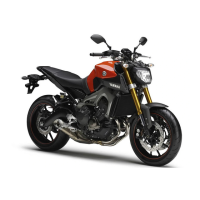
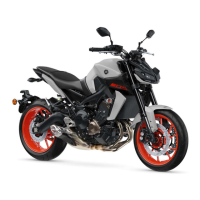
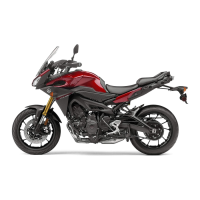
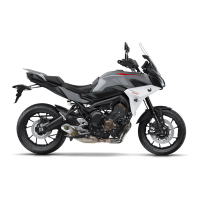
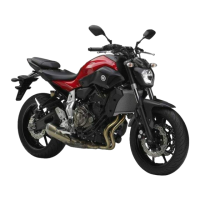
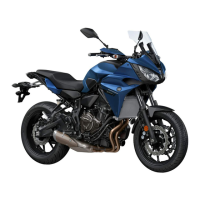
This document is the owner's manual for the Yamaha MT09SPM / MT09SPMC motorcycle, models that are the result of Yamaha's extensive experience in producing high-performance sporting, touring, and racing machines. It provides comprehensive information on the operation, inspection, and basic maintenance of the motorcycle.
The Yamaha MT09SPM / MT09SPMC is a single-track vehicle designed for on-road use only. It is not suitable for off-road use. The motorcycle is designed to carry the operator and one passenger. The total weight of the operator, passenger, accessories, and cargo must not exceed the maximum load limit of 166 kg (366 lb).
Engine and Drivetrain:
The motorcycle is equipped with a 4-stroke, liquid-cooled, DOHC, 3-cylinder inline engine with a displacement of 890 cm³. The bore × stroke is 78.0 × 62.1 mm (3.07 × 2.44 in). The starting system is electric.
The transmission has 6 gears with the following gear ratios:
- 1st: 2.571 (36/14)
- 2nd: 1.947 (37/19)
- 3rd: 1.619 (34/21)
- 4th: 1.381 (29/21)
- 5th: 1.190 (25/21)
- 6th: 1.037 (28/27)
Fuel System:
The recommended fuel is unleaded gasoline (E10 acceptable) with an octane number (RON) of 95 or higher. The fuel tank capacity is 14 L (3.7 US gal, 3.1 Imp.gal), with a fuel reserve amount of 2.8 L (0.74 US gal, 0.62 Imp.gal). The fuel injection system uses a throttle body with ID marks B7N1 (MT09SPMC) and B7N4 (MT09SPM). Gasohol containing ethanol up to 10% (E10) can be used, but gasohol containing methanol is not recommended.
Engine Oil:
The recommended engine oil is API service SG type or higher, JASO standard MA, with SAE viscosity grades of 10W-40, 10W-50, 15W-40, 20W-40, or 20W-50. The oil quantity for an oil change is 2.80 L (2.96 US qt, 2.46 Imp.qt), and with oil filter removal, it is 3.20 L (3.38 US qt, 2.82 Imp.qt).
Cooling System:
The cooling system is liquid-cooled. The coolant reservoir capacity (up to the maximum level mark) is 0.28 L (0.30 US qt, 0.25 Imp.qt), and the radiator capacity (including all routes) is 1.72 L (1.82 US qt, 1.51 Imp.qt). YAMALUBE coolant is recommended.
Electrical System:
The electrical system operates at 12 V. The battery model is YTZ10S, with a voltage and capacity of 12 V, 8.6 Ah (10 HR). All lights, including the headlight, brake/tail light, front turn signal/position light, rear turn signal light, and auxiliary light, are LED, except for the license plate light bulb, which is 5.0 W.
Tires and Wheels:
The motorcycle is fitted with tubeless tires.
- Front tire: Size 120/70ZR17M/C (58W), Manufacturer/model BRIDGESTONE/BATTLAX HYPERSPORT S22F.
- Rear tire: Size 180/55ZR17M/C (73W), Manufacturer/model BRIDGESTONE/BATTLAX HYPERSPORT S22R.
The cold tire normal pressure for up to 90 kg (198 lb) load is 250 kPa (2.50 kgf/cm², 36 psi) for the front and 290 kPa (2.90 kgf/cm², 42 psi) for the rear. For 90 kg (198 lb) to maximum load, the pressure is the same. The minimum tire tread depth (front and rear) is 1.0 mm (0.04 in). The tire air valve is TR412, and the valve core is #9100 (original).
Brakes and Suspension:
- Front brake: Hydraulic dual disc brake.
- Rear brake: Hydraulic single disc brake.
- Front suspension: Telescopic fork.
- Rear suspension: Swingarm (link suspension).
The front fork and shock absorber assembly are adjustable for spring preload, rebound damping force, and compression damping force.
Special Features:
- Cruise Control System: Maintains a set cruising speed, operating in 4th, 5th, or 6th gear between 50 km/h (31 mi/h) and 160 km/h (99 mi/h). It can be activated, adjusted, and deactivated via handlebar switches.
- "D-MODE": An electronically controlled engine performance system with 4 different control maps (D-MODE 1-4) that regulate engine response and output.
- "TCS-MODE": Groups adjustable traction, slide, and lift control systems (TCS, SCS, and LIF). It has 4 settings, including a customizable "TCS-MODE M".
- TCS (Traction Control System): Helps maintain traction during acceleration, adjusting engine power if the rear wheel slips. It also adjusts automatically based on lean angle.
- SCS (Slide Control System): Regulates engine power output when a sideward slide is detected in the rear wheel, using data from the IMU.
- LIF (Lift Control System): Reduces the rate at which the front wheel rises during extreme acceleration.
- QSS (Quick Shift System): Allows for clutch lever-less, electronically-assisted shifting. It operates under specific conditions for upshifting and downshifting.
- BC (Brake Control System): Regulates hydraulic brake pressure for front and rear wheels when brakes are applied and wheel lock is detected.
- BC1: Standard ABS, adjusting pressure based on vehicle and wheel speed data, designed for upright braking.
- BC2: Uses IMU data to regulate applied brake power when cornering to suppress lateral wheel slip.
- Ignition Circuit Cut-off System: Prevents in-gear engine starts unless the clutch lever is pulled and the sidestand is up. It also stops the engine if the sidestand is lowered while in gear.
- Instrument Panel: Features a thin-film-transistor liquid-crystal display (TFT LCD) showing tachometer, speedometer, quick shift indicator, transmission gear, vehicle information displays (odometer, tripmeters, fuel economy, temperatures, fuel meter, fuel consumed, running time), settings MENU icon, grip warmer indicator (option), brake control icon, clock, lap timer, and various warning lights.
Maintenance Features:
The manual provides detailed periodic maintenance charts for emission control and general maintenance. Key maintenance items include:
- Spark Plugs: NGK/LMAR9A-9, gap 0.8–0.9 mm (0.031–0.035 in), tightening torque 13 N·m (1.3 kgf·m, 9.6 lb·ft).
- Engine Oil and Filter: Regular checks and changes.
- Coolant: Regular checks and changes.
- Air Filter Element: Replacement at specified intervals.
- Tires: Regular pressure and tread depth checks.
- Brakes: Fluid level checks, pad wear checks, and fluid changes every 2 years.
- Drive Chain: Slack checks, cleaning, and lubrication every 600 mi (1000 km) and after riding in wet conditions.
- Cables, Levers, Pedals, Sidestand: Regular checks and lubrication.
- Suspension and Steering: Regular checks for condition and operation.
- Battery: VRLA (Valve Regulated Lead Acid) battery, requires special charger.
- Fuses: Located under the seat, specified amperages for various circuits.
- Troubleshooting Charts: Guide for diagnosing common issues.
Usage Features:
- Handlebar Position: Adjustable to two positions.
- Rider Footrest Position: Adjustable to two positions.
- Seat: Removable for access to battery and fuse box.
- Auxiliary DC Connectors: For accessories like grip warmers.
- Settings MENU: Allows adjustment of display settings (lap time mode, tachometer color), TCS/SCS/LIF settings, BC/QS settings, shift indicator settings, unit measurements, screen brightness, clock, and maintenance intervals.
- Lap Timer: Stopwatch function activated through the settings MENU.
The manual emphasizes safe riding practices, including wearing protective apparel, performing pre-operation checks, proper loading, and avoiding carbon monoxide poisoning. It also warns against improper maintenance and the use of non-genuine parts or unauthorized modifications. The brake control system and traction control system are described as aids, not substitutes for appropriate riding techniques.

 Need help?
 General

 To Next Page