EasyManua.ls Logo

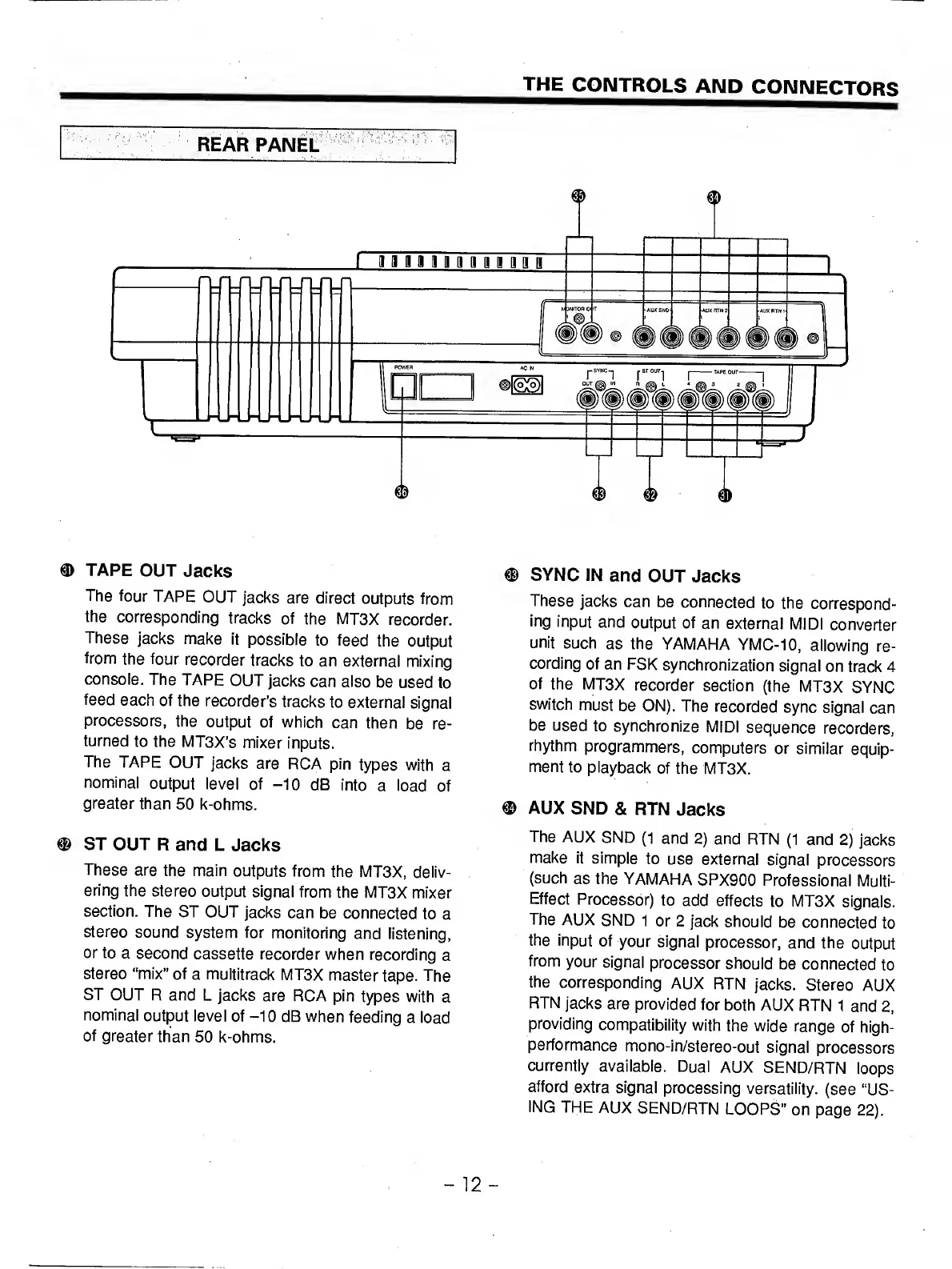
Yamaha MT3X - REAR PANEL CONNECTORS; Audio Output and Sync Jacks; Auxiliary Send;Return Jacks

Yamaha MT3X
92 pages
Print Icon
To Next Page IconTo Next Page
To Previous Page IconTo Previous Page
Loading...
THE
CONTROLS
AND
CONNECTORS
REAR
PANEL
®
TAPE
OUT
Jacks
The
four
TAPE
OUT
jacks
are
direct
outputs
from
the
corresponding
tracks
of
the
MT3X
recorder.
These
jacks
make
it
possible
to
feed
the
output
from
the
four
recorder
tracks
to
an
external
mixing
console.
The
TAPE
OUT
jacks
can
also
be
used
to
feed
each
of
the
recorder’s
tracks
to
external
signal
processors,
the
output
of
which
can
then
be
re¬
turned
to
the
MT3X’s
mixer
inputs.
The
TAPE
OUT
jacks
are
RCA
pin
types
with
a
nominal
output
level
of
-10
dB
into
a
load
of
greater
than
50
k-ohms.
®
ST
OUT
R
and
L
Jacks
These
are
the
main
outputs
from
the
MT3X,
deliv¬
ering
the
stereo
output
signal
from
the
MT3X
mixer
section.
The
ST
OUT
jacks
can
be
connected
to
a
stereo
sound
system
for
monitoring
and
listening,
or
to
a
second
cassette
recorder
when
recording
a
stereo
“mix”
of
a
multitrack
MT3X
master
tape.
The
ST
OUT
R
and
L
jacks
are
RCA
pin
types
with
a
nominal
output
level
of
-10
dB
when
feeding
a
load
of
greater
than
50
k-ohms.
®
SYNC
IN
and
OUT
Jacks
These
jacks
can
be
connected
to
the
correspond¬
ing
input
and
output
of
an
external
MIDI
converter
unit
such
as
the
YAMAHA
YMC-10,
allowing
re¬
cording
of
an
FSK
synchronization
signal
on
track
4
of
the
MT3X
recorder
section
(the
MT3X
SYNC
switch
must
be
ON).
The
recorded
sync
signal
can
be
used
to
synchronize
MIDI
sequence
recorders,
rhythm
programmers,
computers
or
similar
equip¬
ment
to
playback
of
the
MT3X.
®
AUX
SND
&
RTN
Jacks
The
AUX
SND
(1
and
2)
and
RTN
(1
and
2)
jacks
make
it
simple
to
use
external
signal
processors
(such
as
the
YAMAHA
SPX900
Professional
Multi-
Effect
Processor)
to
add
effects
to
MT3X
signals.
The
AUX
SND
1
or
2
jack
should
be
connected
to
the
input
of
your
signal
processor,
and
the
output
from
your
signal
processor
should
be
connected
to
the
corresponding
AUX
RTN
jacks.
Stereo
AUX
RTN
jacks
are
provided
for
both
AUX
RTN
1
and
2,
providing
compatibility
with
the
wide
range
of
high-
performance
mono-in/stereo-out
signal
processors
currently
available.
Dual
AUX
SEND/RTN
loops
afford
extra
signal
processing
versatility,
(see
“US¬
ING
THE
AUX
SEND/RTN
LOOPS”
on
page
22).

Related product manuals