EasyManua.ls Logo

Yamaha RM804 - RM804 Control Panel Operation; Input Channel Controls; Signal Routing Controls

Yamaha RM804
12 pages
Print Icon
To Next Page IconTo Next Page
To Previous Page IconTo Previous Page
Loading...
CONTROL
PANEL
OPERATION
INPUT(CH!
—8)
PAN
INPUT
GAIN
LINE
MIC
HIGH
MID
LOW
ECHO
STEREO
PAN
STEREO
10
INPUT
SECTION
©
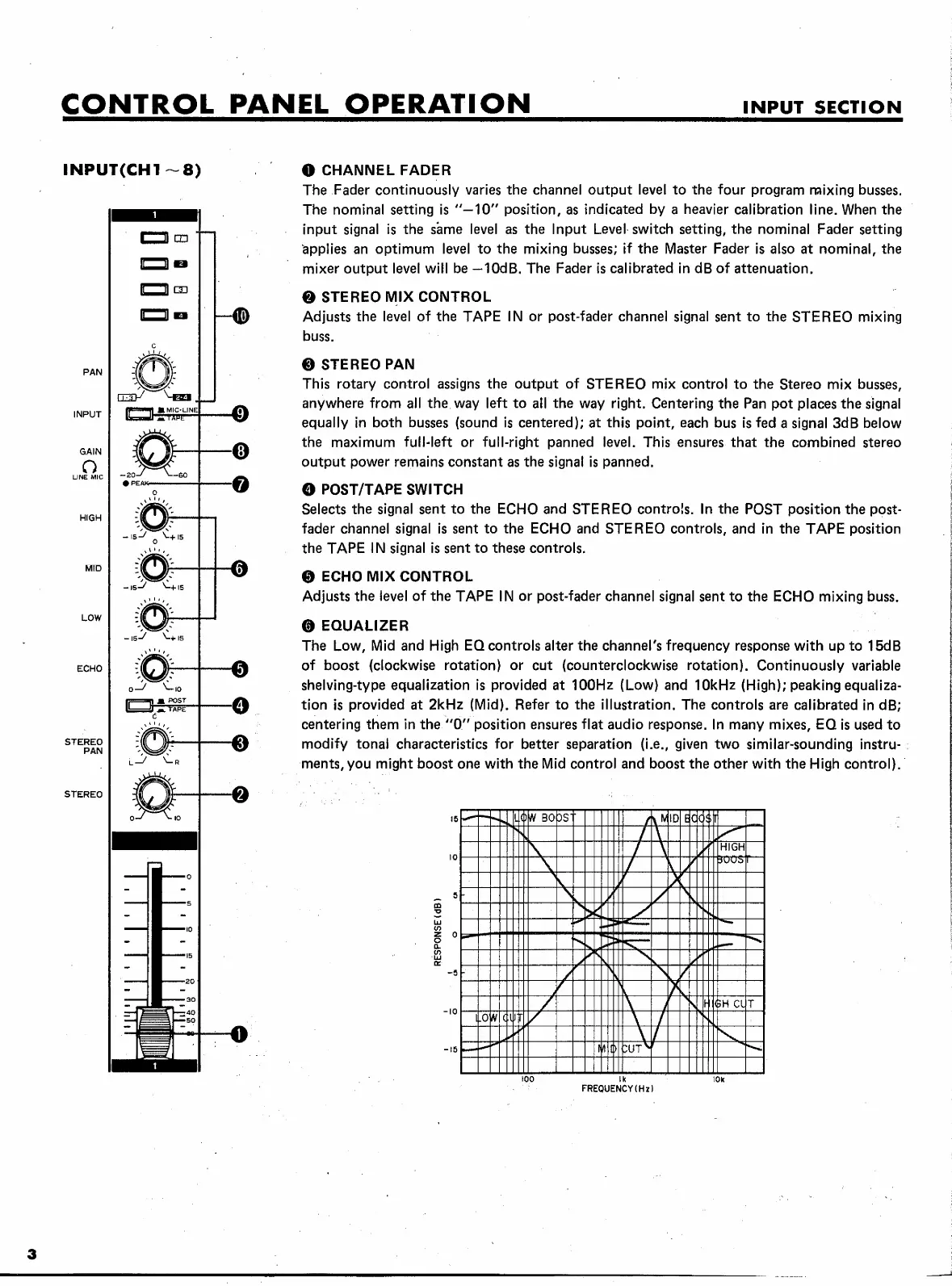
CHANNEL
FADER
The
Fader
continuously
varies
the
channel
output
level
to
the
four
program
mixing
busses.
The
nominal
setting
is
"—10"
position,
as
indicated
by
a
heavier
calibration
line.
When
the
-
input
signal
is
the
same
level
as
the
Input
Level
switch
setting,
the
nominal
Fader
setting
applies
an
optimum
level
to
the
mixing
busses;
if
the
Master
Fader
is
also
at
nominal,
the
mixer
output
level
will
be
—10dB.
The
Fader
is
calibrated
in
dB
of
attenuation.
STEREO
MIX
CONTROL
Adjusts
the
level
of
the
TAPE
IN
or
post-fader
channel
signal
sent
to
the
STEREO
mixing
buss.
STEREO
PAN
This
rotary
control
assigns
the
output
of
STEREO
mix
control
to
the
Stereo
mix
busses,
anywhere
from
all
the
way
left
to
all
the
way
right.
Centering
the
Pan
pot
places
the
signal
equally
in
both
busses
(sound
is
centered);
at
this
point,
each
bus
is
fed
a
signal
Зав
below
the
maximum
full-left
or
full-right
panned
level.
This
ensures
that
the
combined
stereo
output
power
remains
constant
as
the
signal
is
panned.
О
POST/TAPE
SWITCH
Selects
the
signal
sent
to
the
ECHO
and
STEREO
contro!s.
In
the
POST
position
the
post-
fader
channel
signal
is
sent
to
the
ECHO
and
STEREO
controls,
and
in
the
TAPE
position
the
TAPE
IN
signal
is
sent
to
these
controls.
Ө
ECHO
MIX
CONTROL
Adjusts
the
ievel
of
the
TAPE
IN
or
post-fader
channel
signal
sent
to
the
ECHO
mixing
buss.
Ө
EQUALIZER
The
Low,
Mid
and
High
EQ
controls
alter
the
channel's
frequency
response
with
up
to
15dB
of
boost
(clockwise
rotation}
or
cut
(counterclockwise
rotation).
Continuously
variable
shelving-type
equalization
is
provided
at
100Hz
(Low)
and
10kHz
(High);
peaking
equaliza-
tion
is
provided
at
2kHz
(Mid).
Refer
to
the
illustration.
The
controls
are
calibrated
in
dB;
centering
them
in
the
“0”
position
ensures
flat
audio
response.
In
many
mixes,
EQ
is
used
to
modify
tonal
characteristics
for
better
separation
(i.e.,
given
two
similar-sounding
instru-
:
“ments,
you
might
boost
one
with
the
Mid
control
and
boost
the
other
with
the
High
control}.
АРА
ДА
HUI
A
|
———
RESPONSE
(dB)
FREQUENCY
(Hz)

Related product manuals