6
Nuts
CHA
PTER
OI':E
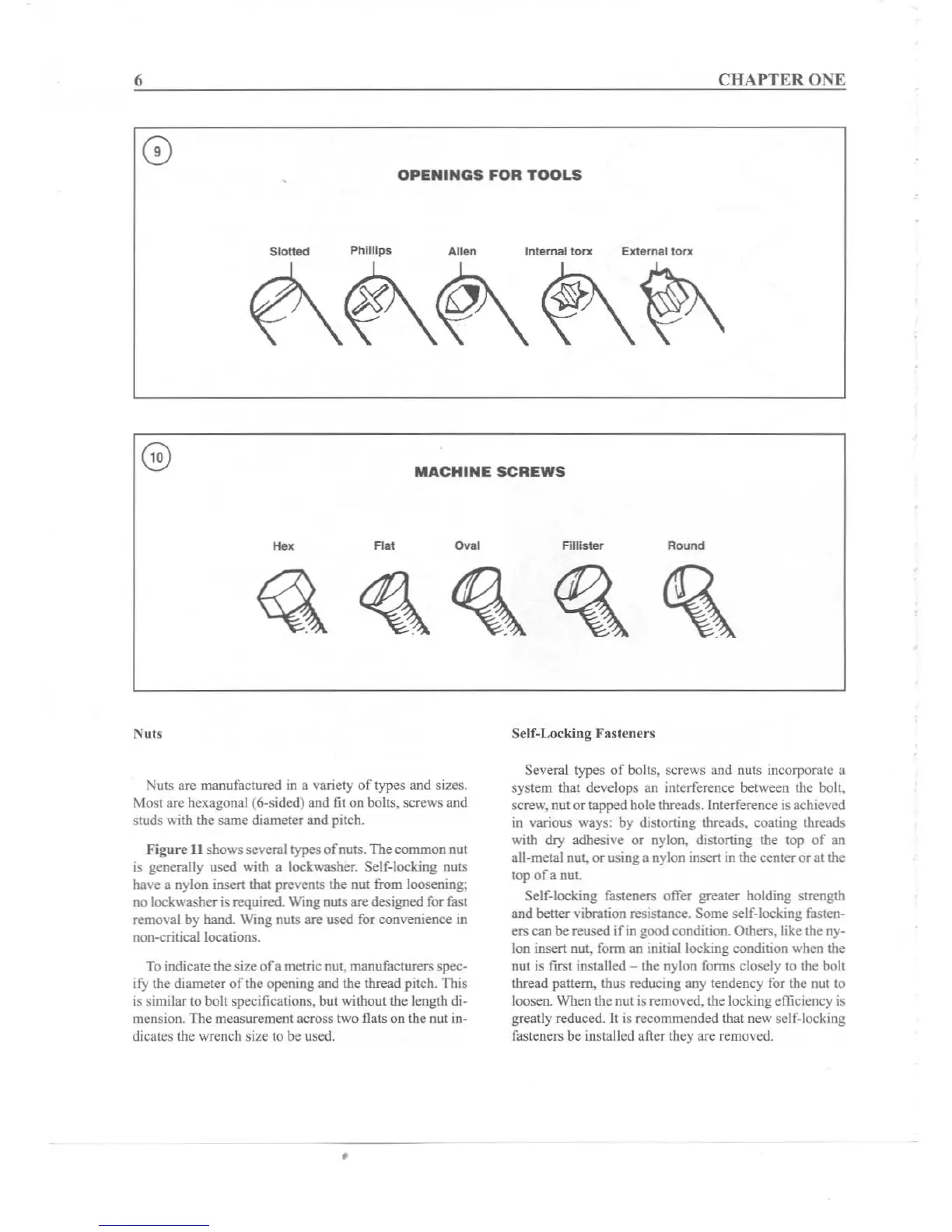
OPENINGS
FOR
TOOLS
Sioned
Ph
illips
Allen I
nternal
torx
External
torx
cA~~~
~
MACHINE
SCREWS
Self
-
Locking
f asten
er
s
Nuts are manufactured in a variety of types and sizes.
Most are hexagonal (6-sided) and
fit on bolts, screws and
studs with the same diameter and pitch.
f igure 11 shows severaltypes
of
nuts. The common nul
is generally used with a lockwasher. Self-locking nuts
have a nylon insert thai prevents the nut from loosening;
no lockwas
her
is required. Wing nuts are designed for fast
removal by hand. Wing nuts are used for convenience in
non-crit
icalloca
tions.
To indicate the size of a metric nut, manufacturers spec-
ify the diameter of the opening and the thread pitch. This
is similar to bolt specifications, but without the length di-
mension. The measurem ent across two flats on the nut in-
dicates the wrench size 10 be used.
•
Several types of bolts, screws and nuts incorporate a
system that develops an interference between the bolt,
screw, nut or tapped hole threads. Inte
rf
erence is achieved
in various ways: by distorting threads, coating threads
with dry adhesive or nylon, distorting the top
of
an
all-metal nut, or using a nylon insert
in the center or at the
top of a nut.
Self-locking fasteners offer greater holding strength
and better vibration resistance. Some self-locking fasten-
ers can
bereused if in good condition. Others, like the ny-
lon insert nut, fo
nn
an initial locking condition when the
nut
is first installed - the nylon forms closely to the bolt
thread pattern, thus reducing any tendency for the nut to
loosen. When the nut is removed, the locking efficiency is
greatly reduced.
It is recommended thai new self-locking
fasteners be installed after they are removed.



 To Next Page