186 CHAPTER NINE
BATTERY
ELECTROLYTE
LEVEL
I.
Vent cap
....
_~
...
, Bottom of
vent well
Maximum liquid
level
-, ;
Plates
10. Tighten the battery cable connections to 9 ft.-lb. (12
Nom). Overtightening the connections can cause damage
to the battery case. Coat the connections with petroleum
jelly, or a light mineral grease. Aerosol anti-corrosion
sprays can also be used.
NOTE
Do not overfill the battery cells in Step 11.
The electrolyte expands due to heat from
charging and may overflow
if
the level is
more than 1/4 in. (6 mm) above the battery
plates.
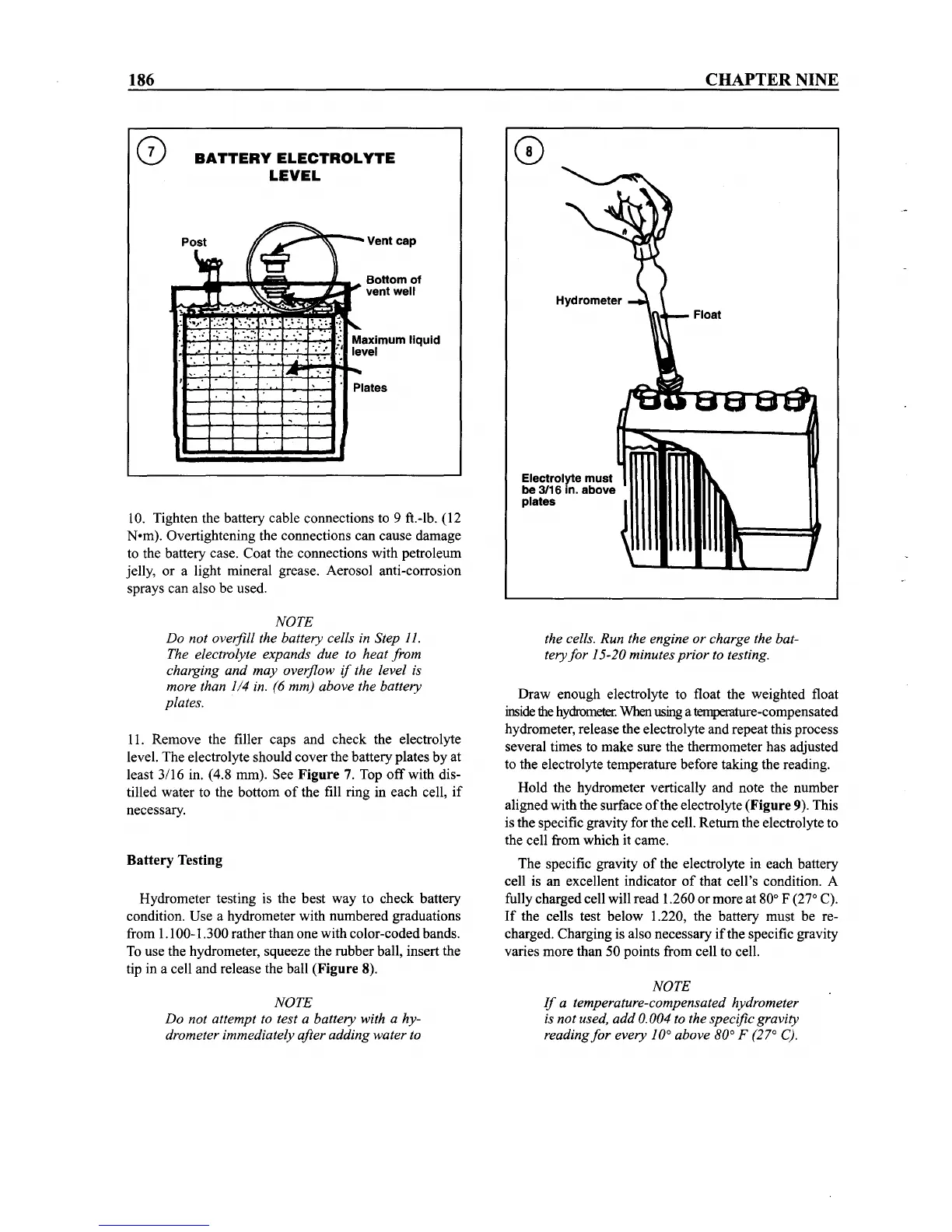
11. Remove the filler caps and check the electrolyte
level. The electrolyte should cover the battery plates by at
least 3/16 in. (4.8 mm). See Figure 7. Top
off
with dis-
tilled water to the bottom
of
the fill ring in each cell,
if
necessary.
Battery Testing
Hydrometer testing is the best way to check battery
condition. Use a hydrometer with numbered graduations
from 1.100-1.300 rather than one with color-codedbands.
To use the hydrometer, squeeze the rubber ball, insert the
tip in a cell and release the ball (Figure 8).
NOTE
Do not attempt to test a battery with a hy-
drometer immediately after adding water to
Electrolyte must
be 3/16 in. above
plates
the cells. Run the engine or charge the bat-
tery
for
15-20 minutes
prior
to testing.
Draw enough electrolyte to float the weighted float
inside
the
hydrometer.
Whenusinga temperature-compensated
hydrometer, release the electrolyte and repeat this process
several times to make sure the thermometer has adjusted
to the electrolyte temperature before taking the reading.
Hold the hydrometer vertically and note the number
aligned with the surface
ofthe
electrolyte (Figure 9). This
is the specific gravity for the cell. Return the electrolyte to
the cell from which it came.
The specific gravity
of
the electrolyte in each battery
cell is an excellent indicator
of
that cell's condition. A
fully charged cell will read 1.260 or more at 80° F (27° C).
If
the cells test below 1.220, the battery must be re-
charged. Charging is also necessary
if
the specific gravity
varies more than 50 points from cell to cell.
NOTE
If
a temperature-compensated hydrometer
is not used,
add
0.004 to the specific gravity
reading
for
every
]00
above 80° F (27° C).



 To Next Page