OPERATION, LUBRICATION, MAINTENANCE AND TUNE-UP
45
criteria that engine oils must meet to attain a diesel engine
oil classification
ofCA,
CB, CC or CD. The classification
system ranges from CA for light diesel engine service to
CD for severe diesel engine service. Yanmar specifies en-
gine oils with classification CB or CC for use in the
Yanmar diesel engines covered in this manual.
Do not mix oil brands. For instance, do not add a differ-
ent oil brand than what is in the crankcase when topping
off
the oil level, except if necessary. Use only a
high-quality oil. Yanmar recommends Shell Rotella,
Caltex RPM Delo, Mobil Delvac, Esso Standard and BP
Energol.
Refer to Table 2 for the recommended oil viscosity.
Engine Oil Level
Check
All engines will consume a certain amount
of
oil as a lu-
bricating and cooling agent. The amount depends on en-
gine use and engine condition. During the engine break-in
period, the engine consumes more oil while the piston
rings seat in the cylinder bore. Engines with high hours
of
use may bum more oil due to worn engine components.
Engines generally consume more oil at higher engine
speeds.
When to check engine oil is generally determined by
the engine's oil consumption rate.
If
the engine has a high
oil consumption rate, then check the oil level before each
use or daily.
If
engine oil consumption is low,check the oil
level weekly. The best procedure is to check the oil level
before operating the engine.
To engine
Wheneverchecking the oil level, always allow approxi-
mately five minutes for the oil in the upper end to drain
back into the crankcase oil pan.
1. With the boat at rest in the water and the engine off,
pull out the dipstick. See Figure
1 for the typical location.
Wipe it with a clean rag or paper towel, reinsert it and pull
it out again. Note the oil level on the dipstick.
2. Add oil, if necessary, so the oil level reaches the full
mark on the dipstick. Remove the oil fill plug (Figure 2)
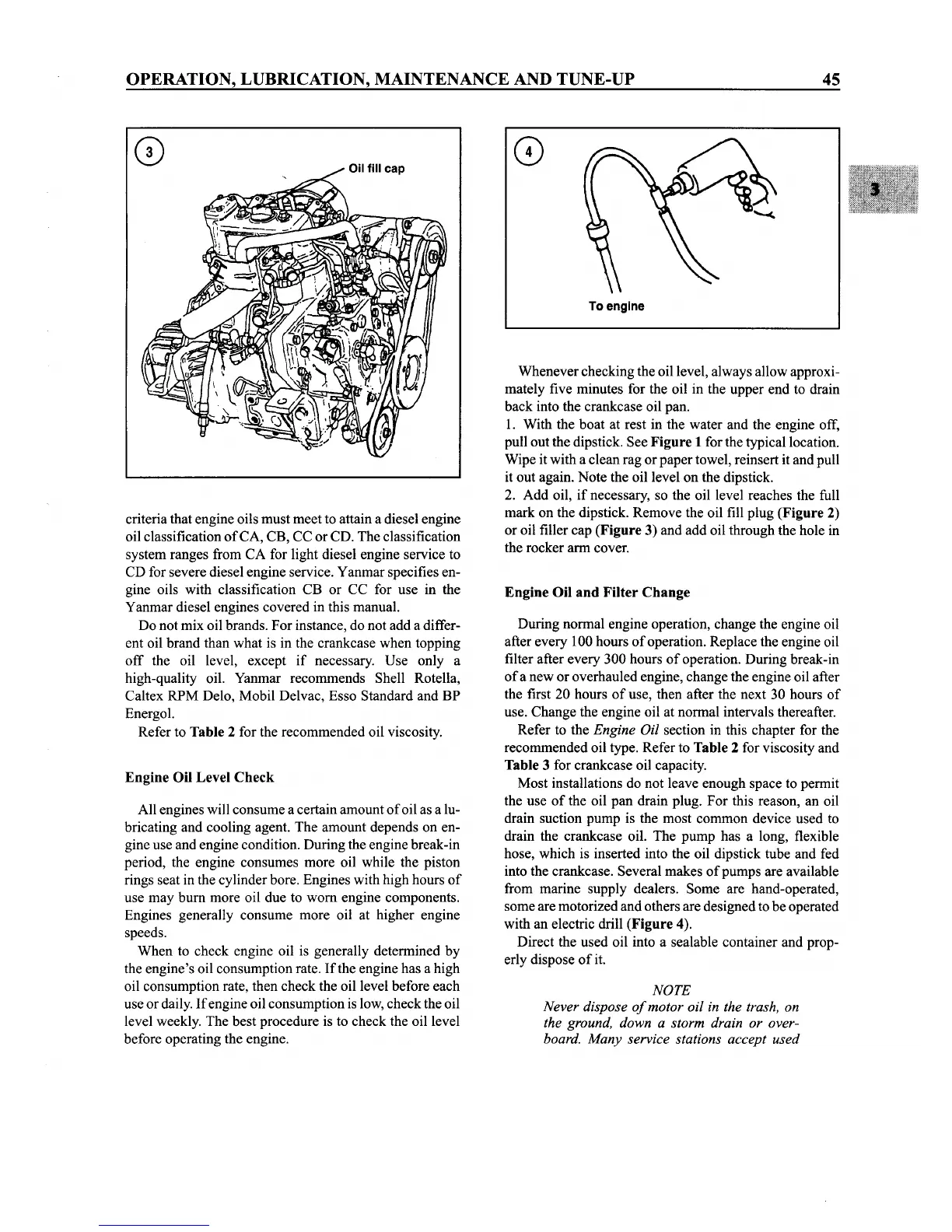
or oil filler cap (Figure 3) and add oil through the hole in
the rocker arm cover.
Engine Oil
and
Filter
Change
During normal engine operation, change the engine oil
after every 100 hours
of
operation. Replace the engine oil
filter after every 300 hours
of
operation. During break-in
of
a new or overhauled engine, change the engine oil after
the first 20 hours
of
use, then after the next 30 hours
of
use. Change the engine oil at normal intervals thereafter.
Refer to the
Engine Oil section in this chapter for the
recommended oil type. Refer to Table 2 for viscosity and
Table 3 for crankcase oil capacity.
Most installations do not leave enough space to permit
the use
of
the oil pan drain plug. For this reason, an oil
drain suction pump is the most common device used to
drain the crankcase oil. The pump has a long, flexible
hose, which is inserted into the oil dipstick tube and fed
into the crankcase. Several makes
of
pumps are available
from marine supply dealers. Some are hand-operated,
some are motorized and others are designed to be operated
with an electric drill (Figure 4).
Direct the used oil into a sealable container and prop-
erly dispose
of
it.
NOTE
Never dispose
of
motor oil in the trash, on
the ground, down a storm drain or over-
board. Many service stations accept used



 To Next Page