64
NOTE
In some instances. such as to
pre
vent rust
for
mation. it
may
be de
sirable
toj
ill
the sea-
water cooling system with an antifreeze so-
lution. Ref er to the following section in this
chap
ter.
7. If the seawater cooling system was drained, remove
the seawater
pump
impe ller as described in
Chapter
Eight.
Lubricate the impeller
with
dishwashing
soap
. then install
the impeller in the
pump
housing. Assemblethe
pwnp.
but
do not lighten the cover retaining screws.
NOTE
Make a highly visible sign as a reminder
that the seawater pump is inoperable. At-
tach the sign to the controls.
8. Apply lubricant to the control cables and all linkage
pivot points.
9. Loosen
belt tension for the pump and alternator drive
belts .
10. Seal or cover all engine openings to prevent the en-
trance
of
water, din or debris.
Make
a list of all the sealed
locations to be sure they
are all uncovered
whe
n returning
the engine to service.
II
. Wipe any d
in
or
co
rrosion
off
the engine and trans-
mission, then use a rag to apply oil or a rust inhibitor to all
engine surfaces.
12. Fill the fue l tank so less
con
densation will fo
nn.
Add
a
good
-quality antibacterial add itive (biocide)
and
fuei
stabilizer to the fuel tank.
i3 . Remove the battery from the boat. Tape the vent holes
closed and clean the battery case with a baking soda solu-
tion to remove any traces
of
corrosion and acid, then rinse
with cold water. Check the electrolyte level in each cell
and top olTwith distilled water as required.
Cover
the ter-
minals with a light coat
of
petrol
eum
je
lly. Sto re the bat-
tery in a cool, dry place.
NOTE
Remove the battery from storage every
30-45 days. Check electrolyte level and
slow-charge f or five or six hours at 6
am
~
peres.
COO U
:'Ii
G SYSTEM DRAIl'lI:'liG
The engine seawater cooling system must be properly
dra ined for storage during the winter months in areas
where t
emperatu
res fall
below
32° F (0°
C)
. If it is not, the
engine block or cooling system
may
be cracked by the ex-
pansion
of
frozen water.
CHAPTER
FOUR
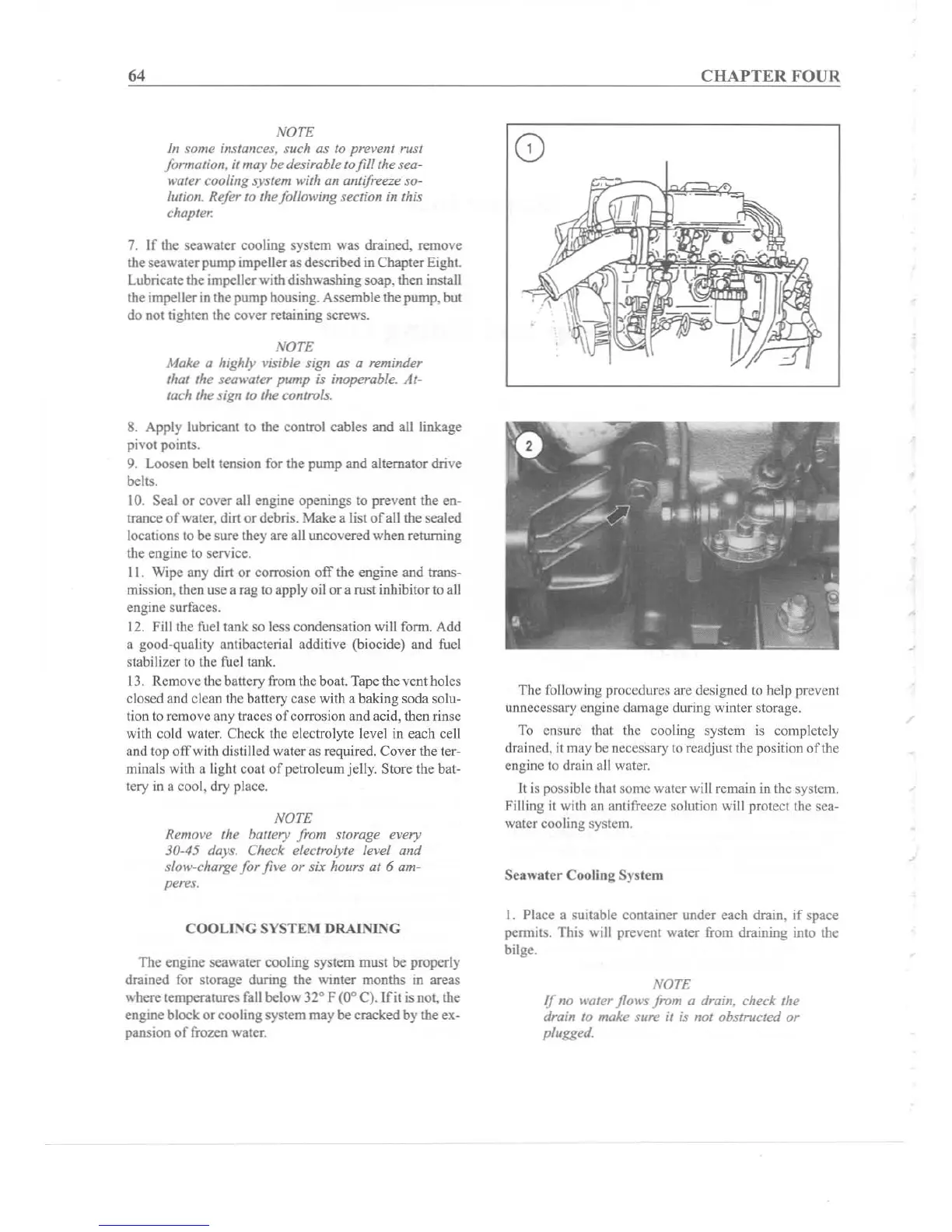
The following procedures are designed to help prevent
unnecessary engine damage during winter storage .
To ensure that the coo ling system is completely
drained, it may be necessary to readj ust the position
of
the
engine to drain all water.
It is possible that some water will remain in the system.
Filling it with an
antifreeze solution will protect the sea-
water cooling system.
Seawat
er
Cooling Sys tem
I. Place a suitable container under each drain, if space
penn
its. This will prevent water from draining into the
bilge.
NOTE
if
no water
flows
from a drain, check the
drain to make
sure
it is not obstructed or
plugged.



 To Next Page