- 11 -
you have cut o the limb further out to reduce the
weight. This prevents stripping the bark from the
main member.
Under-buck the branch 1/3 through for your rst
cut. Your second cut should over-buck to drop the
branch o. Now make your nishing cut smoothly
and neatly against the main member so the bark
will grow back to seal the wound.
WARNING: SPRINGPOLES
A spring pole is any log, branch, rooted stump, or
sapling which is bent under tension by other wood
so that it springs back if the wood holding it is cut
or removed. On a fallen tree, a rooted stump has
a high potential of springing back to the upright
position during the bucking cut to separate the log
from the stump. Watch out for spring poles, they are
dangerous. They could result in severe or fatal injury.
Keep the unit running the entire time you are cutting,
maintain a steady speed.
Allow the chain to cut for you; exert only light down-
ward pressure. If you force the cut, damage to the
bar, chain, or unit can result.
Do not put pressure on the saw at the end of the cut.
When felling a tree, keep everyone a safe distance
from the cutting area. During felling operations, the
safe distance
should be at least twice the height of the largest
trees in the felling area. If the tree makes contact
with any utility line, the utility company should be
notied immediately.
Always cut with both feet on solid ground to prevent
being pulled o balance.
Do not cut above chest height, as a saw held higher
is dicult to control against kickback forces.
Felling A Tree
When bucking and felling operations are being per-
formed by two or more persons, at the same time,
the felling operation should be separated from the
bucking operation by a distance of at least twice the
height of the tree being felled. Trees
should not be felled in a manner that would endan-
ger any person, strike any utility line or cause any
property damage. If the tree does make contact with
any utility line, the utility company should be notied
immediately.
WARNING: Check the tree for damaged or
dead branches that could fall and hit you during
felling.
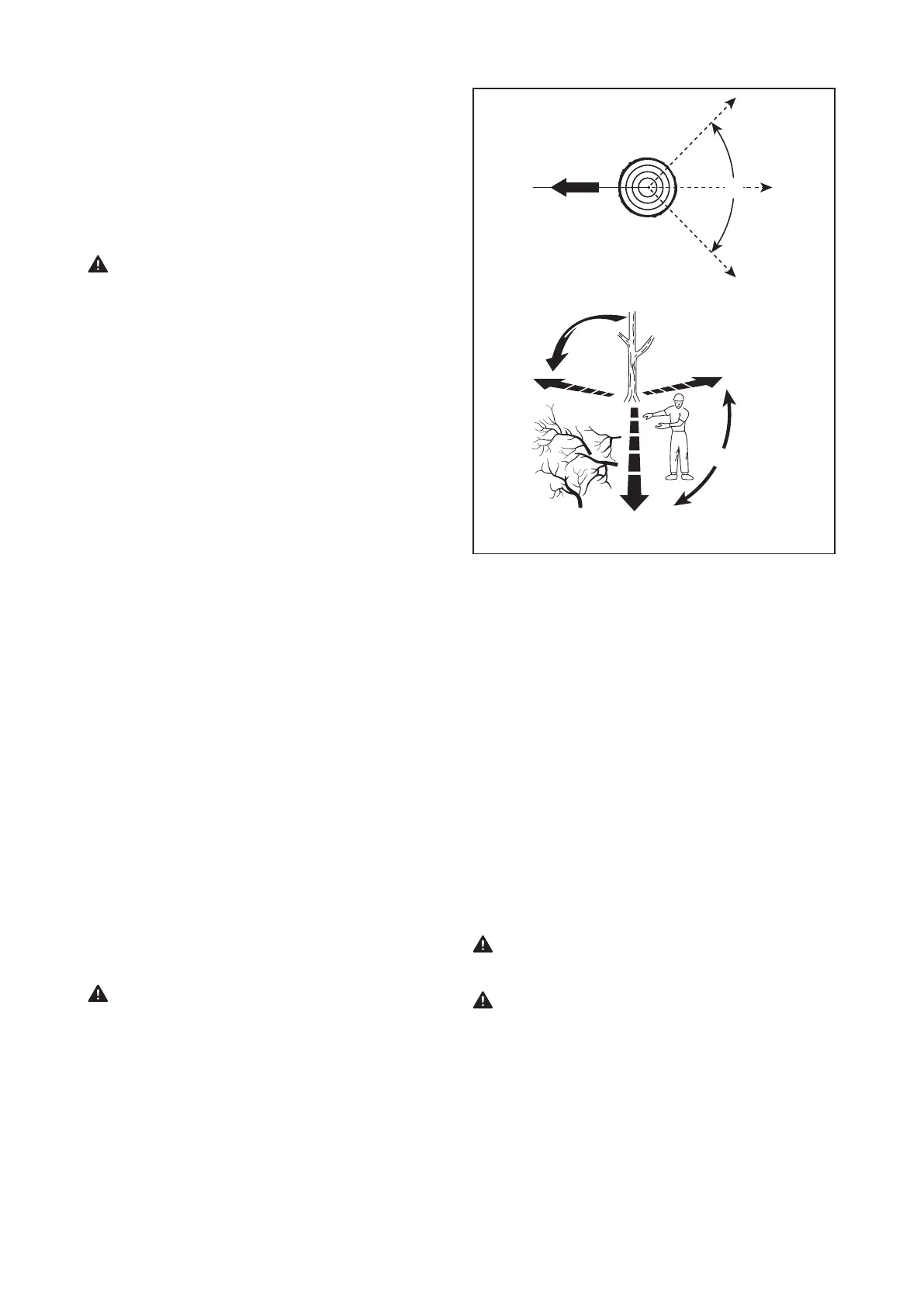
Before any cuts are started, pick your escape route
(or routes in case the intended route is blocked);
clear the immediate area around the tree and make
sure there are no obstructions in your planned path
of retreat. A clear path of safe retreat is approximate-
ly 135 degrees from planned line of fall. The retreat
path should extend back and diagonally to the rear
of the expected line of fall.
Before felling is started, consider the force and direc-
tion of the wind, the lean and balance of the tree,
and the location of large limbs. These things inu-
ence the direction in which the tree will fall. Do not
try to fell a tree along a line dierent from its natural
line of fall.
The chain saw operator should keep on the uphill
side of the terrain as the tree is likely to roll or slide
downhill after it is
felled.
Remove dirt, stones, loose bark, nails, staples, and
wire from the tree where felling cuts are to be made.
NOTCHED UNDERCUT -
Cut a notch about 1/3
diameter of the tree, perpendicular to the direction of
the fall. Make the cuts of the notch so they intersect
at a right angle to the line of fall. This notch should
be cleaned out to leave a straight line. To keep the
weight of the wood o the saw, always make the
lower cut of the notch before the upper cut.
WARNING: Do not fell trees during periods of
high wind or heavy precipitation. Wait to do your
cutting until the hazard has ended.
WARNING: Do not cut down trees having
an extreme lean or large trees that have rotten
limbs, loose bark, or hollow trunks. Have these
trees pushed or dragged down with heavy equip-
ment, then cut them up.
Felling Back-Cut
The back-cut is always made level and horizontal,
and at a minimum of 2 inches (5cm) above the hori-
zontal cut of the notch.
Never cut through to the notch. Always leave a band
of wood between the notch and back-cut (approxi-
PLANNED
LINE OF FALL
PLANNED
LINE OF FALL
SAFE
RETREAT
ZONE
SAFE
RETREAT
ZONE
SAFE
RETREAT
ZONE
PLANNED PATH OF SAFE RETREAT 135° FROM PLANNED LINE
OF FALL
135°
135°
45°
90°
45°
90°




 To Next Page