- 10 -
OPERATING
Cutting Instructions
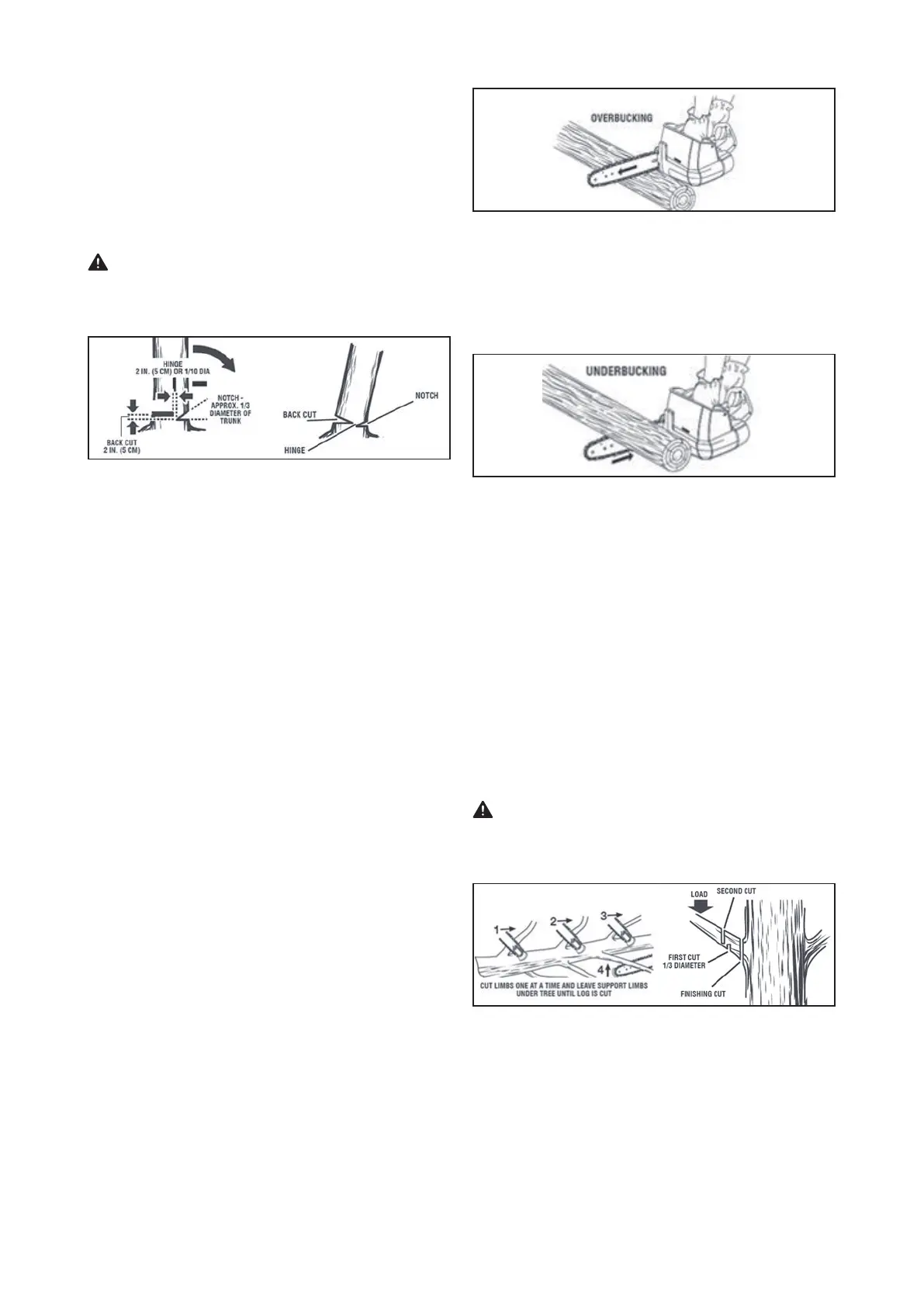
As the tree starts to fall, stop the chain saw and put
it down immediately. Retreat along the cleared path,
but watch the action in case something falls your
way. Be alert for overhead limbs or branches that
may fall and watch your footing.
WARNING: Never cut through to the notch
when making a back-cut. The hinge controls the
fall of the tree, this is a section of wood between
the notch and back-cut.
Bucking
Bucking is the term used for cutting a fallen tree to
the desired log length.
Always make sure your footing is secure and your
weight is distributed evenly on both feet.
Cut only one log at a time. Support small logs on a
saw horse or another log while bucking.
Keep a clear cutting area. Make sure that no objects
can contact the guide bar nose and chain during
cutting, this can cause kickback.
When bucking on a slope, always stand on the
uphill side of the log. To maintain complete control of
the chain saw when cutting through the log, release
the cutting pressure near the end of the cut without
relaxing your grip on the chain saw handles. Do not
let the chain contact the ground. After completing the
cut, wait for the saw chain to stop before you move
the chain saw. Always stop the motor before moving
from tree to tree.
Bucking Logs Under Stress
When the log is supported along its entire length, it
should be cut from the top or over-bucking.
When the log is supported on one end, cut 1/3 di-
ameter from the underside or under-bucking. Then
make the nishing cut by over-bucking to meet the
rst cut.
As the log is being cut, it will tend to bend. The saw
can become pinched or hung in the log if you make
the rst cut deeper than 1/3 of the diameter of the
log.
Give special attention to logs under stress to pre-
vent the bar and chain from pinching
OVERBUCKING -
Begin on the top side of the log
with the bottom of the saw against the log; exert light
pressure downward. Note that the saw will tend to
pull away from you.
UNDER-BUCKING -
Begin on the under side of the
log with the top of the saw against the log; exert
light pressure
upward. During under-bucking, the saw will tend to
push back at you. Be prepared for this reaction and
hold the saw rmly to maintain control.
Pruning
Pruning is trimming limbs from a live tree.
Work slowly, keeping both hands on the chain saw
with a rm grip.
Always make sure your footing is secure and your
weight is distributed evenly on both feet.
When pruning trees it is important not to make
the nishing cut next to the main limb or trunk until
Limbing
Limbing is removing branches from a fallen tree.
Work slowly, keeping both hands on the chain saw
with a rm grip.
Always make sure your footing is secure and your
weight is distributed evenly on both feet.
Leave the larger support limbs under the tree to
keep the tree o the ground while cutting.
Limbs should be cut one at a time. Remove the
cut limbs from the work area often to help keep the
work area clean and safe.
Branches under tension should be cut from the bot-
tom up to avoid binding the chain saw.
Keep the tree between you and the chain saw while
limbing. Cut from the side of the tree opposite the
branch you are cutting.
WARNING: Never climb into a tree to limb or
prune. Do not stand on ladders, platforms, a log,
or in any position which can cause you to lose
your balance or control of the saw.



 To Next Page