Need help?
Do you have a question about the Yuwell 7E-B5 and is the answer not in the manual?
Key safety warnings including risks of electric shock, burns, fire, and personal injury.
Details the unit's purpose, suitability, and its oil-free lubrication system.
Steps for checking the product after unboxing and connecting the unit components.
Procedures for power connection, connector checks, and negative pressure regulation testing.
Detailed steps for inspecting and testing the overflow device's functionality.
Guidelines for unit operation, monitoring, and actions for blocked catheters or removal difficulties.
Instructions on when and how to replace the air filter for optimal suction performance.
Recommendations for cleaning, sterilization, storage, and periodic running of the unit.
Conditions for safe transportation and storage, including temperature, humidity, and atmosphere.
Guidance on proper use adjacent to other equipment and electromagnetic environment considerations.
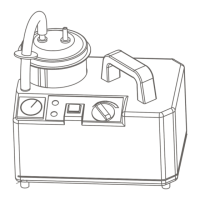
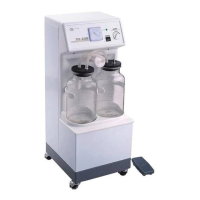
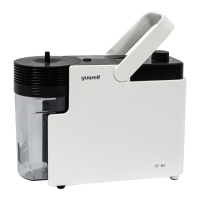
The 7E-B5 Portable Phlegm Suction Unit is a new generation of oil-free lubrication suction device designed for medical and home health care. Its primary function is to assist patients who have difficulty removing phlegm due to illness, coma, or surgery, and to aspirate liquids such as pus and blood in clinical settings. This device is commonly used in emergency rooms, operating rooms, sickrooms, and for general nursing care.
The 7E-B5 operates on an oil-free lubrication pump, which prevents the environment from being polluted by oil mist, ensuring a cleaner and safer operation. It features a negative pressure regulating system that allows for stepless adjustment of suction force, enabling precise control during use. The device is designed to generate no positive pressure during operation, enhancing reliability and safety. A round negative pressure meter and a plastic cover are integrated into the design for ease of monitoring and protection. The unit is small in size, light in weight, and portable, making it convenient for various clinical and home care settings.
The operating principle involves a vacuum pump that creates negative pressure. Air is drawn through an air filter, and then through a suction inlet. The negative pressure regulating valve allows control over the suction force. An overflow valve subassembly is crucial for safety, preventing liquid from entering the pump by automatically closing when the liquid storage bottle reaches its capacity. The aspirated liquid is collected in a liquid holder, and exhaust air is released through an exhaust outlet.
Before use, the device requires proper installation and commissioning. This involves connecting the power plug to a grounded power source, ensuring the power indicator illuminates. A connector inspection should be performed by blocking the air suction inlet and starting the aspirator; the vacuum meter pointer should quickly reach the limit negative pressure, then return below 0.02 MPa upon release, indicating a good connection. The phlegm suction catheter is then attached, and the negative pressure in the system should be within specified limits (less than 0.07 MPa for an F8 catheter, less than 0.03 MPa for an F12 catheter). If the catheter is blocked, it can be cleared by bending the suction conductor into a "V" form (without liquid in the holder) and releasing it to its original status when the negative pressure reaches its maximum value.
Negative pressure regulation is achieved by blocking the suction inlet, opening the aspirator switch, and adjusting the negative pressure valve. The readings on the pressure meter should be within the 0.02 MPa to limit negative pressure range. During clinical practice, the negative pressure can be increased by turning the valve clockwise. It is important to reduce the negative pressure below 0.02 MPa before powering off the device.
The overflow device must be inspected and tested regularly. This involves opening the holder plug, cleaning the valve mouth, and ensuring the rubber valve clack on the float is not warped, bent, or broken, and is well connected to the float. The float should move freely and lift to contact the water surface perpendicularly. After tightening the hold plug and attaching the suction tube conductor, the aspirator is actuated, and the suction conductor is placed into a clean water pail to simulate actual aspiration. The float should rise as the liquid level ascends, closing the valve and stopping suction automatically. After use, the regulating valve is released, the aspirator switch is turned off, and the liquid in the holder is emptied. The float should return to the bottom of the support, and the valve should be in an open status. If the liquid level continues to ascend after the overflow device has shut off, it may be due to residual negative pressure or an incompletely closed valve, requiring careful observation and immediate action to prevent overflow. The aspirator should never be used if the overflow device or conductor is dismantled.
During application, the aspirator should be checked for good performance as per the installation and commissioning sequence. The suction conductor and sterilized phlegm suction catheter are then connected. The negative pressure is regulated via the regulating valve, and the switch is operated as needed. The liquid level in the holder should be frequently observed. Suction should be stopped if the liquid level reaches the rated capacity (even if the aspirator is slanted 10 degrees) and resumed after emptying and cleaning. If the liquid level continues to ascend after the overflow device has shut off, the procedures for inspecting the overflow device should be followed.
Emergency measures during application include quickly loosening the negative pressure regulating knob to release negative pressure if the suction catheter is blocked by phlegm or mucus, then restarting suction after changing the tube. This method is also used if the suction catheter is difficult to remove after suction or if the tube adheres to human tissue. To achieve quicker suction, the tube can be bent into a "V" form before starting suction, inserting the catheter into the patient's phlegm location when the negative pressure reaches the desired range, and then recovering the tube to its original status. Medical personnel must select the appropriate suction catheter based on clinical requirements. The aspirator must be operated strictly according to the medical personnel's instructions, application scope, and operating sequence outlined in the manual.
Regular maintenance is crucial for the longevity and effective operation of the 7E-B5. After each use, it is recommended to suction a small amount of clean water to clean the inner wall of the suction tube before turning off the aspirator. The holder should be emptied, and any dirt on the holder and plug should be cleaned with a soft brush or rag. The holder, overflow device, seal ring, and all tubes should be flushed with water and sterilized. If necessary, the overflow device should be unscrewed, and the float separated from its support for thorough cleaning. The rubber valve clack should not be separated from the float.
Physiological saline should be used to clean out any residual phlegm and mucus in the tube. The suction catheter should be replaced if it is not smooth; using a one-time suction catheter is recommended. The holder, cover, and all tubes should be placed in a disinfectant solution (e.g., KONVIDA disinfector tablets at 0.5 g per tablet in 1:500 concentration) for one hour. Care should be taken to keep the holder away from sharp utensils to avoid damage during cleaning and application. The outer surface of the case should be wiped with a lightly wet rag soaked in disinfectant, taking care to prevent liquid from seeping into the pump. Areas marked with letters and patterns should not be wiped.
The machine should be stored in dry and clean places. Periodically, it should be started and run once (normally every six months) to ensure proper function. Before re-use, the overflow device, conductor, and other tubes must be reinstalled according to the connecting mode.
The air filter needs to be changed when foam or dust accumulates, causing the filter diaphragm to darken and the suction force at the tube inlet to diminish or disappear, while the negative pressure on the vacuum meter climbs to 0.04 MPa or more. It is necessary to frequently change the air filter and destroy it properly.
Troubleshooting guidance is provided for common issues. If the negative pressure is too low (below 0.08 MPa), possible reasons include holder mouth leakage, leakage at connecting points, a loose or released regulating valve, or an unsuitable surrounding atmosphere. Solutions involve removing dirt, tightening or changing the holder cover/seal ring/connector, re-tightening connections, turning the regulating valve tightly, or moving the machine to a suitable atmosphere. If the negative pressure is too high (above 0.04 MPa) with reduced or disappearing suction force, it could be due to the overflow device shutting off, tube blockage, or air filter blockage. Solutions include releasing negative pressure by turning the regulating valve counterclockwise after shut-off, then re-screwing; dredging, cleaning, or replacing the tube; or replacing the air filter. If the normal power voltage is present but the indicator doesn't illuminate, it may be a loose socket or a damaged indicator, requiring repair or replacement by a specialized maintenance worker. Any dismantling or repair of the pump body due to faults should be conducted by a specialized worker, and the manufacturer should be contacted if required.
The device should be stored in a well-ventilated room free from corrosive gas and handled without violent shock.
 General
| Product Name | Yuwell 7E-B5 |
|---|---|
| Category | Medical Equipment |
| Pumping Rate | ≥ 18 L/min |
| Reservoir Volume | 1000 mL |
| Sound Level | ≤ 65 dB(A) |

 To Next Page