18
Any safety devices including low water cutoffs used in conjunction
with this boiler should receive periodic (every six months) inspection
toassureproperoperation.Alowwatercutoffdeviceoftheoat
typeshouldbeushedeverysixmonths.Periodicchecks,atleast
twice a year, should be made for water leaks.
More frequent inspections may be necessary depending on water
conditions.
The boiler-mounted gas and electrical controls have been designed
to give both dependable service and long life. However, malfunction
can occur, as with any piece of equipment. It is therefore
recommended that all components be checked periodically by a
qualiedserviceagentforproperoperation.
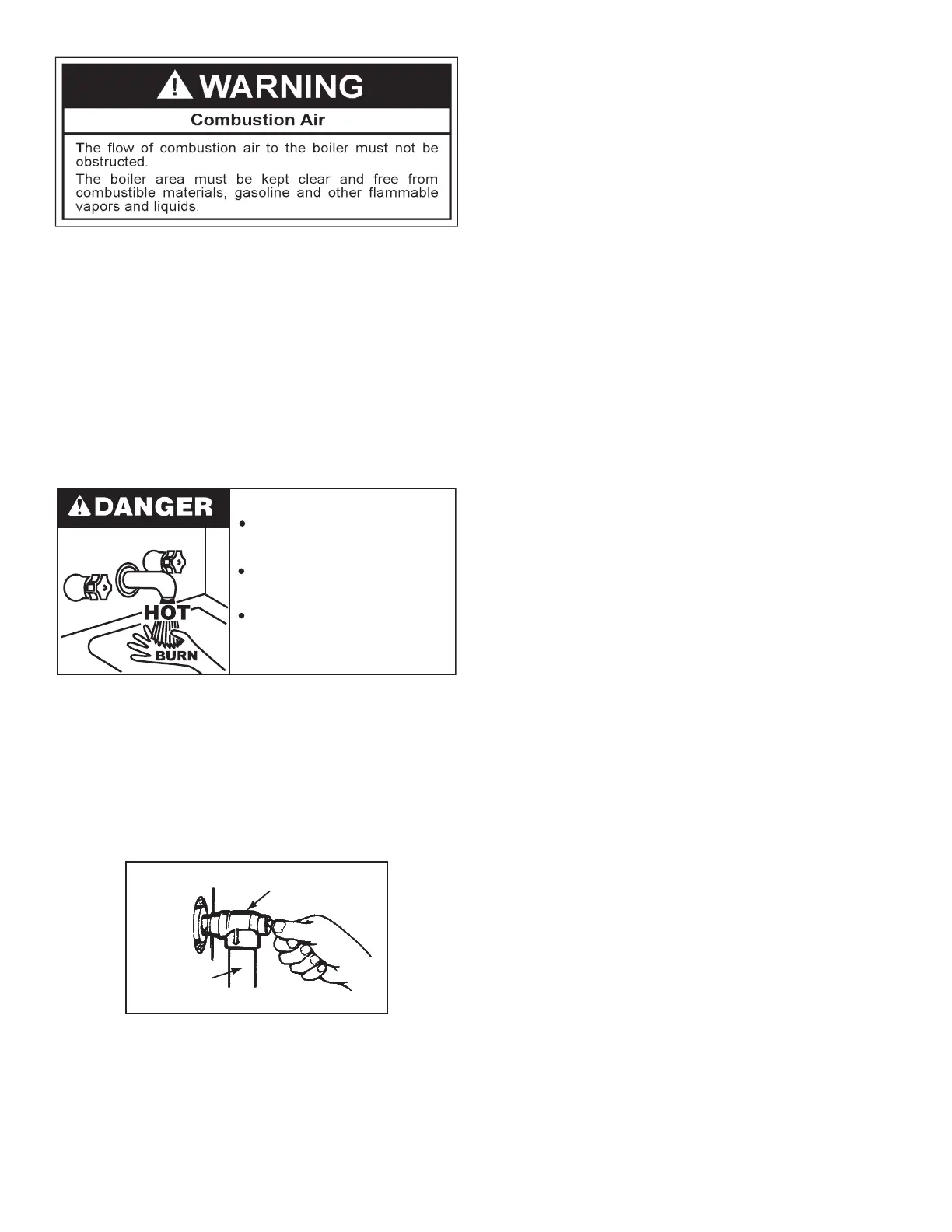
RELIEF VALVE
Burn hazard.
Hot water discharge.
Keep clear of Pressure
Relief Valve discharge outlet.
The pressure relief valve must be manually operated at least
once a year. Caution should be taken to ensure that (1) no one
is in front of or around the outlet of the pressure relief valve
discharge line, and (2) the water manually discharged will not
cause any bodily injury or property damage because the water
may be extremely hot.
To test the relief valve, lift the lever at the end of the valve several
times, see Figure below. The valve should seat properly and
operate freely.
DISCHARGE
PIPE
RELIEF VALVE
FIGURE 4. - RELIEF VALVE
If after manually operating the valve, it fails to completely reset
and continues to release water, turn off power to the boiler at the
main disconnect switch or breaker. Close the cold water inlet to the
boiler and follow the draining instructions in this manual to drain
the boiler. Should the relief valve need to be replaced, call the toll
free phone number listed on the back of this manual for further
technical assistance.
COMBUSTION AIR FILTER
If the combustion air supply to the boiler contains dust, dirt, drywall
dustetc.altermustbeinstalled.Anairlterisnotsuppliedwith
the boiler as shipped from the factory. The installer must provide a
lteringsystemintheairinlettotheboilerifdust,dirtorconstruction
dirt can be pulled into the boiler through the inlet air piping.
Periodicallycleanairlterperthemanufacturer’sinstructions.
BLOWER COMPARTMENT
The blower compartment should be cleaned annually to remove any
dirt and lint that may have accumulated in the compartment or on the
blower and motor. Buildups of dirt and lint on the blower and motor
can create excessive loads on the motor resulting in higher that
normal operating temperatures and possible shortened service life.
BURNER MAINTENANCE
Qualiedservicersshouldfollowthisprocedurewhentheboiler’s
burner needs cleaning.
1. Turn off the electrical power to the boiler and close the main
manual gas shutoff valve(s). Allow the boiler parts to cool before
disassembly.
2. Loosentheangeandseparatethegastrainfromthemanifold
assembly.
3. Separatetheburnerfromthebloweradapterbyrstremoving
the four (4) bolts and subsequently, the blower gas kets. The
blower should be free to move at this point.
FOR DIRECT VENT UNITS: It is necessary to loosen and slide the
rubber coupling on the blower adaptor in order to move the blower.
4. Loosen the seven bolts on the blower adapter at the base and
move the burner ground wire (Green) aside.
5. Lift the blower adapter and remove the manifold assembly up
from the 6 studs located on the cover plate and remove the
burner gasket.
6. Remove any loose foreign material such as dust or lint with a
vacuum. Check all ports for blockage. Dislodge any foreign
material causing blockage. Remove any soot or carbon deposits
with a rag making sure to remove any lint left on the burner by
vacuuming again.
7. Reverse the steps to reassemble the unit.
8. Restore electrical power and gas supply to the boiler.
• Put the boiler back in operation by following the Lighting and
Operating instructions in this manual.
• Check for gas leaks and proper boiler and vent operation.
CONDENSATE REMOVAL SYSTEM
Due to the highly efcient operation of this unit, condensate is
formed during operation and must be removed by the conden sate
drain systems. Inspect the condensate drains and tubes at least
onceamonthandinsuretheywillallowthefreeowofcondensate
at all times. The system must be inspected more frequently in
cold weather if the drain system is located in an area, such as
alongtheoor, where freezing temperaturesarelikelytooccur.
The condensate drain system must be protected against freezing.
Contactaqualiedserviceagenttoinspectandcorrectthecondition
if freezing of the conden sate lines is a problem. The unit is equipped
withablockedueswitchwhichwillshuttheunitoffifcondensate
isunabletodrainandbacksupintheunit.Ablockedueerrorwill
appearwhensufcientcondensateaccumulatesforthiscondition.
The transparent drain lines and condensate drain on the bottom
of the vent collector should be visually inspected at one month
intervals for blockage, particularly in the areas of the loops in the
lines which trap a small amount of conden sate, and the exit point
of the vent collector drain. Conden sate in portions of the line other
than the loop area indicates a blockage in the drain line. Flush the



 To Next Page