Need help?
Do you have a question about the ABB MicroSCADA Pro SYS 600C and is the answer not in the manual?
Details copyright ownership and usage restrictions for the document.
Provides product information, functionality, benefits, and technical details of SYS 600C.
Explains icons used for safety-related conditions and other important information.
Lists technical abbreviations and their full descriptions for clarity.
Lists related system manuals with their respective document identifiers.
Details the version history of the product guide, including dates and changes.
Details how SYS 600C connects to process devices, retrieves, and writes data.
Explains SYS 600C connection to upper-level systems like Network Control Systems.
Describes the gateway's role in signal rerouting and protocol conversion between systems.
Covers the 1-5 workstations for operator configuration, supervision, and interaction.
Describes the display type for process representation using single-line diagrams.
Shows system component status for maintenance and fault localization.
Displays events stored in the database with sorting and filtering capabilities.
Shows system alarms in a list format with sorting and filtering for analysis.
Lists and allows activation of blockings for signals (update, control, logging, etc.).
Collects and visualizes data numerically or graphically for analysis over time.
Collects and visualizes data for logging and reporting over longer periods.
Details user access rights, session limits, and permissions for system control.
Explains the system's ability to translate the user interface into multiple languages.
Describes how SYS 600C synchronizes its clock using GPS or SNTP.
Explains redundant servers configured in Hot Stand-By (HSB) mode for availability.
Covers redundant communication lines for reliable data transfer.
Details process data mirroring for sharing data in hierarchical systems.
Explains OPC as an interface standard for data exchange between systems.
Highlights SYS 600C's advantages: hardware, scalability, availability, and efficiency.
SYS 600C solutions for power automation, substation automation, and process industries.
Details usage in electrical utilities, substations, and remote control systems.
Describes SYS 600C's role in connecting to Remote Control Centers and DCS systems.
Explains SYS 600C's function as HSI for monitoring and controlling processes.
Details SYS 600C's role as a powerful server in SCADA and substation automation.
Covers hardware configuration, upgrades, and operating system considerations.
Details SYS 600 software upgrades, licensing, and product identification.
Lists the master and slave communication protocols supported by SYS 600C.
Lists user interface options like number of workplaces, process displays, and network coloring.
Details system functions such as process I/O, control, history logging, and redundancy.
Specifies system size limits like process I/O and gateway functionality.
Details options for control, history logging, redundancy, and database mirroring.
Enables OPC DA server function for connection to external OPC DA Clients.
Provides OPC DA server interface for HSB systems, connecting to external clients.
Enables OPC A&E server function for connection to external OPC A&E Clients.
Connects loosely coupled OPC DA servers to SYS 600, potentially on a separate computer.
Connects foreign devices to SYS 600 via OPC DA interface, tightly integrated.
Connects foreign devices to SYS 600 via OPC A&E interface for alarms and events.
Provides tools to browse and export process data to a relational database.
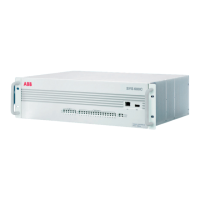
Lists hardware options for the SYS 600C computer, including power supply.
Lists available operating systems for the SYS 600C computer.
Details CPU, memory, storage, ports, power supply, dimensions, and environmental specs.
Lists compliance levels for various EMI/EMS tests according to IEC 61850-3.
Lists compliance levels for EMI/EMS tests according to IEEE Std 1613-2003.
Details compliance for DC voltage, temperature, humidity, and shock tests.
Provides guidelines for maximum process communication, IEDs, and function usage.
Discusses disk capacity limitations for event and data logging.
Lists maximum communication capacities for various protocols like IEC 61850, LON, IEC 101/103/104.
Details how functions like mirroring, gateway, and workplaces affect process communication.
Illustrates communication scenarios with IEDs, NCC connections, and workplace usage.

 To Next Page
 General