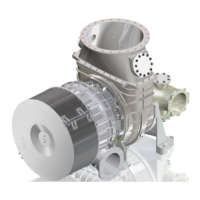
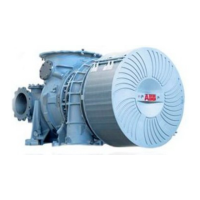
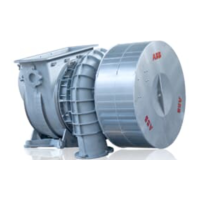
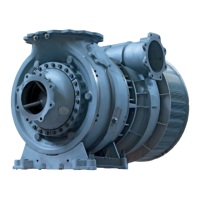
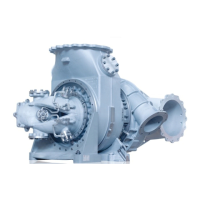
The document provides assembly instructions for ABB TPL-C and TPLVC series turbochargers, specifically models TPL67-C, TPL67VC, and TPL71-C. These instructions detail the correct and safe fitting of the turbocharger to an engine, targeting engineers and mechanics with basic mechanical training.
Function Description:
The ABB TPL-C series turbochargers are described as "reliable peak performers," designed to enhance engine performance. They feature a two-part foot for mounting: a turbine end (TE) foot and a compressor end (CE) foot. The CE foot is rigidly attached to the engine support, while the TE foot is a sliding foot. This sliding design compensates for thermal expansion during operation, ensuring the turbocharger remains properly mounted despite temperature changes. Some models, like the TPL..V, incorporate an additional function with adjustable guide vanes at the turbine end, replacing a traditional nozzle ring. This feature likely allows for variable geometry turbocharging (VTG), optimizing performance across different engine loads and speeds.
Important Technical Specifications:
The document provides specific weight information for transportation and installation:
- TPL67-C: 1330 kg
- TPL67VC32: 1330 kg
- TPL71-C: 2040 kg
Screw strength classes for mounting are consistently 10.9 for all listed models (TPL67-C, TPL67VC32, TPL71-C). The thread size for both CE and TE foot screws is M24.
Minimum bush clearances (Wmin) are specified:
- TPL67-C: 3.0 mm
- TPL67VC32: 3.0 mm
- TPL71-C: 3.5 mm
Pre-tightening torques for M24 screws on both CE and TE feet are 160 Nm. The final tightening torque for all TE and CE foot screws (M24) is 800 Nm.
Usage Features:
The assembly process involves several key steps:
- Preparation: Determine screw strength and length, ensuring the screw-in length of the thread (c) is at least 1.5 times the nominal thread diameter.
- CE Foot Installation: Insert CE foot screws with one washer each. Tighten these screws (3, 4, 5, 6) to a pre-tightening torque of 160 Nm, following a specific sequence based on the gas outlet branch position (e.g., NB000 (045/315): 3, 4, 5, 6; NB090: 3, 6, 5; NB270: 4, 5, 6).
- Bush Installation: Insert bushes (B) into the TE foot, ensuring the "Top" marking on the bush face is upwards. It is crucial to leave the bush (B) in its original condition to prevent damage to the engine or property.
- Bush Position Determination: Insert TE foot screws into the bushes (without cup springs) and screw them in by two turns to determine the correct bush position.
- Clearance Check: Check the position and clearance (W) of the bushes, ensuring they meet the specified minimums.
- TE Foot Preparation: Remove TE foot screws. Grease the contact surface (F) for the cup springs (X) on the turbine end foot with high-temperature grease, avoiding the bush surfaces.
- TE Foot Installation: Insert the specified number of cup springs (X) into the turbine end foot (5 for TPL67-C/TPL67VC32, 6 for TPL71-C). Insert the TE foot screws (1, 2, 7, 8) and tighten them to a pre-tightening torque of 160 Nm, following a specific sequence based on the gas outlet branch position (e.g., NB000 (045/315): 1, 2, 7, 8; NB090: 1, 8, 7; NB270: 2, 7, 8).
- Final Tightening: Tighten all TE and CE foot screws (1, 2, 3, 4, 5, 6, 7, 8) to the final tightening torque of 800 Nm, following a specific sequence based on the gas outlet branch position (e.g., NB000 (045/315): 1, 2, 3, 4, 5, 6, 7, 8; NB090: 1, 6, 3, 5, 8, 7; NB270: 2, 5, 4, 6, 7, 8).
- Completion Work (if required): For TPL..V models, connect the VTG drive to the operating lever according to the engine builder's instructions. Attach all gas, air, water, and oil pipes. Fit insulation components and install the speed sensor, plugging in its cable connector.
Maintenance Features:
The document outlines storage guidelines for new turbochargers and spare parts, emphasizing the importance of proper conditions to prevent corrosion and damage.
- Short-term Storage (up to 6 months): New turbochargers and spare parts can be stored in sealed packaging without additional mothballing measures for up to 6 months from delivery, provided the VCI (Volatile Corrosion Inhibitor) label is present. Storage rooms must be dry, with relative humidity between 40-70%, and no condensation.
- Long-term Storage (more than 6 months):
- VCI Emitter Replacement: Every 6 months, the VCI corrosion protection emitter must be replaced with a new, identical one (available from www.branopac.com). The old emitter must be disposed of professionally and environmentally compatibly.
- Package Integrity: The package must be inspected for damage. If damaged, or if the hygrometer's 70% field has changed color (indicating excessive humidity), the turbocharger must be inspected and repacked by an ABB Turbocharging Service Station.
- Hygrometer Check: The package is equipped with a hygrometer in a sight-glass. This must be checked every 6 months through an opening in the wooden crate. If the 70% display field has changed color, the maximum permissible humidity has been exceeded, requiring inspection and repacking by an ABB Turbocharging Service Station.
- Three-year Inspection: Every 3 years, an ABB Turbocharging Service Station must perform the following: inspect the component, replace the desiccant agent, and repackage the component.
- Unpacking: The corrosion protection effect ends upon unpacking. To prevent condensation, the surroundings and package contents should be at the same temperature during unpacking.
The document stresses occupational safety, warning against suspended loads, mechanical hazards, and hazards from operating materials. Personal protective equipment (PPE) such as safety footwear, protective clothing, safety glasses, safety goggles, safety gloves (against mechanical, chemical, and thermal hazards), safety helmets, respiratory masks (against dusts and gases), and ear protection are mandatory. Specific warnings are given for welding work near the turbocharger (cover the filter silencer) and handling VCIs (ensure ventilation, avoid ingestion/skin contact, wear safety gloves, clean hands/face). The document also warns against climbing on the turbocharger and emphasizes using proper tools and maintaining a clean workplace.


 To Next Page
 General