Need help?
Do you have a question about the abem WalkTEM 2 and is the answer not in the manual?
Details known issues like battery status and self-discharge, plus limitations in coil testing and measurement scripts.
Explains the laboratory-based calibration due to site access limitations and provides contact for more information.
Step-by-step guide on laying out the TL-1k6 transmitter loop, including orientation and markers.
Instructions for positioning the RC-5 receiver coil centrally and connecting it.
Guidance on centring and aligning the RC-200 receiver loop relative to the transmitter loop.
Details on connecting transmitter loops and receiver coils to the WalkTEM TX and RX units via specific inputs.
Instructions for connecting the WalkTEM TX and RX units using a sync cable for communication.
Specifies minimum power requirements and connection methods for external batteries to the TX unit.
Steps to configure the instrument with a transmitter loop and select a script for analysis.
Guide on using the 'Analyze' function, connecting the Rogowski coil, and following screen prompts.
How to interpret Rogowski coil test results, plot decays, and choose the optimal damping resistor.
Procedures for mounting and connecting an external power resistor to the transmitter loop.
Describes the layout for the TL-400 transmitter loop, including receiver coil placement and connections.
Specifies the required power source for the 20x20m transmitter loop (12V battery).
Instructions for laying out the 100x100m TL-10k transmitter loop and connecting receiver coils.
Details the minimum power requirement for the 100m transmitter loop (24V).
Steps for laying out the 200x200m TL-40k transmitter loop and connecting receiver coils.
Specifies the minimum power requirement for the 200m transmitter loop (24V).
Information on TX-60 compatibility with high power loops and differences from TX-8/TX-20.
Notes on loop layout adjustments for TX-60, including the RC-5 coil and lead-in cables.
Details the battery requirements for the TX-60, including control electronics and current generator power.
Overview of the main UI tabs: Configuration, Measurement, Post Processing, and Administration.
Explains the function of each key on the ABEM WalkTEM keypad for operation.
How to select the correct regional powerline frequency for appropriate script availability.
Guidance on selecting existing projects or creating new ones for survey data.
Instructions for configuring transmitter loops and receiver coils, including offsets.
Information on choosing measurement scripts based on data type and survey goals.
Steps to start the measurement process, including noise, low, and high moment measurements.
How to switch between different real-time measurement views using the TAB button.
How to navigate through projects and stations to access measured soundings.
Using the Plot Data function to review stacked decay curves and apparent resistivity.
Steps to run data inversion, view the resulting layered model, and residual value.
Specific measurements for laying out the TL-400 (20x20m) transmitter loop.
Specific measurements for laying out the TL-1k6 (40x40m) transmitter loop.
Specific measurements for laying out the TL-10k (100x100m) transmitter loop.
Specific measurements for laying out the TL-40k (200x200m) transmitter loop.
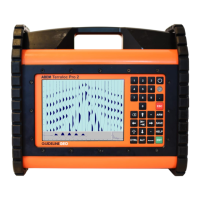
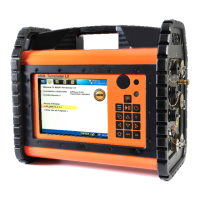
The ABEM WalkTEM 2 is a user-friendly, rapid survey solution designed for Transient Electromagnetics (TEM) measurements, providing precise resistivity models directly in the field. This instrument is ideal for applications such as the search, mapping, and monitoring of groundwater, mineral deposits, and environmental changes. Its modular hardware allows for scalability and expansion of capabilities to adapt to evolving survey needs.
The WalkTEM 2 operates by transmitting a current into a transmitter loop, which creates a primary magnetic field. When the current is abruptly switched off, the collapse of this field induces eddy currents in the ground. These eddy currents generate a secondary magnetic field that decays over time, and this decay is measured by receiver coils. The rate and shape of this decay provide information about the electrical resistivity of the subsurface.
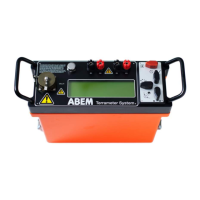
The system includes a Transmitter (TX) unit and a Receiver (RX) unit. The TX unit is responsible for generating and switching the current in the transmitter loop, while the RX unit measures the induced voltage in the receiver coils. The instrument's software processes these measurements to produce resistivity data, which can then be used to create 1D inversion models of the subsurface.
The WalkTEM 2 supports various transmitter loop sizes, including TL-1K6 (40x40m), TL-400 (20x20m), TL-10k HP6 (100x100m), and TL-40k HP6 (200x200m), catering to different depths of investigation and survey requirements. It also accommodates different receiver coils, such as the RC-5 (small coil) and RC-200 (large coil), which can be connected to inputs A and B on the RX unit. The choice of loop and coil depends on the desired depth and resolution of the survey.
The instrument features an intuitive user interface with dedicated tabs for Configuration, Measurement, Post-Processing, and Administration. This structured approach guides the user through setting up parameters, initiating measurements, managing data, and configuring instrument settings.
Setup and Configuration: The WalkTEM 2 emphasizes a systematic setup process to ensure accurate and positive current flow and measurements. The transmitter loop is laid out first, typically in a clockwise order, with corner markers on the cable aiding in positioning. The loose end of the loop is kept near the TX unit. Receiver coils (RC-5 or RC-200) are then positioned centrally within the transmitter loop, with attention to their orientation and lead-in cable routing to avoid coiling and ensure a 90° crossing of the transmitter loop.
Connecting the TX loop and RX coils to their respective units is straightforward, with specific inputs for each coil type. A 3m lead-in cable connects the transmitter loop to the TX unit. The RX and TX units are connected via a 1.5m TX sync cable, ideally before powering up, though synchronization occurs whenever the connection is made.
External power is crucial for the TX unit, with minimum requirements starting from a single 12V battery. Additional batteries can be connected in series to achieve 24V or 30V, allowing the TX unit to reach maximum current. Correct polarity observation during battery connection is critical to prevent damage.
Damping Resistor Decisions: A key feature is the manual selection of damping resistors, which is vital for optimizing the decay curve shape and minimizing oscillations. The instrument provides a Rogowski Coil test to assist in this decision. Users can run the test, plot the results, and choose the internal resistor that yields the steepest drop-off and quick return to zero. The system also supports external damping resistors for custom resistance values, which are connected in parallel with the transmitter loop via the 3m TX lead-in cable.
Measurement Process: Measurements are initiated from the "Measurement" tab by pressing "Start." The instrument then proceeds through cycles of noise, low moment, and high moment measurements. A progress bar on the screen indicates the measurement's progress and estimated time remaining. Audio and visual notifications signal the completion of a measurement.
The user interface allows for real-time monitoring of measurement views, with tabs like "ChA-All" and "ChB-All" redrawing curves as new data is acquired. This provides immediate feedback on the data quality and helps in making informed decisions during the survey.
User Interface and Navigation: The WalkTEM 2 features a keypad for navigation and input. Numerical keys are used for entering values, while navigation arrows move the cursor. The "Tab" button jumps between configuration items, and "Shift" provides shortcuts. "PgUp" and "PgDn" are used to switch between tabs, and "Enter" executes commands. The "Menu" button provides access to file management options.
Script Selection: The "Configuration" tab allows users to select measurement scripts tailored to specific survey needs, such as "DualMoment_10ms_32gates" for shallow to deep data or "HighMoment_Noise_10_90ms" for the deepest data collection. The "Number of Cycles" setting determines how many times a script is repeated, influencing the signal-to-noise ratio and survey time.
File Management and Inversion: The "Post-Processing" tab is used for file management and data inversion. Users can select projects and stations, expand the data tree to view soundings, and access file management options via the "Menu" button. Shortcut keys are available for common actions like renaming, reconverting data, plotting, and exporting.
The instrument integrates with the SPIA TEM software for data inversion. After selecting a station and choosing "Model Data," the software automatically discards poor quality readings and performs a smooth-layered inversion. The resulting resistivity model, along with a residual value, is displayed, providing an indication of the model's reliability. The data can be viewed as stacked decay curves, raw curves, or apparent resistivity curves, with options for zooming, panning, and toggling individual data sets. Screenshots of the plots can be taken and saved.
Battery Management: The WalkTEM 2 RX unit has two internal batteries that can be charged either within the instrument or using a separate charging cradle. The TX-60 unit has a non-removable battery that is charged using the Office Power Supply while the unit is switched on. The TX-8 and TX-20 units do not have internal batteries and rely on external power.
The instrument's battery status is displayed on the user interface, showing the charge levels of internal batteries ("Bat 1 / Bat 2") and indicating if external power is connected ("Ext Power"). It is advisable to remove batteries if the instrument is not in use for a long period due to dormant circuitry that can cause self-discharge.
Calibration and Support: The initial release of WalkTEM 2 instruments undergoes laboratory-based calibration and basic verification. For any issues or calibration concerns, users are advised to contact Guideline Geo support.
Firmware and Documentation Updates: Guideline Geo is committed to releasing a series of firmware and documentation updates to enhance operation and customer experience, addressing known issues and limitations. This ongoing support ensures the instrument remains up-to-date and performs optimally.
Troubleshooting: The "Administration" tab includes an "Error Log" for recording issues, aiding in troubleshooting. The system also provides notifications for critical events, such as the TX unit not reinitiating if a measurement is restarted too quickly after completion.
General Care: While not explicitly detailed, the robust design of the WalkTEM 2 suggests general care practices such as protecting it from extreme conditions, ensuring proper cable connections, and following power-up/power-down sequences to maintain its longevity and performance in the field.
 General
| Synchronization | GPS synchronization |
|---|---|
| Operating Temperature | -20°C to +50°C |
| Transmitter Waveform | Bipolar square wave |
| Type | Transient Electromagnetic (TEM) system |
| Application | groundwater exploration, mineral exploration |
| Frequency Range | Not applicable (TEM instrument) |
| Measurement type | Transient electromagnetic |
| Transmitter | Integrated transmitter |
| Power Supply | Rechargeable battery |
| Battery Life | Up to 8 hours (depending on settings) |

 To Next Page