CARICAMENTO / SCARICAMENTO IMPIANTO
Durante il periodo invernale, in caso di sosta dell’impianto,
l'acqua presente nello scambiatore può ghiacciare, provo-
cando danni irreparabili allo scambiatore stesso, il completo
scaricamento del circuito frigorifero e, talvolta, il danneggia-
mento del compressore.
Per evitare il pericolo di gelo sono possibili due soluzioni:
1) completo scaricamento dell'acqua dagli scambiatori a
fine stagione e riempimento all'inizio della stagione suc-
cessiva. È necessario predisporre sulle tubazioni in usci-
ta un rubinetto per lo svuotamento degli scambiatori.
Per meglio evacuare i residui d’acqua, si suggerisce di
soffiare aria nelle tubazioni.
2) funzionamento con acqua glicolata, con una percen-
tuale di glicole scelta in base alla temperatura minima
esterna prevista. In questo caso si dovrà tenere debito
conto delle diverse rese ed assorbimenti del refrigerato-
re, dimensionamento delle pompe e rese dei terminali.
In ogni caso lo scambiatore del circuito esterno dovrà
essere svuotato come descritto al punto 1.
NORME D’USO PER GAS R407C
I refrigeratori d’acqua funzionanti con gas frigorigeno R407C
richiedono particolari attenzioni nel montaggio e nella manuten-
zione, al fine di preservarli da anomalie di funzionamento.
È necessario pertanto:
- Evitare reintegri d’olio differente da quello specificato già
precaricato nel compressore.
- In caso vi siamo fughe di gas tali da rendere il refrigerato-
re anche solo parzialmente scarico, evitare di reintegrare
la parte di fluido frigorigeno, ma scaricare completamente
la macchina e dopo avere eseguito il vuoto, ricaricarla
con la quantità prevista.
- In caso di sostituzione di qualsiasi parte del circuito fri-
gorifero, non lasciare il circuito aperto più di 15 minuti.
- In particolare, in caso di sostituzione del compressore,
completare l’installazione entro il tempo sopraindicato,
dopo averne rimosso i tappi in gomma.
- In condizioni di vuoto non dare tensione al compressore;
non comprimere aria all’interno del compressore.
- Utilizzando bombole di gas R407C si raccomanda di fare atten-
zione al numero massimo di prelievi consentito al fine di garanti-
re il corretto rapporto dei componenti la miscela gassosa R407C.
CHARGING / DRAINING THE SYSTEM
During the winter season, water in the system can freeze (in
the event of system shut down), causing permanent damage
to the exchanger, the discharging of the refrigerant circuit, as
well as damage to the compressor.
To prevent the risk of freezing, two options are possible:
1) empty the exchangers completely at the end of the sea-
son, then fill them at the beginning of the next. A valve
should be fitted to the water outlet lines to empty the
exchangers in this manner.
To facilitate elimination of residual air, blow air through
the pipes.
2) use a glycol/water solution; the percentage of the glycol
content will depend on the minimum expected outdoor
temperature. In this case, account for the various absorp-
tion values of the chiller, pump dimensions and the
capacity of the terminals.
In either case the exchanger on the outdoor circuit must
be discharged as per point 1.
REQUIREMENTS FOR GAS R407C
Water chillers using coolant gas R407C require special attention
during assembly and maintenance operations to prevent operating
faults from arising.
Observe the following requirements:
- Do not top up the oil with a type that is different from that
already precharged in the compressor.
- In the event that a gas leak has discharged the chiller, do
not top up with the coolant fluid; discharge the machine
completely, apply a vacuum, then recharge with the quan-
tity specified.
- Do not leave the cooling circuit open for more than 15
minutes when replacing parts.
- When replacing the compressor, complete the operation
within the time specified above (after having removed the
rubber plugs).
- Do not power up the compressor when under vacuum;
do not compress air inside the compressor.
Using R407C gas bottle take care to the maximum num-
ber of allowed drawings in order to ensure the correct
proportioning of R407C gas.
USI IMPROPRI
L'apparecchio è progettato e costruito per garantire la mas-
sima sicurezza nelle sue immediate vicinanze.
L’apertura accidentale del quadro elettrico con macchina in
funzione provoca l’intervento dell’interblocco meccanico
che toglie tensione all’unità.
IMPROPER USES
The unit is designed and constructed to guarantee maximum
safety in its immediate proximity.
Accidental opening of the electric switchboard with the
machine in operation is impeded by mechanical interlock
that turn off the unit.
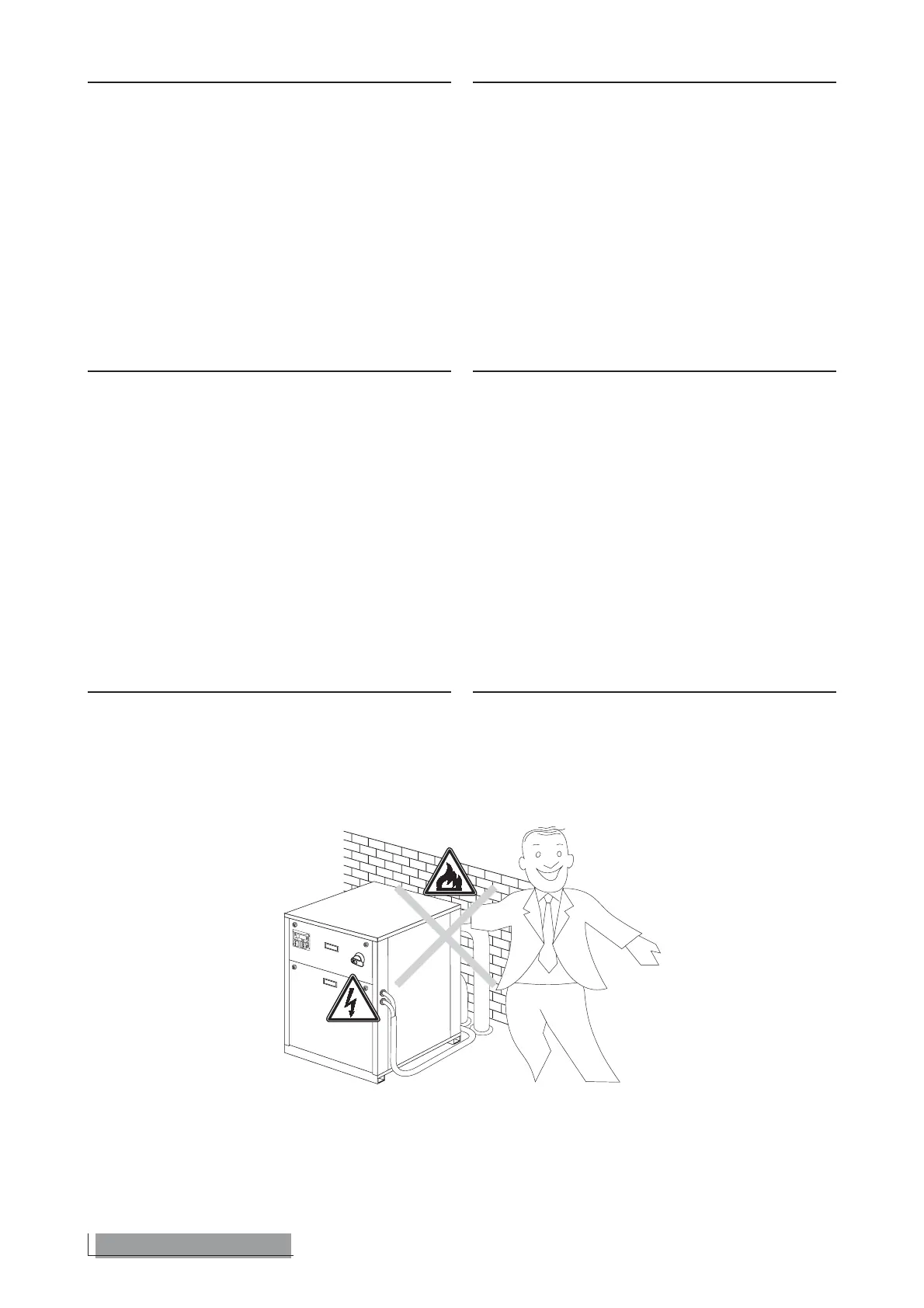
NON appoggiarsi alle tubazioni: possibili superfici ad alta temperatura.
NON appoggiarsi alle connessioni elettriche.
NEVER lean on the pipes: they could be hot.
NEVER lean on the wiring connections.
Aermec s.p.a.


 To Next Page