10 21.01 5723611_01
2 GENERAL DESCRIPTION
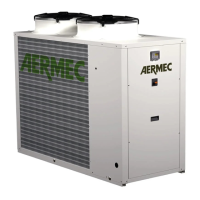
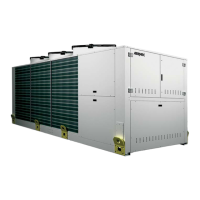
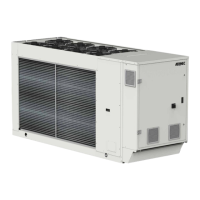
This unit, which may only be installed outdoors, is designed and built for the air
conditioning of industrial buildings and/or processes, through the use of water or
a mixture of water and glycol within the limits that will be indicated further on in
this manual.
Use refrigerant uid R32, whose classication according to ISO 817 is
A2L (non-toxic, odourless and slightly ammable refrigerant).
Refrigerant is considered slightly ammable if all the following condi-
tions apply:
— In the presence of an ignition source, it demonstrates ame propagation (test
performed at atmospheric pressure and t = 60°C);
— The lower ammability limit LFL is greater than 3.5% by volume;
— The heat of combustion is lower than 19,000 kJ/kg;
— the ame propagation speed is lower than 0.1 m/s.
HAZARD The refrigerant R32 has a density higher than air in the ref-
erence conditions: therefore, if dispersed in the environment in an area
that is not correctly ventilated, it could lead to the generation of potentially
explosive atmospheres.
In order to correctly install the unit, observe all the instructions provid-
ed in this manual, all the laws and regulations in force (EN 378, national
and local standards) and in any case an additional risk analysis must be
carried out by the system designer.
This chapter describes and gives explanations to the additional residual risks origi-
nating from the refrigerating systems when using refrigerant.
— The end user has to make a risk assessment for the plant where the refrigeration
system operate, considering the hazardous zones and the ammability risk due
to refrigerant leakages;
— The following information may in no way replace the risk assessment for the
refrigeration system at the installation site;
— The end user (the Operator or plant manager/owner) bears the responsibility
at the installation site;
— The following standards and regulations are mandatory for the transport/stor-
age/installation/operation/maintenance and disposal of the refrigerant system:
EU Directives, national and local laws, regulations and standards concern-
ing safety (such as EN378), general safety standards;
— Avoid the presence of ignition sources during the entire service life of the refrig-
erant system (transport/storage/installation/operation/maintenance);
— Refers to international standard and regulation to evalute ignition sources (e.g.
EN1127-1) according to the refrigerant ammability characteristics.
GENERAL SAFETY RECOMMENDATION
Take the risks, measures, advice and recommendations indicated on the refrigerant
safety data sheet into account.
During the whole life of the refrigerating system (trasportation/storage/installa-
tion/operation/mantainance):
— Provide adequate ventilation;
— Don't place or storage the refrigerating system in conned spaces;
— Avoid traps where gases may fall and stagnate;
— Avoid open ames and ignition sources near the refrigerant system;
HAZARD the refrigerant system could accidentally release potentially
ammable refrigerant gas mixed with air:
avoid open ames or sources of ignition near the refrigerant system.
RISK of re in the presence of a source of ignition:
— The ames could cause the emission of hydrogen uoride;
— Hazardous decomposition products could be released (products of pyrolysis
containing uoride, hydrogen uoride). See the safety data sheet.
WARNING If the refrigerant is presumably burnt:
— Contact the experts and wait for specic instructions before using the refriger-
ant system;
— The system may only be manipulated by expert, authorised personnel. Do not
open the electrical box of the compressor boxes.
— Wait until the toxic combustion products have been completely degraded.
WARNING do not inhale: the evaporation products or the smoke from
res.
INSTALLATION REQUIREMENTS
This unit must be installed outdoors: (installation according to class III,
EN 378-1; 2016). As this unit is intended only for installation outdoors and
in an area with authorised access only, there are no refrigerant charge lim-
its according to EN378 Table C.2.
In particular, the unit is intended to be connected:
— to a hydronic system that must be designed to be classied according to EN
378-1 as an indirect ventilated system (ref EN 378-1; 2016, par. 5.5.2.2 ), as an
indirect vented closed system (ref EN 378-1;2016, par. 5.5.2.3 ), or as a double
indirect system according to EN 378-1 (ref. EN 378-1; 2016, par. 5.5.2.4 ).
— The intermediate uid (water or water-glycol mixture) is in direct communica-
tion with the occupied space and a refrigerant leak in the intermediate circuit
must be dissipated to the atmosphere outside the occupied space and in an
area that is suitably ventilated to prevent the generation of explosive atmos-
pheres.
— In particular, for a closed system this condition requires installing a properly
sized mechanical device in a suitable position of the hydronic circuit for the col-
lection and draining of the refrigerant. If drain and/or safety valves are installed
in the unit, they do not in any way replace this device.
— The automatic air drain must be installed in all the highest points of the hydrau-
lic circuit, outside the building and far from sources of ignition. In order to gua-
rantee that ammable refrigerant will not ow into the environment in the case
of leaks, it is recommended to install it with a primary and secondary circuit.
— The are occupied by the unit and in its immediate vicinity must be made acces-
sible only by authorised personnel, also installing a fence if necessary;
— Provide adequate ventilation;
— Do not position or store the refrigerant system in narrow spaces or places where
they may be hatches, ducts, basement window or near openings towards the
building or its environments;
— Avoid traps where gases may fall and stagnate;
— Avoid open re and ignition sources near the refrigerating system;
ADDITIONAL INFORMATION ABOUT THE REFRIGERANT
— A risk assessment must be carried out for the refrigerant system at the site of
installation, considering the ammability of the refrigerant at the site of instal-
lation and avoiding the presence of sources of ignition;
— The unit has openings in the compressor compartment to avoid the accumula-
tion of refrigerant inside in the case of a fault.
LEAK DETECTORS
— The refrigerant system has leak detectors located inside the compressor com-
partment.
WARNING: do not change the position of the leak detectors.
— The leak detectors installed inside the refrigerant system must not be taken into
consideration for compliance with the safety standards and local laws applica-
ble at the installation sites. In fact, this is not the intended use of these devices.
These devices detect leaks in the various parts of the refrigerant system. No as-
sessment can be carried out regarding system safety. The leak detectors inside
the refrigerant system must not be considered a system that is sucient for
monitoring the system and the hazardous installation areas.
— The leak detectors must be periodically checked and calibrated. For mainte-
nance and the calibration procedure refer to the leak detector user manual and
the calibration certicate, the periodic controls
— Aermec is not responsible of the refrigerating system safety if the periodical
mantainance, calibration and substitution of the leak detectors is not done cor-
rectly and according to leak detector operation manual;
— On powering up, the leak detector will sense for the presence of gas after an
initial warm-up delay and after a sensor stabilitazion period (see leak detector
operation manual).
PRESSURE SWITCHES
— The refrigerating system is equipped with pressure switches for protection
against insucient and excessive pressure, as reported in the refrigeration cir-
cuit scheme;


 To Next Page