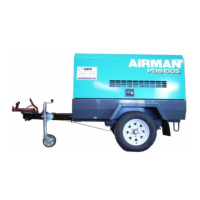
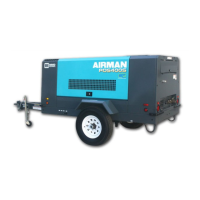
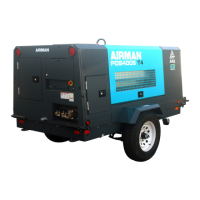
This document is an instruction manual for the AIRMAN PDS185S-5C2 Screw Compressor.
Function Description
The AIRMAN PDS185S-5C2 is a portable screw compressor designed for various industrial applications. It operates by compressing air using a screw mechanism, providing a continuous supply of compressed air. The unit is equipped with an instrument panel for monitoring various operational parameters, including discharge pressure, fuel level, hour meter, digital monitor indicators for temperature and suction pressure, and indicator lamps for glow, auto idle, emergency stop, warning, and charge. The compressor is designed for ease of operation and maintenance, with clear instructions for starting, stopping, and managing different operational modes like "AUTO IDLE" for fuel efficiency.
Important Technical Specifications
The PDS185S-5C2 model features a single-stage oil-cooled, screw-type compressor.
- Free air delivery: 175 cfm (5 m³/min)
- Working pressure: 100 psi (6.9 bar)
- Lubricating system: Forced lubrication by compressed pressure
- Driving system: Direct driving with gear coupling
- Receiver tank capacity: 1.27 cu in. (0.020 m³)
- Lubricating oil capacity: 3.96 gal. (15 L)
- Model (Engine): YANMAR 4TNV88-BDHK
- Type (Engine): Water-cooled 4-cycle direct injection type
- Number of cylinders, bore x stroke: 3-3.46 in. x 3.54 in. (4-88 mm x 90 mm)
- Total displacement: 133.6 cu in. (2.190 L)
- Rated output: 36.4 kW (3,000 min⁻¹) / 34.5 kW (3,000 min⁻¹)
- Lubricating oil capacity (Engine): 2.0 gal. (7.4 L)
- Coolant capacity (including radiator): 1.6 gal. (6.0 L)
- Battery: 80D26R (12V) equivalent
- Fuel tank capacity: 25 gal. (95 L)
- Overall length: 78.7 in. (2,000 mm)
- Overall width: 33.0 in. (838 mm)
- Overall height (Bonnet only): 43.5 in. (1,150 mm)
- Overall height: 50.1 in. (1,273 mm)
- Net dry mass: 1,687 lb (765 kg)
- Operating mass: 1,929 lb (875 kg)
Usage Features
The compressor is designed for safe and efficient operation.
- Starting and Stopping: The unit is started by turning a starter switch to "RUN" and then to "GLOW" for preheating, followed by turning the starter switch to "START." Stopping involves turning the starter switch to "STOP" and removing the key.
- Digital Monitor: The digital monitor displays various parameters such as discharge air temperature, engine water temperature, discharge pressure, and suction pressure. Users can select which item to display using a selector switch.
- AUTO IDLE Mode: This mode is designed to reduce fuel consumption. When activated, the engine speed is reduced, and the unloader valve gradually closes, decreasing air consumption. The compressor automatically switches to "AUTO IDLE" when air consumption is reduced and returns to normal operation when more air is needed.
- Cold Weather Operation: Specific procedures are outlined for starting the unit in cold weather (below 23°F or -5°C), including using SAE10W-30 (CD class) engine oil and LLC (antifreeze) for coolant.
- Safety Precautions: The manual emphasizes numerous safety warnings, including avoiding compressed air for human respiration, proper handling of batteries, cautions regarding hot parts, and the use of personal protective equipment. It also details fire prevention measures and safe handling of fuel and waste liquids.
Maintenance Features
Regular maintenance is crucial for the longevity and safe operation of the PDS185S-5C2.
- Periodic Inspection and Maintenance: A detailed schedule is provided for daily, every 50 hours, 250 hours, 500 hours, 1,000 hours, 2,000 hours, and 3,000 hours/every 2-3 years maintenance tasks.
- Engine Oil: Check engine oil level daily and change every 50 hours (first time) and every 250 hours thereafter. Recommended oil is SAE10W-30.
- Compressor Oil: Check compressor oil level daily and change every 50 hours (first time) and every 500 hours thereafter.
- Coolant: Check coolant level daily and change every 1,000 hours or every 2 years. LLC (Antifreeze) is recommended, with specific mixing ratios depending on ambient temperature.
- Filters:
- Engine oil filter: Change every 250 hours.
- Air filter element (compressor side and engine side): Clean every 250 hours and change every 500 hours.
- Fuel filter: Change every 500 hours.
- Strainer in the scavenging orifice: Clean every 500 hours.
- Element in sedimenter: Clean every 500 hours.
- Battery: Check battery electrolyte every 250 hours.
- Belts: Adjust belt tension every 50 hours.
- Hoses: Check hoses for cracks or tears every 3,000 hours or every 3 years.
- Pressure Regulator and Valves: Inspect and replace components like the diaphragm of the speed regulator, auto-relief valve, vacuum relief valve, and pressure control valve O-rings and pistons at specified intervals (e.g., 1,000 hours or every 3 years).
- Storage: Instructions are provided for long-term storage, including draining lubricants, removing the battery, and protecting openings from dust and moisture.
- Troubleshooting: A comprehensive troubleshooting guide lists common symptoms, causes, and counter-measures for various operational issues, including starter revolution speed, engine not reaching maximum speed, and indicator lamp malfunctions.

 Need help?
 General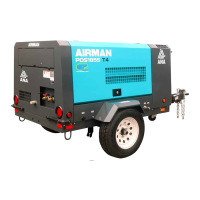

 To Next Page