Need help?
Do you have a question about the AirSep SeQual Workhorse Series and is the answer not in the manual?
Overview of the Workhorse Oxygen Concentrator's operation, components, and typical applications.
Safety precautions regarding oxygen as an oxidizer, ignition sources, cleanliness, ventilation, and environmental conditions.
Lists US patents protecting the Workhorse Oxygen Concentrator and mentions pending patents.
Instructions for installing the wall bracket and connecting the oxygen outlet fitting to the unit.
Instructions for installing the compressor inlet filter if it was removed for shipping damage prevention.
Steps to start the Workhorse Oxygen Concentrator, including power connection, switch, LED indicators, and flow settings.
Information on changing the Compressor Inlet Filter and compressor rebuild intervals based on operating hours.
Explains pressure gauges, normal operation ranges, and troubleshooting steps for low pressure/concentration issues.
Detailed technical specifications of the Workhorse-8, including performance, dimensions, power requirements, and environmental conditions.
Provides a mechanical outline drawing (front and side views) of the Workhorse-8 unit for reference.
Lists available service parts for the Workhorse-8, including part numbers and quantities.
Details specifications for replacement tubing, including size, construction, pressure, and temperature ratings.
Contact information for AirSep Technical Support for assistance with troubleshooting, repairs, and parts orders.
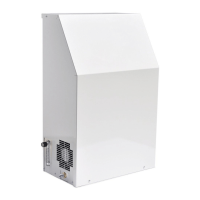
The SeQual® Workhorse-8 is a Pressure Swing Adsorption (PSA) Oxygen Concentrator System designed to deliver oxygen at concentrations greater than 90%. Its primary function is to produce oxygen using synthetic zeolite molecular sieve technology, making it suitable for applications such as aquaculture and ozone generation for water treatment. The system is capable of delivering oxygen flows up to 8 standard cubic feet per hour (SCFH) or 3.8 liters per minute (LPM).
All performance ratings are based on an ambient temperature up to 100°F (38°C), up to 1,000 feet elevation, and 80% relative humidity.
The Workhorse-8 is designed for indoor operation or within an enclosure in a non-condensing environment, as it is not weather-proof. It requires a well-ventilated area to prevent the accumulation of low oxygen concentration waste gas, especially if the space is occupied.
Installation involves mounting a supplied wall bracket on a sturdy vertical surface. The unit's backplate has large through holes for alignment with the bracket's hanger screws. It is crucial to ensure sufficient access space around the unit for maintenance and service, as well as a free flow of cooling air. The unit must be connected to a grounded power source matching the voltage and current requirements specified on its label.
Before operation, all internal packaging materials must be removed to prevent severe damage. The oxygen outlet connection is a 1/8" female National Standard Pipe Thread (NPT) located on the front of the unit. Care must be taken to prevent rotation of the bulkhead fitting during connection.
To start the unit, connect it to power and push the toggle switch on the front panel to the "up" position. A green LED will indicate power, and a red LED will initially indicate low oxygen concentration. As oxygen concentration reaches 70%, the red LED will turn off, and a yellow LED will light. When concentration exceeds 85%, the yellow LED will also turn off. The system includes an optional oxygen monitor with visual LED alarms and two alarm outputs (Form A one amp dry contacts) on a nine-pin D-sub connector. These contacts are normally open and close during an alarm condition. For example, if oxygen concentration falls below 85%, the yellow LED lights, and pins 4 and 5 close. If it falls below 70%, the yellow LED turns off, and the red LED lights, closing pins 2 and 3. Pins 1 and 6 can be used with a digital voltmeter to measure concentration, with 0-1 volt output corresponding to 0-100% concentration.
The flow meter on the Workhorse Concentrator is calibrated for atmospheric discharge pressure. If the actual discharge pressure is significantly higher, an adjustment formula is provided to determine the precise flow rate: (adjusted flow) = (measured flow) x √(oxygen pressure + 14.7) / 14.7. It is important not to allow the oxygen product to vent freely and not to exceed the rated capacity.
Regular maintenance is essential for optimal performance. The Compressor Inlet Filter should be changed approximately every 4,000 hours of operation, though frequency may vary depending on environmental conditions. Compressors typically require a rebuild after 5,000 to 12,000 hours of operation, also dependent on environmental conditions. Filters and compressor rebuild kits can be obtained from AirSep.
Troubleshooting guidance is provided for common issues. If pressures and concentration are low, checks should include the intake filter, potential leaks (using Snoop on pressurized fittings, but not intake fittings), and the need for a compressor rebuild. If pressures are high and concentration is low, checks include verifying the ATF motor rotation and speed (typically 2-4 RPM), and checking for water or oil contamination in the ATF. An audibly actuating pressure relief valve may indicate high pressures or a drifted valve requiring replacement. Fluctuating pressures (more than 2 psig around the median) could suggest an internal rupture or a previous motor stoppage. Fluctuations on the air input (more than 3 psig) might indicate compromised flow-controlling orifices. Contaminated beds, possibly due to electrical discontinuity or valve stoppage, can also cause pressure fluctuations. For accurate oxygen concentration measurement, handheld devices like the MiniOx or Salter Labs PrO2 Check Elite are recommended.
Replacement tubing specifications are provided, including 1/2" x 7/8" reinforced silicone (Max. Working Pressure: 141 psig, Temperature Range: -40 to 175°F) and 1/4" x 1/2" PVC (Max. Working Pressure: 70 psig, Temperature Range: -40 to 175°F). Service parts, including ATF modules, compressors, rebuild kits, cylinder walls, filters, pressure relief valves, vibration mounts, and oxygen monitors, are listed with their respective part numbers and quantities. Technical support is available via phone, fax, and email for assistance with troubleshooting, repairs, and ordering parts.
 General
| Brand | AirSep |
|---|---|
| Model | SeQual Workhorse Series |
| Category | Oxygen Equipment |
| Language | English |

 To Next Page