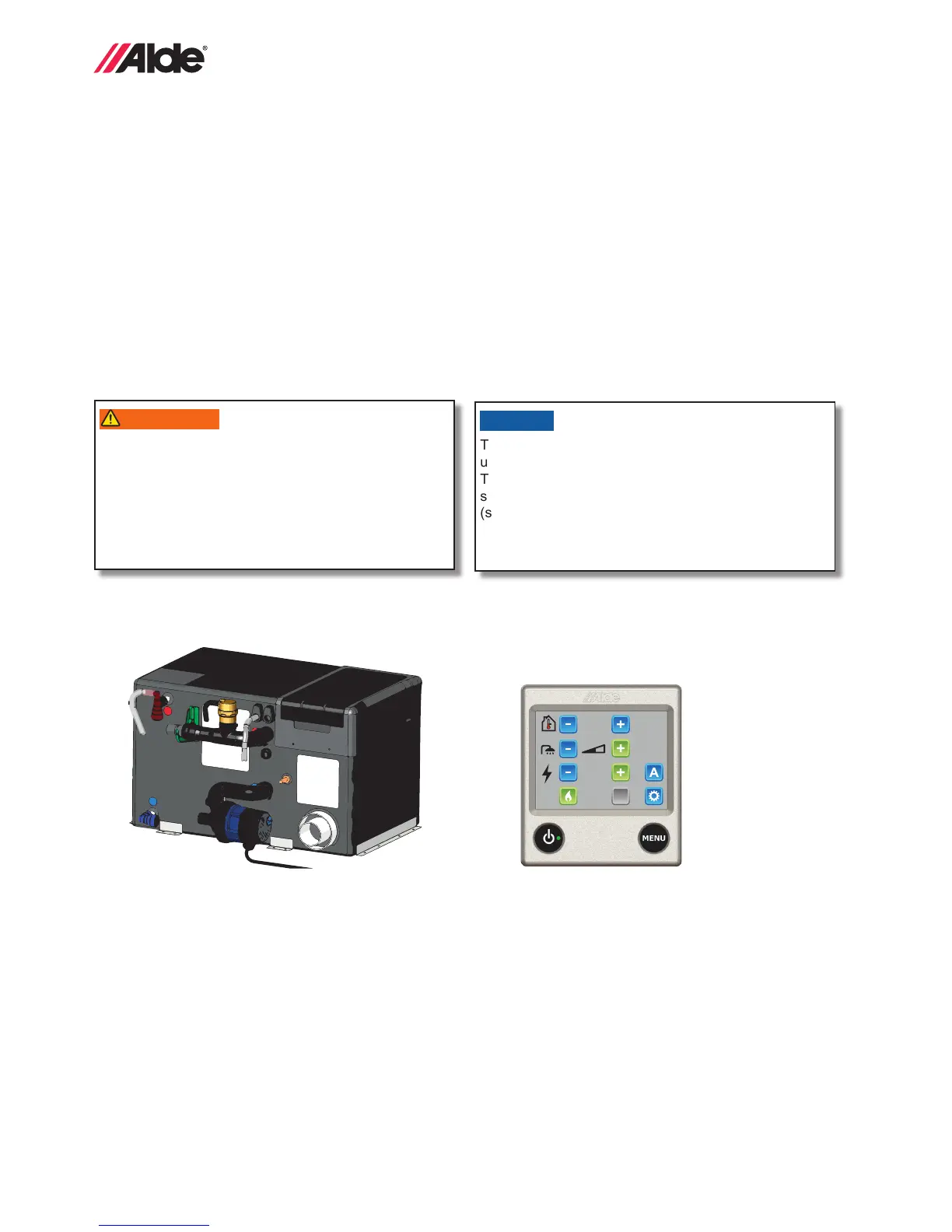
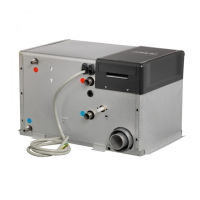
Figure 2. Alde Compact 3020 HE boiler Figure 3. Alde control panel 3020 113
The Compact 3020 heating system is designed to be
used with a thermostat control.
This manual includes instructions for controlling the
system using the Alde control panel 3020 113
(see Figure 3).
WARNING
VARNING
AVERTISSEMENT
WARNUNG
ADVARSEL
VAROITUS
ADVERTENCIA
AVVERTENZA
WAARSCHUWING
HOT WATER HAZARD
Hot water at temperatures above 49 ºC can cause seri-
ous scalding injuries and in extreme cases even death.
The heating system can deliver hot water at tempera-
tures up to 85°C.
– For safe operation, use a mixing valve set at
a temperature no higher than 48 °C.
1:3 DESCRIPTION OF THE HEATING SYSTEM
The Alde Compact 3020 HE boiler (Figure 2). is designed to provide both heat and hot water.
The heating system includes both an LPG burner and electric heating elements and you can use the system with
either LPG, electricity or both.
The heating system consists of the boiler unit as well as an expansion tank, which is installed at the highest point in
the vehicle. Check with your vehivles’s manual to determine where the expansion tank is installed. The heating system
works by circulating hot glycol uid through pipes and heat convector’s, similar to the heating system used in many
homes.
The heating system is tted with a 12-volt electrical circulation pump that is used to circulate the heated uid. The heat
convector’s located near the oor of the vehicle allow air to be heated by the hot uid in the system and then the air
rises and circulates to heat the space in your vehicle. The heating system is also tted with a built-in hot water boiler
that has a volume of approx. 8.4 liters of fresh water.
The LPG boiler in the heating system can produce around 12 liters of 40 °C water every half-hour. If the electric hea-
ting elements are used instead of gas for powering the heating system, the capacity is slightly less. You may use the
heating system to heat the vehicle without lling the hot water boiler.
The control system allows you to select LPG, electricity or both as the energy source.
1 kW
+22°C
ACC
WARNING
VARNING
AVERTISSEMENT
WARNUNG
ADVARSEL
VAROITUS
ADVERTENCIA
AVVERTENZA
WAARSCHUWING
BURN HAZARD
The exhaust temperatures from the LPG burner can be
up to 200 °C.
– Keep clear of the wall ue when in LPG operation.
WARNING
VARNING
AVERTISSEMENT
WARNUNG
ADVARSEL
VAROITUS
ADVERTENCIA
AVVERTENZA
WAARSCHUWING
FIRE/EXPLOSION HAZARD
The exhaust temperatures from the LPG burner can be
up to 200 °C.
– Do not place combustible materials and liquids
close to the ue.
1:4 HEATING WITH LPG
• ABOUT LPG
LPG is a petroleum product, formally known as “liquid petroleum gas.” It consists primarily of propane and butane gas.
The advantage of propane is that it remains gaseous at temperatures as low as -40 °C.
For this reason, propane is used in colder climates.
LPG cylinders contain LPG in both liquid and gaseous forms. When the cylinders are lled, the pressure turns the gas
into liquid. When the gas cylinder valve is opened, the liquid becomes a gas again.
WARNING
VARNING
AVERTISSEMENT
WARNUNG
ADVARSEL
VAROITUS
ADVERTENCIA
AVVERTENZA
WAARSCHUWING
FIRE/EXPLOSION HAZARD
The risk involved in using LPG is that any leaking gas
can ignite and explode. Since LPG is heavier than air,
leaking gas will collect at the lowest point in the area
where the leak occurs. To make it easier to detect gas
leaks, a substance with a distinctly strong smell has
been added to the gas.
– For your safety install a gas alarm according to the
gas alarm manufacturer’s recommendations.
WARNING
VARNING
AVERTISSEMENT
WARNUNG
ADVARSEL
VAROITUS
ADVERTENCIA
AVVERTENZA
WAARSCHUWING
ASPHYXIATION HAZARD
LPG contains no toxic substances, but breathing in
concentrated gas may cause suffocation due to lack of
oxygen. Incomplete combustion of LPG can produce
carbon monoxide (CO) gas, which is a asphyxiation
hazard.
– For your safety, install and use a CO detector.
• USING THE LPG HEATING
Refer to the control panel instructions section “2. Operating instructions for Controlpanel”
When LPG operation is selected on the control panel, the LPG burner in the heating system and the pump for circula-
ting the glycol heating uid start automatically whenever heat is called for by the thermostat.
The LPG burner keeps operating and the pump keeps circulating until the thermostat reaches the set temperature.
Should the LPG burner go out for any reason, a sensor will be activated and the heating system will attempt to auto-
matically restart (in about 10 seconds).
• SNOWY CONDITIONS
WARNING
VARNING
AVERTISSEMENT
WARNUNG
ADVARSEL
VAROITUS
ADVERTENCIA
AVVERTENZA
WAARSCHUWING
ASPHYXIATION HAZARD
To burn properly and safely, the LPG burner in the heating system must have adequate air intake. Inadequate air
intake may cause the build-up of CO gas, which is an asphyxiation hazard. The inlet air to the gas burner enters
through the ue, which is usually installed on the side of the vehicle near the boiler. While camping during the winter,
make sure that the ue is kept clear of snow and ice.
– Do not start the LPG operation on the heating system until the ue is completely free of snow and/or ice.
Tip! A ue extension
(part no. 3000 320) is recommended for the roof ue for camping in winter.


 To Next Page