CAUTION
OBSERVERA
ATTENTION
VOORZICHTIG
The heating system comes installed with glycol heating
uid. If the uid level is to low you must ll the system to
the right level before operating the heating system.
Your warranty may be voided and the heating system
may be damaged if you attempt to start it with little or
no glycol heating uid.
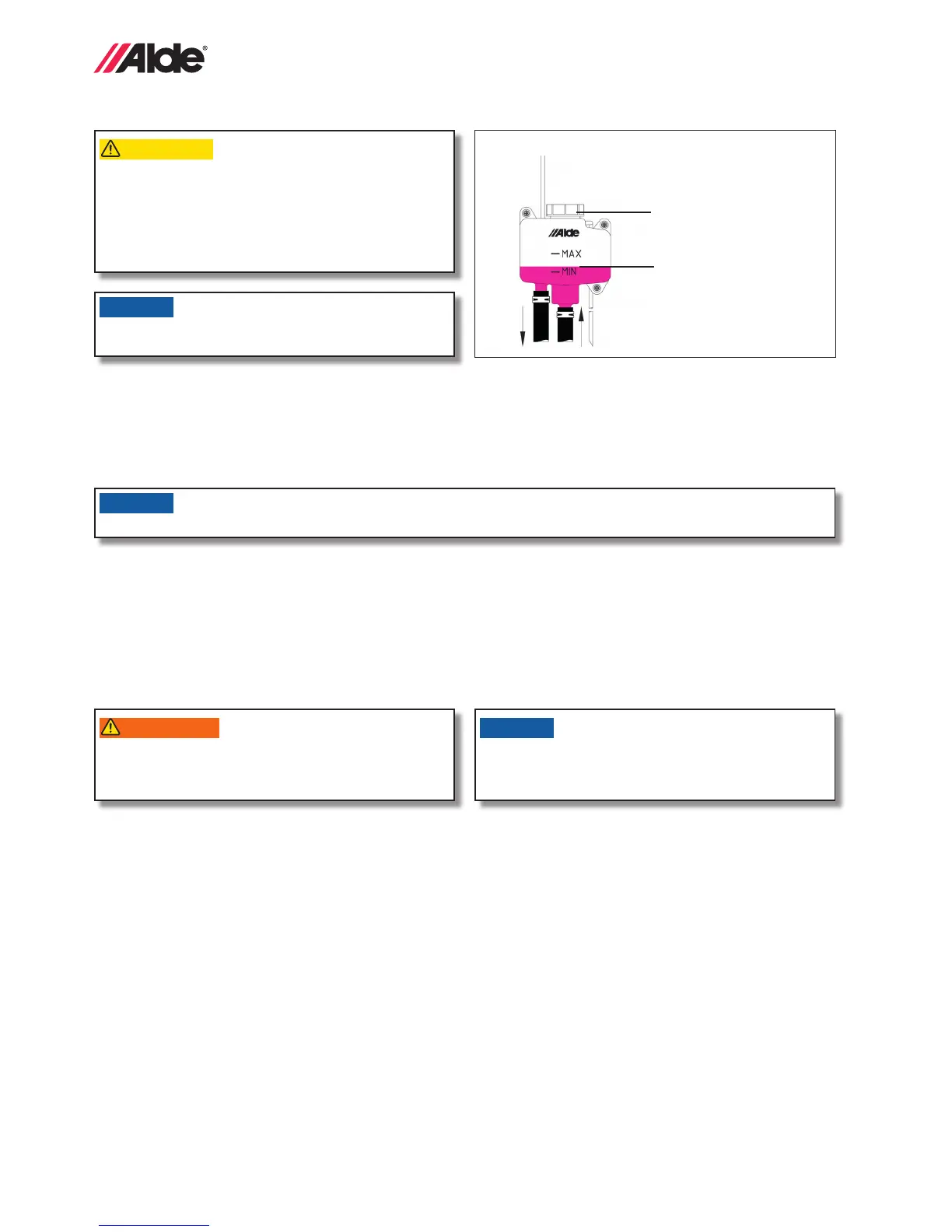
Fluid level in a cold
heating system
Do not mix different types of glycol; this can lead to coagulation
of the glycol uid.
Figure 8. Fluid level of heating system
1:11 GLYCOL HEATING FLUID
The heating system must be lled with a uid mixture consisting of distilled water and ethylene glycol. For best re-
sults, use high-quality ready-mixed ethylene glycol (with inhibitors) intended for use in aluminium heating systems.
The proportions when using concentrated ethylene glycol are 60% distilled water, or water that is free of salts, and
40% ethylene glycol. If the heating system will be exposed to temperatures below -25°C, the ethylene glycol content
has to be increased, however, do not exceed 50%. The ethylene glycol mixture has to be changed every other year,
since properties such as corrosion protection, deteriorate over time. If Alde Premium Antifreeze is used, the interval for
changing the mixture can be extended to max 5 years under normal operating conditions.
The ethylene glycol system is topped up in the expansion tank. Either manually or using Alde’s top-up pump, which
both lls and vents the system. During manual lling, pour the ethylene glycol mixture slowly into the expansion tank.
When the heating system is cold, the level should be approx. 1 cm above the MIN line, see Figure 8. Bleed the sys-
tem. Top up with more uid if the level falls during bleeding. In newly lled heating systems, bleed at regular intervals,
see the section “1:12 lling the heating system with glycol uid”.
The glycol content should be checked at the expansion tank using a pH tester before topping up with new liquid to
help ensure that the concentration of glycol in the mixture is not too high.
If the uid level falls for reasons other than evaporation, please check all joints, drain cocks and bleeder screws for
leakage, including the bleeder located at the end of the convector.
WARNING
VARNING
AVERTISSEMENT
WARNUNG
ADVARSEL
VAROITUS
ADVERTENCIA
AVVERTENZA
WAARSCHUWING
POISONING HAZARD
Be sure to thoroughly clean up any puddles of leaked
glycol. Rinse the area with water and wipe up the ex-
cess to prevent accidental ingestion by children or pets.
The glycol mixture should be changed every second
year to help ensure maximum corrosion inhibitor
effectiveness
1:12 FILLING THE HEATING SYSTEM WITH GLYCOL FLUID
Fill the heating system through the expansion tank, either manually or using the Alde lling pump, which both tops up
and bleeds the system. To purchase a lling pump, contact your Alde dealer. For manual lling, remove the nut
(Figure 8) from the expansion tank. Slowly pour the glycol mixture into the expansion tank , the level should be approx.
1 cm above the MIN line, see Figure 8. Bleed the system. Top up with more uid if the level falls during bleeding. In
newly lled heating systems, bleed at regular intervals.
Omitting to change the uid can result in frost damage, corrosion, bacterial growth and/or overheating.
Nut
Never open the bleeder screws while the pump is
running, because this will induce air into the system.
Figure 9. Automatic Air bleeder
Be sure that the heating system has been thoroughly
bled. If this is not the case, there may be a risk of over-
heating.
Never use full electric or gas capacity before the sys-
tem has been thoroughly bled. There may be a risk of
overheating.
WARNING
VARNING
AVERTISSEMENT
WARNUNG
ADVARSEL
VAROITUS
ADVERTENCIA
AVVERTENZA
WAARSCHUWING
SCALDING HAZARD
Remember, the glycol heating uid may be hot.
1:13 BLEEDING THE SYSTEM
Depending on how the pipes have been tted, air pockets may form when the system is lled with ethylene glycol uid.
If the pipes only warm up a metre or so from the boiler, even though the circulation pump is operating, this is a symp-
tom of air trapped in the system.
In newly lled heating system, small air bubbles can form in the expansion tank, creating a gurgling sound. If the circu-
lation pump is stopped for a few seconds, the bubbles will usually disappear; however, if the problem persists, bleed
the heating system to remedy the problem.
Bleed as follows:
1. The boiler has to be switched off.
2. If a bleed screw is tted to the outgoing pipe of the boiler, open this bleed screw and leave it open until uid starts
coming out. Then, go to point 4.
3. If the boiler is equipped with an automatic air vent, bleeding the boiler takes place automatically. Start the boiler
and circulate the uid in the system until it is vented, top-up with uid, if needed, according to point 5. If this
doesn’t help, switch off the boiler and go to point 4.
4. Open the other bleed screws in the system, one by one. Leave the bleed screws open until ethylene glycol uid
starts coming out of them, and then close them.
5. Check the uid level. Top-up if the level has fallen during venting, the uid level in the expansion tank has to be
approx. 1 cm above the min line in a cold heating system.
6. Start the boiler and let it run for a while. Feel if the pipes and radiators are heating up around the vehicle.
If this does not help, use an Alde lling pump.
• PERSISTENT AIR LOCK
If air lock persists, try the following:
Single-axle trailers:
1. Stop the circulation pump.
2. Lower the front of the trailer as far as possible. Leave it in this position for a few minutes to allow the air to travel
upward in the heating system.
3. Open the bleeder screw at the highest point. Leave it open until it discharges glycol uid.
4. Raise the front of the trailer as far as possible and repeat the procedure in this position.
5. Position the trailer horizontally and start the circulation pump.
6. Check that the pipes and convector’s around the vehicle are heating up.
Motor-home or twin-axle trailers:
The easiest way to bleed the heating system is to place the vehicle on a sloping surface or to raise one end of the
vehicle using a jack. Bleed the heating system as described above. Alternatively, the heating system can be bled using
the approved lling pump. To obtain a pump, contact your Alde dealer.


 To Next Page