Editing Effects: Chapter 7
S4 Plus Reference Manual 95
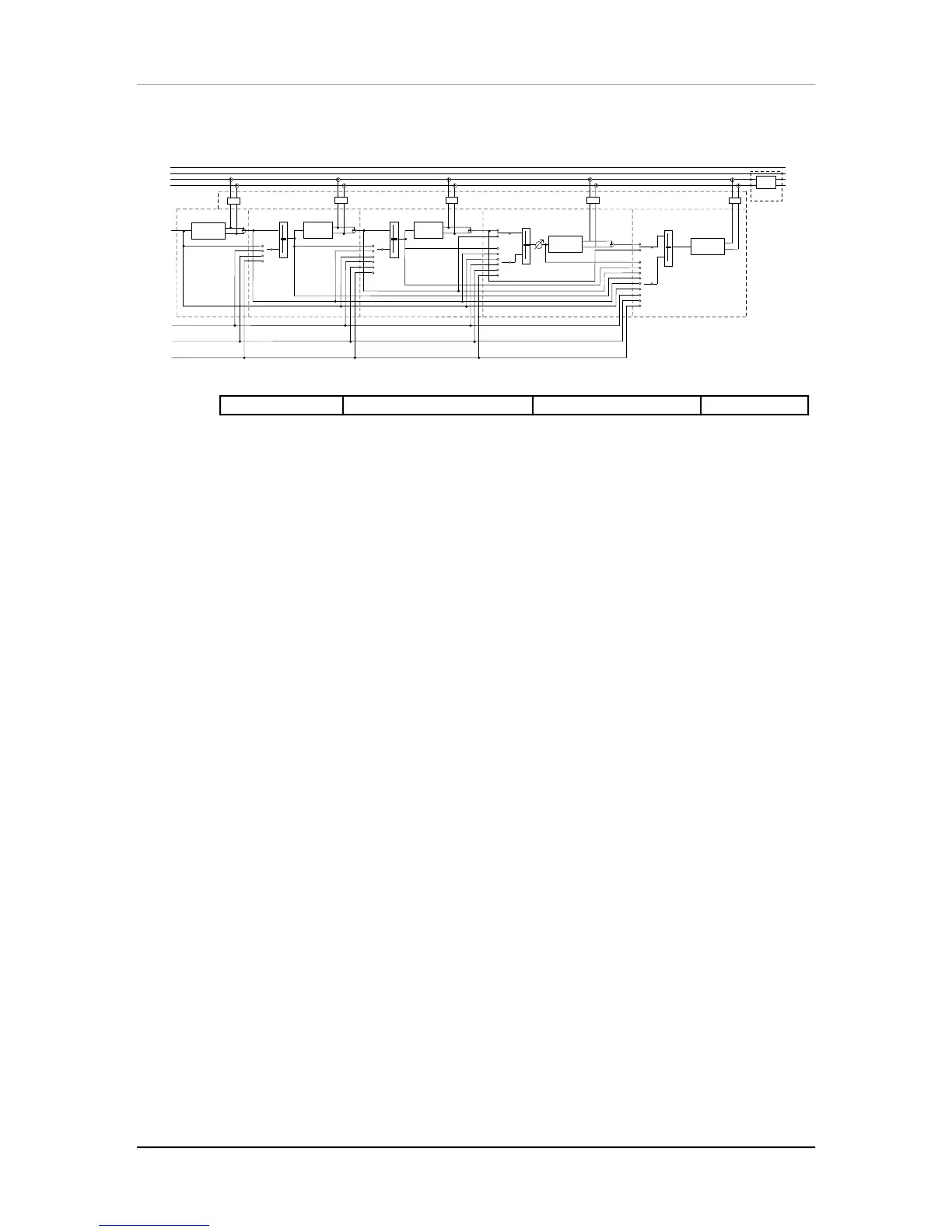
Configuration #5: OD>CHS>DDL>REV>LZ
AUX LEFT
AUX RIGHT
MAIN LEFT
MAIN RIGHT
AUX LEFT
AUX RIGHT
MAIN LEFT
MAIN RIGHT
1
BAL.
FX SEND 1
MISC. 1
1
PITCH 1 REVERB 1
MIX
OVERDRIVE
FX SEND 2
FX SEND 3
FX SEND 4
PITCH 1
BAL.
1
DELAY 1
BAL.
1
2
AMP
REVERB 1
1
BAL.
1
2
LEZLIE
DELAY 1
1
EQ
PITCH 1
MISC. 1
Pitch 1 Delay 1 Reverb 1 Misc. 1
Mono chorus Mono delay Plate 1 Overdrive
Mono flange Stereo delay Plate 2 -------------
Resonator Ping-Pong delay Room EQ
------------------ Hall
Lezlie Large
Gate
Reverse
This is an “all-for-one” Configuration. You get six effects all at once, and they are all
found in the Send 1 section, but other sends may be used to access particular parts
of the chain. Send 1 feeds the Overdrive effect which provides classic distortion. The
Overdrive output then feeds the Pitch effect. The Pitch effect has a second input
which can come from either Sends 1, 2, 3 or 4 . These two inputs can be mixed
together.
The Delay effect has two inputs which can be mixed together. The first input comes
from the Pitch effect’s output. The second input can come from either Sends 1, 2, 3
or 4 , or the Overdrive effect’s output, or Pitch effects input.
The Reverb effect has two inputs which can be mixed together. The first input can
come from the Pitch effect’s output or the Delay effect’s output. The second input can
come from either Sends 1, 2, 3 or 4 , or the Overdrive effect’s output, or the Delay
effect’s input.
The Lezlie effect (found in the Pitch Function, Page 4) has two inputs which can be
mixed together. The first input can come from the Delay effect’s output or the Reverb
effect’s output. The second input can come from either Sends 1, 2, 3 or 4 , or the
Overdrive effect’s output, or the Pitch effect’s input or output, or the Delay effect’s
input, or the Reverb effect’s input.
The outputs of all these effects are routed back to the Main Outputs, and sent
through the shelving EQ effect (found in the Misc. Function, Page 4).


 To Next Page