Chapter 3
Addressing Modes for Your Remote I/O
3-15
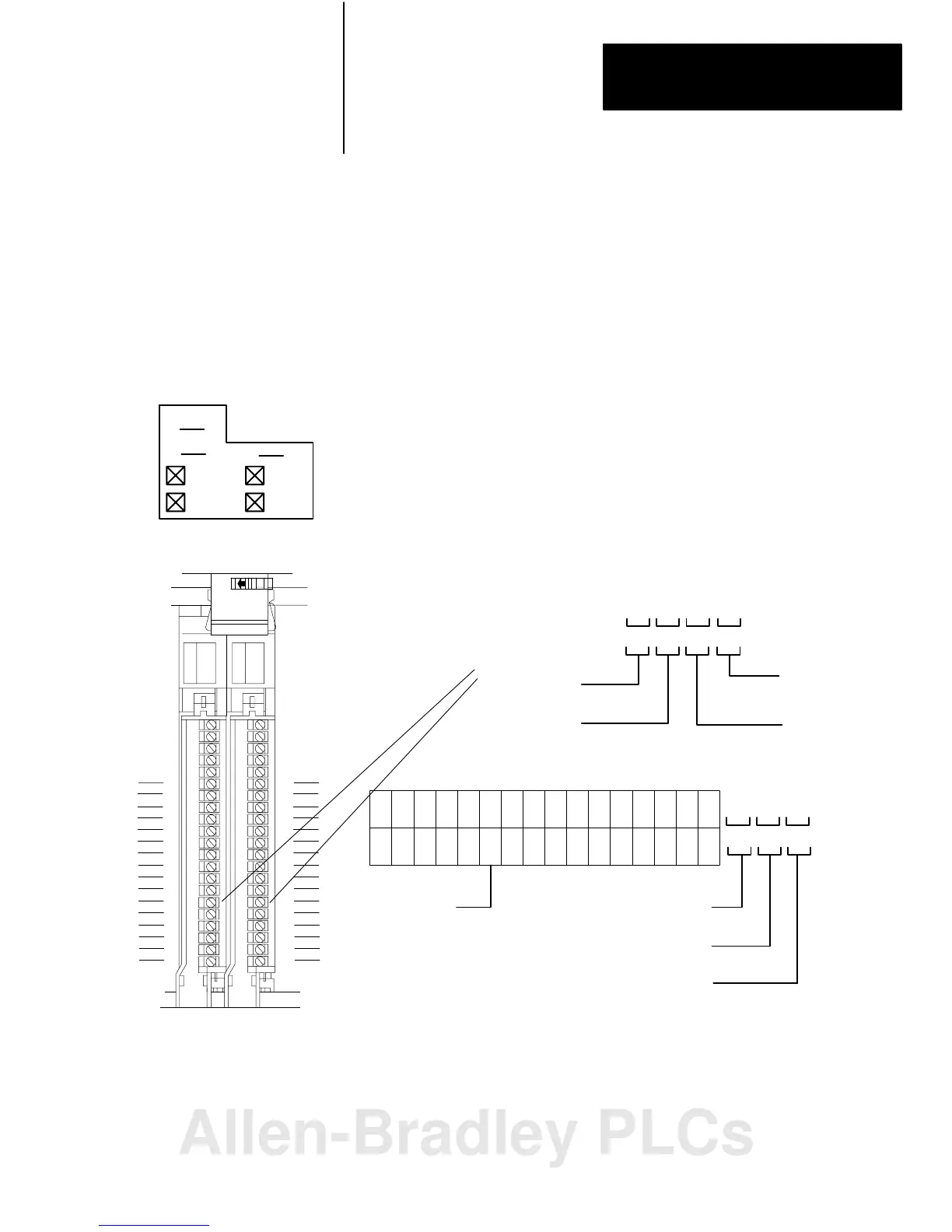
Identifying I/O Groups
You identify your I/O groups in one of three ways, depending on the
addressing method and I/O chassis you use. Refer to Figure 3.13 for 1-slot
addressing when using series B I/O chassis.
Figure 3.13
Identifying
1slot I/O Groups with Series B I/O Chassis
Type of I/O module
1 = Input
0 = Output
I/O Rack Number
Physical Address
Module
Terminal
Number
I/O Group
Number
17 16 15 14 12
10
07
06
05 03
02 01 00
04
11
13
Input image table word corresponding
to the I/O group.
11 112
Module
Terminal
Number
Type of I/O module
1 = Input
0 = Output
I/O Rack Number
11 1
I/O Group
Number
Example: Using I/O Group 0 and 16point modules, a sample
physical address (with its corresponding data table address) is:
00
01
02
03
04
05
06
07
10
11
12
13
14
15
16
17
00
01
02
03
04
05
06
07
10
11
12
13
14
15
16
17
Input
Terminals
2-slot I/O Group
R
G
G
0007
1017
0007
1017
1
1
0
Rules
for module terminal point assignments are:
Standard density discrete I/O module in the left slot
has terminals numbered 0007. (Mark top only.)
High density (16point) discrete I/O module in either slot
has terminals numbered 0007 and 1017.
17 16 15 14 12
10
07
06
05 03
02 01 00
04
11
13
11 0
11 012
Input
Terminals
I/O
Group 0
I/O Group 1
I/O Group 0
I/O Group 1
I/O Rack Number
I/O Group
Number
10810I
Allen-Bradley PLCs



 To Next Page
 Loading...