507404-02 Page 33 of 80Issue 1448
DIRECT VENT APPLICATION
USING EXISTING CHIMNEY
NOTE: Do not discharge exhaust gases directly into any chimney or
vent stack. If vertical discharge through an existing unused chimney
or stack is required, insert piping inside chimney until the pipe open
end is above top of chimney and terminates as illustrated. In any
exterior portion of chimney, the exhaust vent must be insulated.
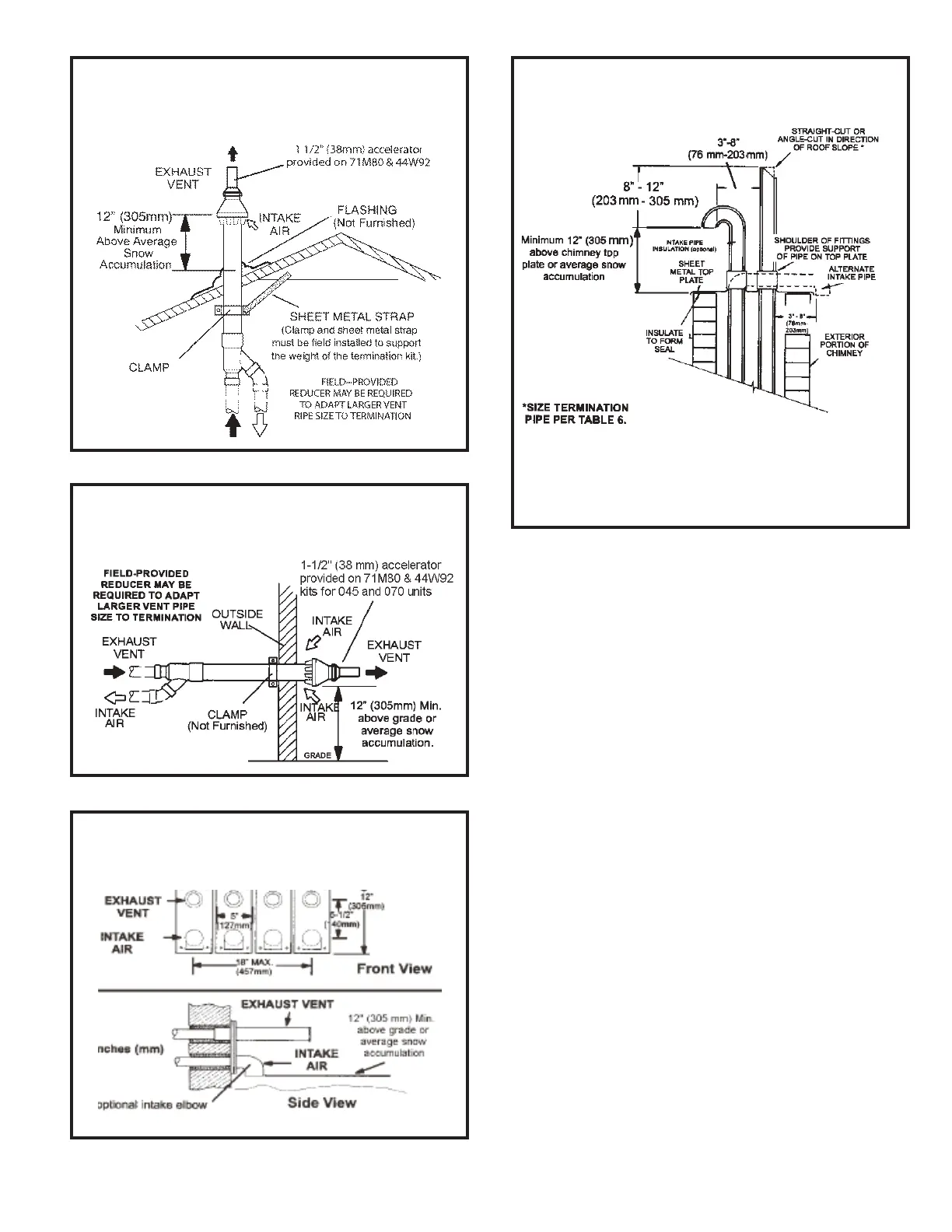
Figure 44
Figure 41
Figure 43
OPTIONAL VENT TERMINATION FOR MULTIPLE
UNIT INSTALLATION OF DIRECT
VENT WALL TERMINATION
DIRECT VENT CONCENTRIC WALL TERMINATION
71M80, 69M29 OR 60L46 (US)
41W92 or 41W93 (Canada)
Figure 42
DIRECT VENT CONCENTRIC ROOFTOP
TERMINATION
71M80, 69M29 or 60L46 (US)
41W92 or 41W93 (Canada)
Details of Exhaust Piping Terminations for Non-Direct
Vent Applications
Exhaust pipes may be routed either horizontally through
an outside wall or vertically through the roof. In attic or
closet installations, vertical termination through the roof is
preferred. Figures 45 through 48 show typical terminations.
1. Exhaust piping must terminate straight out or up as
shown. The termination pipe must be sized as listed
in Table 7. The specied pipe size ensures proper
velocity required to move the exhaust gases away from
the building.
2. On eld supplied terminations for side wall exit, exhaust
piping may extend a maximum of 12 inches (305 mm) for
2” PVC and 20” (508 mm) for 3” (76 mm) PVC beyond
the outside wall. See Figure 46.
3. If exhaust piping must be run up a sidewall to position
above snow accumulation or other obstructions, piping
must be supported every 24” (610 mm) as shown in
Figure 47. When exhaust piping must be run up an
outside wall, any reduction in exhaust pipe size must
be done after the nal elbow.


 To Next Page