508433-01Issue 2345Page 30 of 70
Vent Piping Guidelines
NOTE: Allied has approved the use of DuraVent
®
and
Centrotherm manufactured vent pipe and terminations as
an option to PVC. When using the PolyPro
®
by DuraVent
or InnoFlue
®
by Centrotherm venting system the vent
pipe requirements stated in the unit installation instruction
– minimum & maximum vent lengths, termination
clearances, etc. – apply and must be followed. Follow
the instructions provided with PoyPro by DuraVent and
InnoFlue by Centrotherm venting system for assembly
or if requirements are more restrictive. The PolyPro by
Duravent and InnoFlue by Centrotherm venting system
must also follow the uninsulated and unconditioned space
criteria listed in Table 14.
The A97UH2E can be installed as either a Non-Direct
Vent or a Direct Vent gas central furnace.
NOTE: In Non-Direct Vent installations, combustion air is
taken from indoors and ue gases are discharged outdoors.
In Direct Vent installations, combustion air is taken from
outdoors and ue gases are discharged outdoors.
Intake and exhaust pipe sizing -- Size pipe according
to Table 12 and Table 13A through Table 13C. Count all
elbows in side and outside the home. Table 12 lists the
minimum vent pipe lengths permitted. Table 13A through
Table 13C lists the maximum pipe lengths permitted.
Regardless of the diameter of pipe used, the standard roof
and wall terminations described in section Exhaust Piping
Terminations should be used. Exhaust vent termination
pipe is sized to optimize the velocity of the exhaust gas as
it exits the termination. Refer to Table 15.
In some applications which permit the use of several
dierent sizes of vent pipe, a combination vent pipe may
be used. Contact Allied Technical Services Department for
assistance in sizing vent pipe in these applications.
NOTE: The exhaust collar on all models is sized to
accommodate 2” Schedule 40 vent pipe. In horizontal
applications, any transition to exhaust pipe larger than 2”
must be made in vertical runs of the pipe. Therefore a 2”
elbow must be added before the pipe is transitioned to
any size larger than 2”. This elbow must be added to the
elbow count used to determine acceptable vent lengths.
Contact the Application Department for more information
concerning sizing of vent systems which include multiple
pipe sizes.
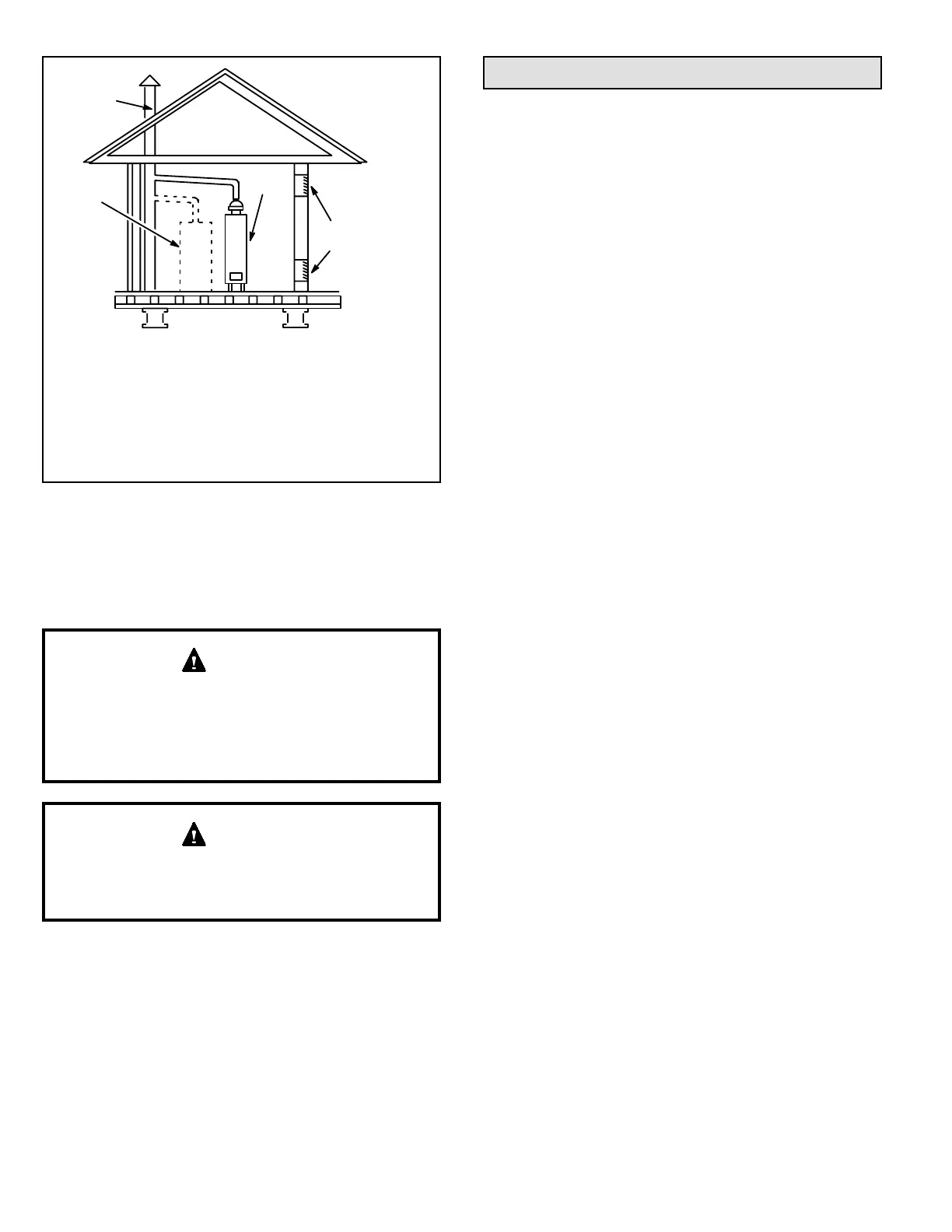
Figure 16.
CHIMNEY
OR GAS
VENT
(Check sizing
for water
heater only)
FURNACE
(Replaced
by EL195)
WATER
HEATER
OPENINGS
(To Adjacent
Room)
If the furnace replaces a furnace which
was commonly vented with another gas appliance,
appliance must be checked. Without the heat of the
original furnace flue products, the existing vent pipe
is probably oversized for the single water heater or
other appliance. The vent should be checked for
proper draw with the remaining appliance.
REPLACING FURNACE THAT
WAS PART OF A COMMON
VENT SYSTEM
the size of the existing vent pip for that gas
Exhaust Piping (Figure 17, Figure 19, Figure 20)
Route piping to outside of structure. Continue with
installation following instructions given in piping termination
section.
Do not discharge exhaust into an existing stack or
stack that also serves another gas appliance. If vertical
discharge through an existing unused stack is required,
insert PVC pipe inside the stack until the end is even
with the top or outlet end of the metal stack.
CAUTION
The exhaust vent pipe operates under positive pressure
and must be completely sealed to prevent leakage of
combustion products into the living space.
CAUTION


 To Next Page