508433-01Issue 2345Page 46 of 70
Condensate Piping
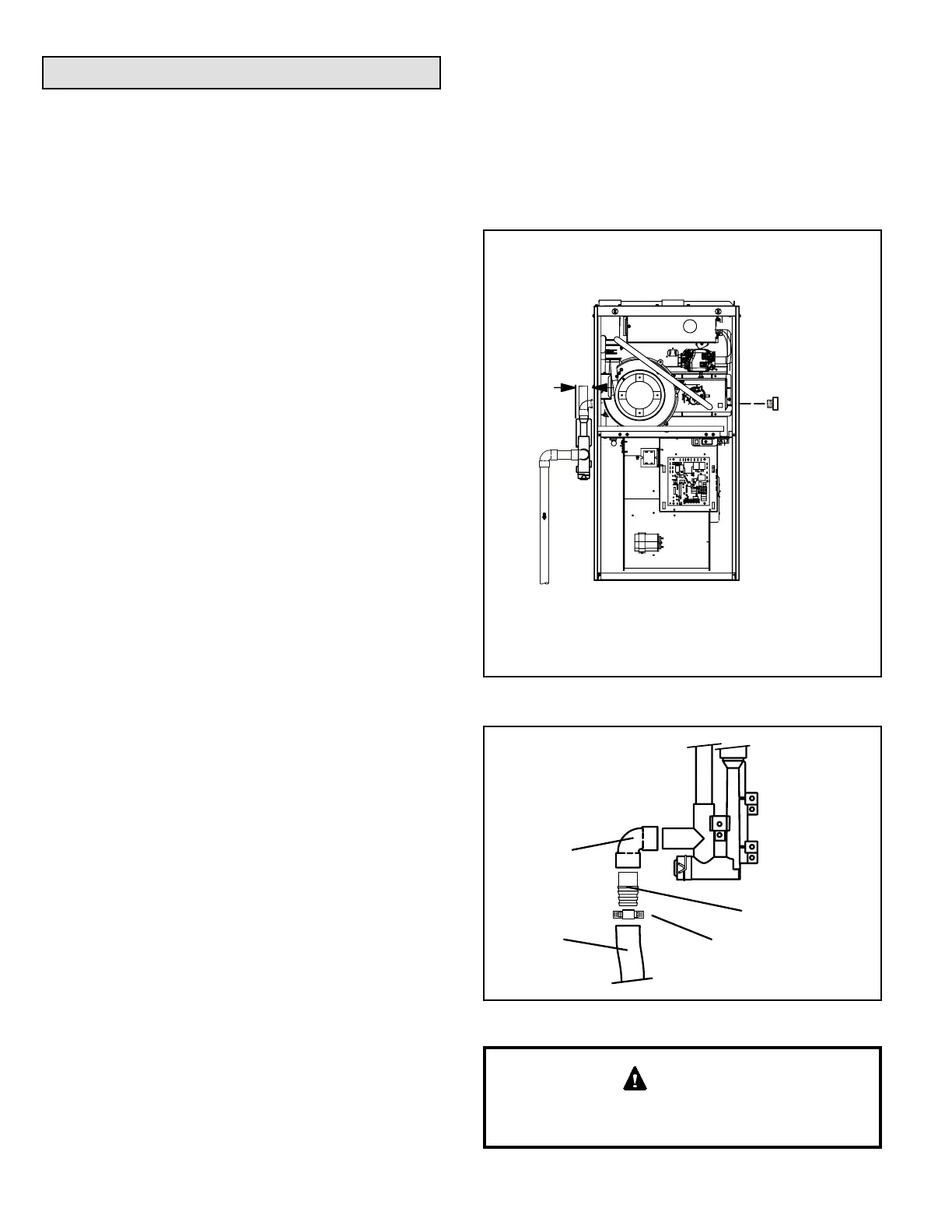
This unit is designed for either right- or left-side exit of
condensate piping in upow applications. In horizontal
applications, the condensate trap must extend below the
unit. An 8” service clearance is required for the condensate
trap. Refer to Figure 41 and Figure 43 for condensate trap
locations. Figure 49 (3/4” drain connection) and Figure
41 (1/2” drain connection) show trap assembly using 1/2”
PVC or 3/4” PVC.
NOTE: If necessary the condensate trap may be installed
up to 5’ away from the furnace. Use PVC pipe to connect
trap to furnace condensate outlet. Piping from furnace
must slope down a minimum of 1/4” per ft. toward trap.
1. Determine which side condensate piping will exit the
unit, location of trap, eld-provided ttings and length
of PVC pipe required to reach available drain.
2. For furnaces with a 1/2” drain connection use a 3/8
allen wrench and remove plug (Figure 41) from the
cold end header box at the appropriate location on the
side of the unit. Install eld-provided 1/2 NPT male
tting into cold end header box. For furnaces with
a 3/4” drain connection use a large at head screw
driver or a 1/2” drive socket extension and remove
plug. Install provided 3/4 NPT street elbow tting into
cold end header box. Use Teon tape or appropriate
pipe dope.
NOTE: Cold end header box drain plugs are factory
installed. Check the unused plug for tightness to
prevent leakage.
3. Install the cap over the clean out opening at the base
of the trap. Secure with clamp. See Figure 49.
4. Install drain trap using appropriate PVC ttings, glue
all joints. Glue the provided drain trap as shown in
Figure 49. Route the condensate line to an open drain.
Condensate line must maintain a 1/4” downward slope
from the furnace to the drain.
5. Figure 44 and Figure 45 show the furnace and
evaporator coil using a separate drain. If necessary
the condensate line from the furnace and evaporator
coil can drain together. See Figure 46 through Figure
48.
Upow furnace (Figure 44 and Figure 47) - In upow
furnace applications the eld provided vent must
be a minimum 1” to a maximum 2” length above
the condensate drain outlet connection. Any length
above 2” may result in a ooded heat exchanger if the
combined primary drain line were to become restricted.
Horizontal furnace (Figure 45 and Figure 48) - In
horizontal furnace applications the eld provided vent
must be a minimum 4” to a maximum 5” length above
the condensate drain outlet connection. Any length
above 5” may result in a ooded heat exchanger if the
combined primary drain line were to become restricted.
NOTE: In horizontal applications it is recommended to
install a secondary drain pan underneath the unit and
trap assembly.
NOTE: Appropriately sized tubing and barbed tting
may be used for condensate drain. Attach to the drain
on the trap using a hose clamp. See Figure 42.
CONDENSATE TRAP AND PLUG LOCATIONS
(Unit shown in upflow position)
Plug
(same on
left side)
Trap
(same on
right side)
1-1/2 in.
NOTE - In upflow applications where side return air
filter is installed on same side as the condensate
trap, filter rack must be installed beyond condensate
trap or trap must be relocated to avoid interference.
Figure 41.
Tubing
Hose Clamp
Barbed Fitting
Elbow
Figure 42. Field-Provided Drain Components
Do not use copper tubing or existing copper condensate
lines for drain line.
CAUTION


 To Next Page