Need help?
Do you have a question about the Alpine 35278 and is the answer not in the manual?
Configures how input signals are processed by the channels.
Sets the crossover mode for speaker output filtering.
Details how to set input signal levels for optimal performance.
Explains the indicator light for operational status and protection.
Manages signal routing for channels 3 and 4.
Adjusts equalization for interior acoustics.
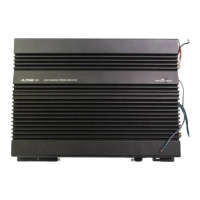
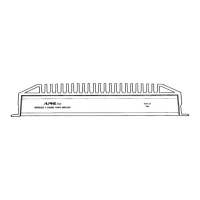
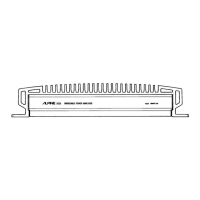
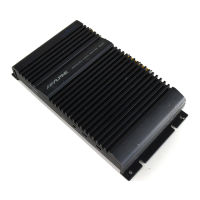
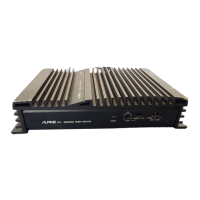
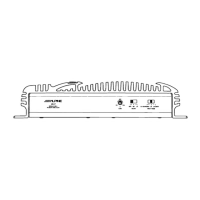
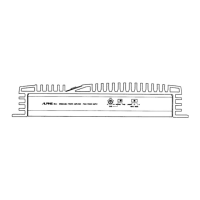
The Alpine 3527S is a versatile 4/3/2 channel power amplifier designed to enhance the audio experience in a vehicle. It is engineered to deliver sonic excellence, a core philosophy of Alpine, by providing high-quality sound and reliable performance. This amplifier is suitable for audiophiles who seek to maximize the enjoyment of their car audio system.
The 3527S functions as a power amplifier, taking a low-level audio signal and amplifying it to drive speakers. Its multi-channel design allows for flexible system configurations, catering to various audio setups. It can operate as a 4-channel amplifier, a 3-channel amplifier, or a 2-channel amplifier, offering different power outputs depending on the configuration. This adaptability makes it suitable for powering a range of speakers, from full-range satellites to subwoofers.
A key feature of the 3527S is its Active Dividing Network, which incorporates two independent, built-in crossover networks. These crossovers allow each pair of channels to operate as either a low-pass (for subwoofers), high-pass (for tweeters/midrange satellites), or full-range amplifier. The crossover frequency is fixed at 80 Hz with an 18 dB per octave slope, ensuring precise frequency separation and optimized sound reproduction for different speaker types.
The amplifier also includes Acoustic Compensation Circuitry, a selectable equalization curve that can be applied to the output signal. This feature helps to compensate for the inherent non-linearities of the automobile interior, which often negatively impact sound quality. By extending low bass response and eliminating mid-bass boominess, it contributes to a tighter and more accurate low-frequency response from the audio system.
Duo-Beta Feedback Circuitry is another advanced technology integrated into the 3527S. This proprietary Alpine feedback system provides low negative feedback across the audio frequency bandwidth and very high negative feedback at DC. This design stabilizes the amplifier, removes DC offset, and delivers excellent total harmonic distortion (T.H.D.) characteristics. Furthermore, it ensures low transient intermodulation distortion (T.I.M.), excellent slew rate, stability, and overall musicality, resulting in a cleaner and more faithful audio reproduction.
The absence of current limiters in the audio section of the 3527S is a deliberate design choice to ensure low T.I.M., excellent transient response, and superb sonic quality. Current limiters, while protective, can sometimes compromise audio fidelity, and their omission here prioritizes uncompromised sound.
The amplifier supports both Line Level and Speaker Level Input Capability, making it compatible with a wide range of head units, whether they have preamp outputs or not. This flexibility simplifies integration into various existing car audio systems.
A POWER MOSFET DC-TO-DC Switching Mode Power Supply is utilized to provide excellent power output across the entire audio bandwidth (20Hz to 20kHz). This power supply design contributes to the amplifier's soft clipping characteristics, which are crucial for superb transient response and musicality, even at high output levels.
The 3527S offers several user-adjustable features to fine-tune the audio system. It includes Independent, Continuously Adjustable Gain Controls for both channel pairs (CH1/2 and CH3/4). These controls allow for precise level matching between different signal sources or speakers, ensuring a balanced sound stage.
Gold-Plated RCA Input Connectors are used for the most accurate signal transmission and lowest possible loss. Gold plating resists corrosion, which can degrade signal quality over time, ensuring long-term performance. Similarly, Gold-Plated, Screw-Down Power and Speaker Terminals are employed for high definition, minimum loss power transfer, and resistance to oxidation. These robust terminals ensure secure and efficient electrical connections.
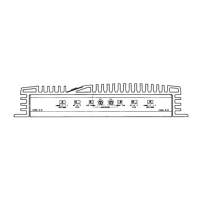
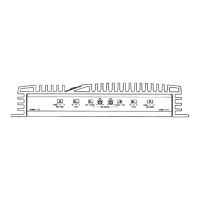
The Input Mode Selector switch (MONO/ST/L+R) allows the user to specify how the input signal enters the amplifier. This switch can eliminate the need for RCA-type Y-adaptors when bridging the amplifier, simplifying wiring and reducing potential signal loss. The "ST" (stereo) position is used when two channels operate in stereo. The "1 (MONO)" position is for when two channels are used for a single channel of a stereo or bridged system. The "1+2" position is for a subwoofer system that sums the right and left channel signals.
The Input Channel Selector switch allows the user to specify the input signal entering channels 3 and 4. This can be set to "1/2" to send the CH1/2 input signal to CH3/4, eliminating the need for Y-adaptors with single preamp output head units. It can also be set to "3/4" for independent input signals to CH3/4, suitable for dual preamp output head units. A "1+3/2+4" setting sums CH1 & CH3 inputs to CH3 and CH2 & CH4 inputs to CH4, providing a non-fading subwoofer output with fadable front and rear outputs for a separate satellite amplifier.
The Active Dividing Network Mode Selector switch for CH1/2 and CH3/4 allows selection between "LP" (low-pass), "HP" (high-pass), or "OFF" (full-range). The "LP" setting is for subwoofer systems, cutting frequencies above 80 Hz. The "HP" setting is for tweeter/midrange systems, cutting frequencies below 80 Hz. The "OFF" setting allows the amplifier to operate as a full-range amplifier, suitable for regular stereo systems with full-range speakers.
The Acoustic Compensation Switch can be turned ON to compensate for low bass loss and reduce mid-bass boominess. Users are encouraged to listen to the system with the switch in both ON and OFF positions to determine the best sound reproduction for their specific vehicle and listening environment.
The 3527S is built with Fully Discrete, Complementary Output Circuitry for excellent reliability, superb sonic performance, and high current capability, ensuring accurate transient response and long-term durability.
It incorporates High Performance, Low Noise, Audiophile Quality Active and Passive Components to ensure the best possible performance and consistency from unit to unit, minimizing the need for frequent adjustments or repairs.
Third-Order (18 dB per Octave) Capacitive/Inductive Power Supply Input and Output Filtering is included to prevent radio frequency interference (RFI) and provide immunity to system noises, such as alternator whine. This filtering helps maintain a clean audio signal, reducing potential maintenance issues related to noise.
S.T.A.R. Circuitry (Signal Transit for Accurate Response) is an Alpine-developed circuit topology that improves sonic properties by reducing interaction between different sections of the circuitry. This design contributes to the amplifier's overall stability and reliability.
The amplifier features Extra Heavy Duty Construction, including glass-epoxy printed circuit boards and separate high current power transfer bus-bars for primary voltage and ground connections. This robust build quality enhances durability and heat dissipation, which are crucial for an amplifier's lifespan.
A Status Monitor indicator is provided for troubleshooting. This light illuminates green when the amplifier is on and operational. If any internal protection circuitry is activated, the light will turn orange, signaling a potential issue. This visual cue can help in diagnosing installation problems or internal faults. The indicator will also illuminate orange for a few seconds when the power is turned on as the turn-on muting circuit is activated, which is normal operation.
For safety and proper functioning, it is important to replace fuses with ones of the same amperage. Using improper fuses can lead to serious damage to components. The manual provides clear instructions on connections, emphasizing the importance of clean and well-secured connections due to the high power output. It also recommends mounting the amplifier in a location that allows for free air circulation and heat dissipation to prevent overheating and ensure optimal performance.
 General
| Channels | 2 |
|---|---|
| RMS Power at 4 Ohms | 75W x 2 |
| RMS Power at 2 Ohms | 100W x 2 |
| Bridged RMS Power at 4 Ohms | 200W x 1 |
| Frequency Response | 10Hz - 50kHz |
| THD at Rated RMS Power | 0.08% |
| Input Sensitivity | 200mV - 4V |
| Crossover | 50Hz |

 To Next Page