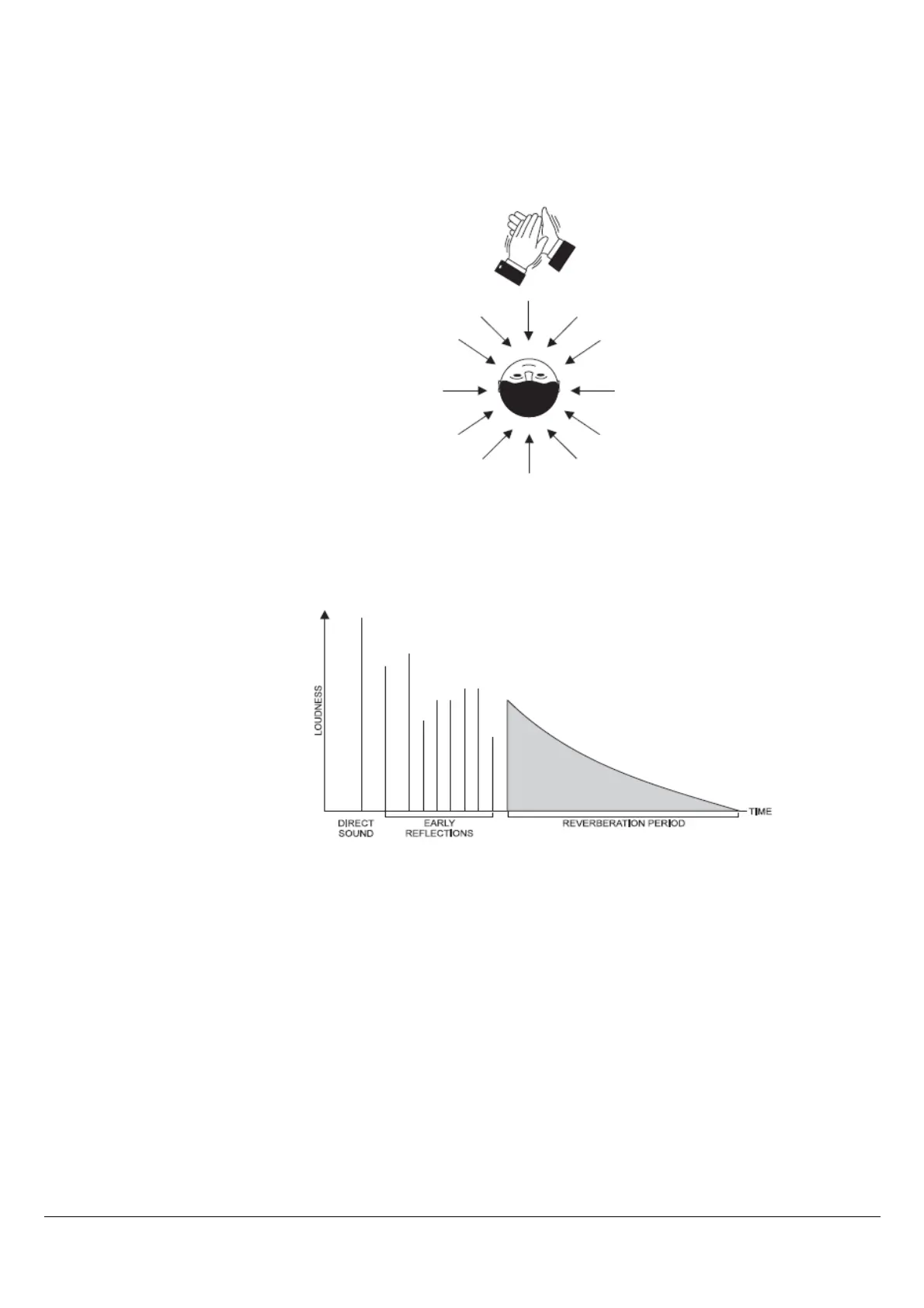
These early reflections can extend from 5ms in a small room to some 200ms in a
large hall. Even at 200ms, if the sound is not impulsive, we are unable to pick out
individual reflections during this period, but we are able to extract important
psycho-acoustic information about the type of hall and the type of boundaries
involved.
These reflections eventually build up into an extremely dense, omni-directional
reflection pattern called the 'reverberant period'. At this stage so many reflections
are arriving at once that a pleasing diffuse sound is heard which slowly dies away.
Stereo From a Mono Source
Another important aspect of sound in any acoustic space is its binaural nature.
Sound occurs in three dimensional space and even a single hand clap is heard in
stereo, even though emanating from a single source. The stereo image is created
by each ear receiving a slightly different pattern of reflections, coming from
different directions at different times. The 'stereo image' in artificial reverberation is
an extremely important concept and should not be ignored. We never hear truly
mono sounds in nature.
RMX-16 Digital Reverberation System - 7 - Issue 1



 To Next Page