EasyManua.ls Logo

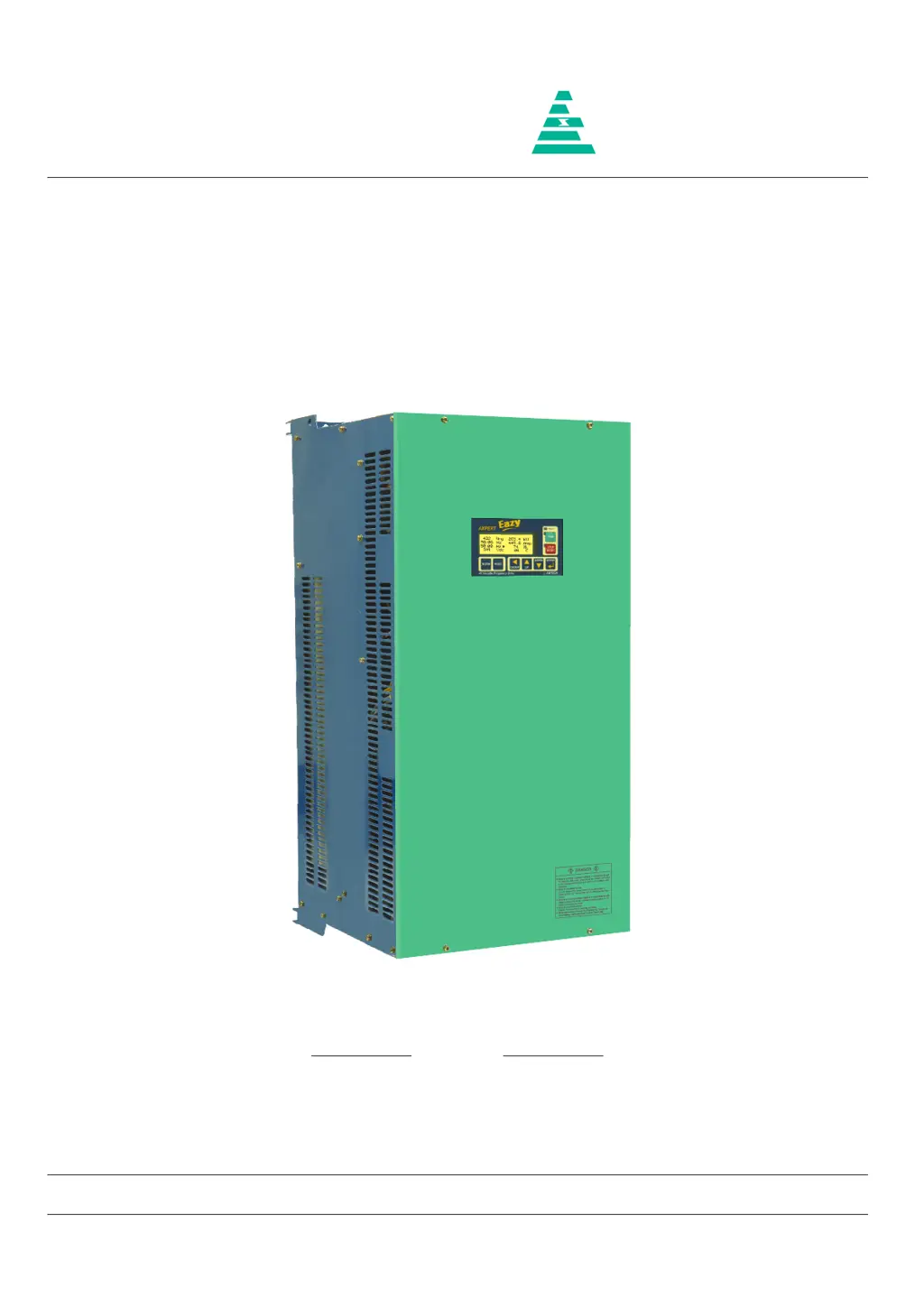
Amtech Axpert-Eazy AMT-132-4 - User Manual

Default Icon
242 pages
Print Icon
To Next Page IconTo Next Page
Loading...
NOTICE
1. Read this manual thoroughly before using the Axpert-Eazy, and store in a safe place for reference.
2. Make sure that this manual is delivered to the final user.
200 V System, 11 kW (15 Hp) ~ 90 kW (125 Hp)
400 V System, 22 kW (30 Hp) ~ 1550 kW (2075 Hp)
500 V System, 30 kW (40 Hp) ~ 1550 kW (2075 Hp)
600 V System, 30 kW (40 Hp) ~ 1800 kW (2415 Hp)
Instruction Manual
Axpert-Eazy Series
AMTECH
IMAE-01, Rev. 1.20
JUL 2017
AMTECH

Table of Contents

Questions and Answers

  • W
    Wendy MooreSep 5, 2025
    What causes Output Current Unbalance in Amtech DC Drives?
    • E
      Elizabeth BarkerSep 5, 2025
      Output Current Unbalance in Amtech DC Drives can stem from various factors. Ensure that the parameters are set properly. Abnormal setting of V/F, Torque Boost, Acceleration time and Speed search function related parameters and current limit may result in output current unbalance. Increase the acceleration time (A201 / A203). If fault occurs during deceleration, increase the deceleration time (A202 / A204). Abnormal setting of DC braking parameters can result in unbalance current fault during deceleration. Reduce the dc braking start frequency (A306) and dc braking time (A308) settings if used.
  • K
    Kimberly BrownNov 19, 2025
    What to do if Amtech DC Drives show an Over Current Fault?
    • M
      Matthew BrownNov 20, 2025
      If your Amtech DC Drive displays an Over Current Fault, several issues could be the cause. First, the power module(s) in the main circuit might be damaged, so switch off the power supply and check them. Second, there may be a loose or improper connection of the current sensor cable, or a short in the cable. In this case, switch off the power supply, remove the cable, and inspect it for proper crimping on both sides. Reinsert the cable securely. If the issue persists, replace the cable. Third, the current sensor itself may have failed, so switch off the power supply, remove the current sensor, and check. If no fault is observed, replace the damaged current sensor. Fourth, the fault may originate from the Driver Board. Switch off the power supply and remove the FRC (in case of wire interface...
  • B
    brenda75Sep 18, 2025
    What to do if Amtech DC Drives show an EEPROM Fault?
    • C
      Charles ColemanSep 18, 2025
      If your Amtech DC Drive is showing an EEPROM Fault, it means the data received from the EEPROM is incorrect or out of range. On fault reset, default values will be stored in the EEPROM. If the fault occurs again after power recycling, replace PCA-2014A.
  • J
    John GonzalezSep 16, 2025
    How to troubleshoot Auto Tuning Fault in Amtech Axpert-Eazy AMT-132-4?
    • D
      Danny NguyenSep 16, 2025
      If you encounter an Auto Tuning Fault in your Amtech DC Drive, it means the auto-tuning process has failed. The motor parameter setting value may be incorrect, so set the correct motor parameter. Ensure that the motor is directly connected to the inverter, removing any additional components like output chokes during auto-tuning.
  • A
    amandawrightSep 14, 2025
    What to do if Amtech Axpert-Eazy AMT-132-4 DC Drives show an External Fault?
    • C
      Christopher MillerSep 14, 2025
      If your Amtech DC Drive displays an External Fault, the signal for the external fault is present at the PSI. Check and correct it. If the signal is not present, remove the selection of the external fault with the help of Mode-C parameters. There may be a problem in PCA-2014A, so remove the control board PCA-2014A.
  • W
    wallsericaSep 12, 2025
    What does Reference Missing mean on Amtech Axpert-Eazy AMT-132-4 DC Drives?
    • M
      Michelle MillerSep 12, 2025
      If your Amtech DC Drive shows Reference Missing, the analog current input reference (4-20 mA) to the unit is below 3 mA. Check the voltage level at FSI terminal of PCA-2014A.
  • K
    Katie LoveSep 12, 2025
    What causes Under Current Fault in Amtech DC Drives?
    • J
      Jennifer RojasSep 12, 2025
      An Under Current Fault in Amtech DC Drives may occur if the Under Current Limit B304 is set too low. Disable the feature by setting 0% in B304.
  • R
    Ricardo MoralesSep 9, 2025
    What to do if my Amtech Axpert-Eazy AMT-132-4 DC Drives have Charging Fault?
    • L
      Lori MezaSep 9, 2025
      If your Amtech DC Drive displays a Charging Fault, the DC bus voltage didn’t reach the predefined voltage level within 5 seconds after power up. The soft charge resistor may be open. One or more phases may have failed. DC bus voltage feedback may be missing. Ensure proper connection of DC bus voltage feedback at J9.
  • S
    sfreemanSep 7, 2025
    What to do if Amtech Axpert-Eazy AMT-132-4 show an Output Phase Loss?
    • A
      Andrew WeberSep 7, 2025
      If your Amtech DC Drive indicates an Output Phase Loss, it could be due to a single phasing of the motor, so disconnect and check the motor. It can also happen if one or more output cables are open or loosely connected, so check the output connections and correct it.
  • O
    omayerAug 22, 2025
    What causes Amtech Axpert-Eazy AMT-132-4 DC Drives to have an Over Voltage Fault?
    • Y
      ypierceAug 22, 2025
      An Over Voltage Fault in Amtech DC Drives can occur if the power supply voltage rises above specified limits (785 VDC for 400 V series, 965 VDC for 500 V series, or 1160 VDC for 600 V series). Reduce the voltage to stay within the correct range. It can also happen if the speed is fluctuating.

Summary

Instruction Manual

Preface

Precautions For Safety

Essential safety guidelines to prevent injury and equipment damage.

Chapter 2: Installation and Wiring

2-2 Power Supply and Motor Wiring Precautions

Critical safety warnings and instructions for connecting power supply and motor wiring.

2-3 Power Terminal Layout

Diagrams illustrating the location and connection of power terminals for various series.

2-4 Control Signals Wiring Precautions

Guidelines for wiring control circuits, including wire type, torque, and shielding.

Chapter 3: Digital Operation Panel (LCD Keypad Module)

3-2 Modes and Parameters Overview

Describes the parameter grouping into Modes and Groups based on their functions.

3-3 Parameter Display and Setting

Details how to navigate, display, and change parameter values using the operation panel keys.

Chapter 4: Test Operation and Adjustment

4-1 Preparation Before Turning Power ON

Essential checks and preparations required before applying power to the AC Drive.

4-1-1 Selection of Control Modes

Explains the different motor control modes available and how to select them via parameter A401.

4-1-2 Selection of Start Control

Describes how to select the control source (Local, Terminal, Serial) using parameter A301.

4-1-3 Selection of Frequency Reference Input

Details the various sources for frequency reference input and their selection via parameter A106.

4-2 Initialization of Motor Constants in Mode-B

Steps for inputting motor rating parameters in Mode-B for proper operation and tuning.

4-3 Automatic Tuning & Adjustment

Guides on performing automatic tuning to optimize motor performance and parameter adjustment.

4-4 Test Operations

Procedures for testing the AC Drive operation and motor after automatic tuning.

Manual Adjustment for Torque Accuracy (IM Vector Control)

Details manual adjustments for Group-6 and Group-7 parameters when high torque accuracy is needed.

Chapter 5: Control Input; Output Terminals

5-1 Input; Output Terminal Functions (PCA-2014 A)

Detailed description of terminal functions on the PCA-2014A control unit and their symbols.

5-2 Programmable Sequence Input (PSI) Wiring

Wiring examples and precautions for programmable sequence inputs (PSI) in Sink and Source logic.

5-3 Programmable Analog Input (PAI) Wiring

Wiring instructions and precautions for programmable analog inputs (FSV, VIN, FSI, IIN).

5-4 Programmable Analog Output (PAO) Wiring

Wiring diagrams and precautions for programmable analog outputs (VO1, VO2, IO1, IO2).

5-5 Programmable Sequence Output (Open Collector)

Wiring diagram and precautions for programmable sequence outputs (PSO) using open collector type.

5-6 Programmable Sequence Output (Relay) Wiring

Wiring diagrams for programmable fault and general relays (FA/FC, R1A/R1C, R2A/R2C).

Chapter 6: Parameter Settings & Functions

MODE-M: Monitor Parameters

Details on parameters used for monitoring operating data, status, and system information.

MODE-A Parameter

Parameters related to frequency setting, motor characteristics, and V/F curve configuration.

MODE-B Parameters

Parameters for motor configuration, automatic tuning, and protection settings.

MODE-C Parameters

Parameters for programmable inputs, outputs, status detection levels, and serial communication.

MODE-D: Auxiliary Drive Parameters

Parameters specific to configuring and operating an auxiliary drive.

MODE-P: In-Built PLC Command Parameters

Parameters for configuring and managing the built-in PLC functions and commands.

In-built PLC Function Explanation

Overview of the In-built PLC function's capabilities and features for PLC-related applications.

In-built PLC Function Related Parameters and Command

Lists parameters and commands associated with the In-built PLC function.

Chapter 8: Maintenance, Inspection and Part Replacement

8-1 Inspection Items

Guidelines for periodic inspections to ensure proper operation and identify abnormalities.

Chapter 10: Encoder Specifications

Chapter 11: Serial Communication Set-Up

11-1 Connection Method

Describes the network configuration for serial communication using RS485 and Modbus protocol.

11-2 Connecting the Host Computer and Axpert-Eazy (1-to-1)

Wiring examples for establishing a 1-to-1 connection between a host computer and the Axpert-Eazy drive.

11-3 Connecting the Host Computer and Axpert-Eazy (1-to-many units)

Wiring examples for connecting a host computer to multiple Axpert-Eazy units in a network.

Chapter 12: UL Instructions

Chapter 13: CE Marking

13-3 Wiring and Earthing Practices

Critical guidelines for selecting input/output cables, wiring separation, earthing, and control cable routing.

Appendix B: Fault Codes

Fault Codes and Descriptions

Comprehensive list of fault codes, their names, and detailed descriptions of causes and countermeasures.

Appendix C: Trouble Shooting Guidelines

Voltage Checks and Jumper Positions

Guidelines for checking voltage levels and jumper settings for troubleshooting.

Fault Name Causes & Countermeasures

Detailed troubleshooting steps for common faults like Over Current, Overload, and Sensor Failures.

Amtech Axpert-Eazy AMT-132-4 Specifications

General IconGeneral
BrandAmtech
ModelAxpert-Eazy AMT-132-4
CategoryDC Drives
LanguageEnglish

Related product manuals