
 Need help?
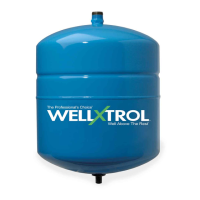
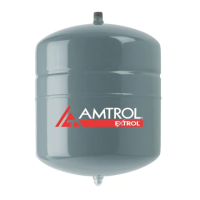
Do you have a question about the Amtrol EXTROL EX-15 and is the answer not in the manual?
Use only in residential closed hydronic systems; avoid domestic or open heating systems.
Emphasizes following manual instructions and professional installation for safety and warranty.
Warns of potential product failure, rupture, or explosion due to pressure, temperature, or improper handling.
Requires installation and periodic inspection of relief valves to prevent hazardous pressure build-up.
Advises testing and treating water to prevent premature product failure due to corrosive elements.
Informs about chemicals known to cause cancer or reproductive harm.
Visually inspect for any damage and ensure the expansion tank is sized properly for the application.
Check and adjust precharge pressure by charging with air to match the boiler fill valve setting.
Drain the boiler system or isolate the area where the EXTROL will be installed.
Install the EXTROL on the supply side of the boiler, on the suction-side of the heating circulator.
Pressurize the system, check for leaks, and repair as necessary.
A professional should check the system, including the expansion tank, yearly or more frequently.
Always check precharge while the tank is isolated and empty of water.
Monitor the inspection cap for discoloration; discolored cap requires tank replacement.
Details five-year limited warranty for EX models and one-year for SX models.
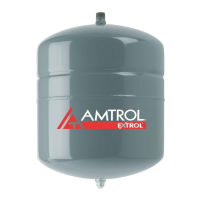
This document outlines the installation and operation instructions for EXTROL® expansion tanks, designed for use in hydronic heating and chilled water systems. These tanks are available in various models, including EX-15 through EX-90 and SX-30V through SX-160V.
EXTROL expansion tanks are crucial components in closed hydronic heating and chilled water systems. Their primary function is to accommodate the expansion and contraction of water volume within the system as it heats and cools. Water, like most fluids, expands when heated and contracts when cooled. Without an expansion tank, this change in volume would lead to excessive pressure buildup, potentially damaging system components, or a drop in pressure, which could introduce air into the system. The expansion tank provides a compressible air cushion that absorbs the expanding water, maintaining a stable system pressure. This prevents the relief valve from constantly discharging due to overpressure and ensures the system operates efficiently and safely. The tanks are specifically designed for residential closed hydronic systems and should not be used in domestic water systems or open heating systems, where corrosion and tank failure could occur. For domestic water systems, Therm-X-Trol® or Therm-X-Span® products are recommended, while Radiant EXTROL® is suggested for radiant heating systems without air elimination equipment or barrier tubing.
The installation process for EXTROL expansion tanks begins with a thorough pre-installation check. It is essential to visually inspect the product for any shipping damage and ensure the tank is correctly sized for the specific application, referring to the provided sizing chart based on boiler net output and type of radiation. Before installation, the plastic cap on the air stem must be removed, and the pre-charge pressure checked and adjusted to match the boiler fill valve setting. This adjustment should only be performed at ambient temperature. Once the pre-charge is set, the cap must be replaced and tightened snugly, ensuring it is flush against the tank surface.
For installation, the boiler system should first be drained or isolated. The EXTROL tank is then installed on the supply side of the boiler, specifically on the suction side of the heating circulator(s). After installation, the system is pressurized, and all connections are checked for leaks. Finally, the boiler system is restarted, and the relief valve discharge is monitored. If the relief valve drips, it indicates that the tank may be improperly charged or undersized, requiring further attention.
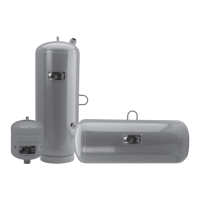
The tanks are designed for specific mounting orientations. In-line models (EX-15 through EX-90) are typically mounted vertically in a downward position. Stand models (SX-30V through SX-160V) are floor-standing and should not be hung from the piping due to their weight. It is crucial to ensure that the piping can support the entire weight of the tank when full of water. The EXTROL should not be installed on a dead-end pipe or in areas where air can collect, as this can lead to corrosion and potential leakage.
A critical safety feature is the requirement for a relief valve to be installed in the system. This valve prevents pressure from exceeding local code requirements or the maximum working pressure specified in the product manual. Failure to install and regularly inspect this valve can lead to unsafe pressure buildup, product failure, serious injury, or property damage, and will void the product warranty.
Regular maintenance is vital for the longevity and safe operation of EXTROL expansion tanks and the overall hydronic system. A professional plumber should inspect the complete system, including the expansion tank, yearly and more frequently as the system ages. Checking the pre-charge is a key maintenance task. This should always be done with the tank isolated and empty of water to ensure an accurate reading. Maintaining the proper pre-charge prevents insufficient air charge, which can lead to system inefficiencies and potential tank failure.
For in-line models, an InSight™ Service Indicator Cap is provided as a visual aid for maintenance. This cap, typically clear or white during normal operation, will discolor to indicate the presence of water in the air chamber, signaling that the tank needs replacement. While this cap is a helpful indicator, it should not be relied upon as the sole means of determining tank condition. Regular product inspection by a qualified professional remains essential.
The quality of water in the system can significantly impact the life of the product. Corrosive elements, acidity, total solids, and contaminants like chlorine can lead to premature failure. Therefore, it is recommended to test the water for these elements and treat it appropriately to ensure satisfactory performance and prevent early degradation of the tank.
The product warranty varies by model: EX models come with a five-year limited warranty, while SX models have a one-year limited warranty. Adhering to all installation and maintenance instructions is crucial, as failure to do so can void the product warranty. If the product appears to be malfunctioning or shows signs of corrosion, a qualified professional should be contacted immediately to prevent personal injury and property damage.
 General
| Model | EX-15 |
|---|---|
| Category | Water Heater |
| Weight | 10 lbs |
| Max Pressure | 150 psi |
| Material | Steel |
| Maximum Working Pressure | 150 psi |
| Maximum Operating Temperature | 240°F |
| Precharge | 12 psi |
| Diaphragm Material | Butyl |
| Type | Expansion Tank |
| Connection Size | 3/4 inch NPT |

 To Next Page