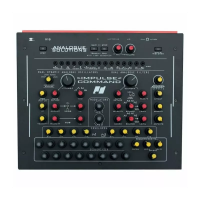
The Analogue Solutions FUSEBOX X is a compact, true analogue monophonic synthesizer designed for musicians and electronic music enthusiasts. It combines a comprehensive set of electronic music circuitry into one compact module, offering a wide range of sound possibilities from huge bass and synth leads to percussion and effects.
Function Description:
The FUSEBOX X is a versatile instrument that serves multiple roles:
- Mono Synthesizer: It excels at producing classic analogue sounds like fat basses, screaming leads, beeps, tones, zaps, and other characteristic analogue synthesis effects. It's intended as an alternative to digital synths and DSP soft synths.
- Effects Processor: Equipped with an audio input socket, the FUSEBOX X can process external sounds through its on-board analogue filters, allowing for unique analogue sound treatment.
- Drum Synthesizer: The unit is capable of generating electronic percussion sounds, including kicks, snares, hi-hats, and cymbals.
- Modular Synthesizer: While partially pre-patched, most internal patches can be overridden using switches and controls. It offers extensive modulation routing possibilities, making it almost as versatile as a full modular system without the complexity of excessive cabling. It also features a large selection of patch sockets for re-patching or connecting to external modular systems like Eurorack.
The FUSEBOX X can be used with a MIDI keyboard, DAW, or sequencer via CV & Gate. It can also be used with an analogue sequencer or as a standalone unit utilizing its Patternator and Interval Generator. MIDI and CV can be used simultaneously, allowing for transposition of analogue sequences via a MIDI keyboard or sequencer.
Circuits Included:
- Analogue Oscillators: Three analogue Voltage Controlled Oscillators (VCOs) provide the raw audio sound sources. VCO2 and VCO3 can also function as Low Frequency Oscillators (LFOs) for modulation.
- VCO1, VCO2, VCO3: Each VCO features controls for DETUNE (fine pitch adjustment), PITCH (modulation signal attenuation), PW (manual pulse width adjustment for Square wave), and PWM (external pulse width modulation amount). Each VCO has separate jack socket audio outputs for its Square and Sawtooth waveforms (VCO3 also has Triangle).
- OCT (VCO1): Transposes pitch up one octave.
- XMOD (VCO1): Routes Square wave audio from VCO2 to VCO1 pitch for cross-modulation effects.
- WIDE TUNE (VCO2, VCO3): Dramatically increases the DETUNE range, allowing frequencies from LFO speeds to much higher pitches, ideal for using VCOs as LFOs or for extreme modulation.
- SYNC (VCO2): Synchronizes VCO1 and VCO2 pitches for sync effects.
- MIDI PITCH (VCO3): Disconnects VCO3 pitch control from MIDI, allowing it to run freely as a modulator.
- MASTER TUNE: Alters the pitch of all three VCOs globally.
- GLOBAL PITCH: Attenuates any modulation signal patched into its adjacent socket, affecting all three VCOs (e.g., LFO sine wave for vibrato).
- Analogue Low Frequency Oscillator (LFO): A dedicated LFO with Sine and Square wave modulation signals and a delay feature.
- SPEED: Adjusts LFO frequency.
- CUTOFF: Sets the amount of Sine wave LFO signal modulating the Filter Frequency Cut-Off.
- PWM: Sets the amount of Sine wave LFO signal modulating all three VCOs' Square wave pulse width.
- FADE IN: Controls the delay time for Sine wave modulation to reach maximum after a MIDI key is hit, useful for delayed vibrato.
- LFO Jacks: Two Sine wave and two Square wave jack socket outputs for patching to other synth areas or as a clock source.
- 4 Analogue Filter Types: A two-pole 12dB per octave multimode VCF offering Low Pass, Band Pass, High Pass, and Notch filters.
- CUTOFF: Sets the filter frequency cut-off.
- RES: Adjusts resonance/feedback level.
- MODE: Selects filter output signal (Band Pass, LP/HP/Notch).
- CUTOFF MODULATION: Includes inputs for external CV, MIDI Velocity (VEL), and Envelope 1 (EG1) to modulate the filter cut-off.
- Audio Outputs: Separate audio output jacks for each filter type (LP, HP, Band, Notch).
- Analogue Mixer: Five inputs, each with a level control, typically used for patching VCO outputs. It also has sockets for external audio.
- NOISE / SUB:
- NOISE: An analogue white noise generator for percussion, effects, wind, and breathe sounds.
- SUB: A Square wave Sub-Oscillator driven by VCO3 (one octave lower) for thickening bass sounds.
- Analogue Amplifier (VCA): The final circuit in the audio chain, controlling the audio level.
- VOLUME: Controls the overall output level.
- Headphone Volume: Controls headphone output level.
- MODE: Selects VCA modulation source: THRU (always open, for effects processing), EG2 (Envelope 2 signal), or external CV.
- 2 Analogue Envelopes (EG1, EG2): ADSR-type envelopes where Decay and Release share a single control.
- ATT: Attack time.
- DEC/REL: Decay and Release time.
- SUS: Sustain level.
- CV Output Jacks: Two CV output jacks on the right.
- TRIG: Trigger input jack.
- Rocker Switch: Selects internal triggering source (Patternator Gate or MIDI Gate).
- EG RE-TRIGGERING: When activated, envelopes re-trigger continuously as long as a MIDI key is held down, at a rate determined by the LFO speed.
- Patternator: A unique sequencer blending an analogue step sequencer and an arpeggiator, designed for creating short melodic rhythms and rhythm patterns.
- CV Sequencer: Four steps with analogue CV controls and activity LEDs. Each step has a rocker switch for SKIP (skips the step) or normal play.
- GATE Sequencer: An 8-step rhythm pattern generator primarily for triggering Envelope Generators. Two BEAT controls adjust the gate pattern by turning on/off steps.
- Outputs: CV out jack with PITCH and CUTOFF attenuators, GATE jack for trigger output.
- SYNC Switch: Selects clock source (MIDI Note 000 or LFO) or external clock input (M.CLOCK, Bar1, or external modular clock).
- Digital Sequencer: A vintage-style mini step sequencer (similar to Roland SH101) for creating simple, transposable melodic loops.
- SEQ & REST: Activates the sequencer, memorizing up to 16 MIDI notes (including rests) in a continuous loop.
- Direction: Two playback modes (normal or reverse).
- RANGE: Two playback ranges (programmed or programmed + octave higher).
- SYNC Switch: Selects clock source (MIDI Note 000 or LFO) or external clock input (M.CLOCK, Patternator Gate, or external modular clock).
- Interval Generator: Transposes the entire synth pitch in real-time using six analogue pots and push buttons.
- Six transpose settings, each with an analogue control for interval amount.
- Rocker switch activates IG (UP for off/no transposition, DOWN for all three VCOs transposed).
- Control CV:
- CLOCK IN: Advances the Interval Generator one step per trigger/gate input.
- TUNER / STEP1: Outputs a 440Hz tuning note (when activated by TRANSPOSE button) or a trigger each time the sequencer loops.
- M.CLOCK: Outputs a 16th pulse when Fusebox receives MIDI Clock.
- GATE: Outputs a Gate voltage when MIDI notes are played.
- VELOCITY: Outputs MIDI Velocity as a voltage.
- NOTE0: Outputs a trigger whenever MIDI Note 0 is played, useful for custom MIDI Clock streams.
Important Technical Specifications:
- Construction: Full rugged steel/aluminium case, no plastic mouldings. Good quality smooth, metal potentiometers, fully sealed against dust. Good quality knobs with spun aluminium caps. High grade double-sided circuit board. Real wood sides.
- MIDI-CV Conversion: High quality 16-bit DAC for stable MIDI to CV conversion.
- Analogue Circuitry: True retro analogue voice and modulation circuits based on 1970s designs, no DSP, CPU-stabilized circuits, DCOs, digital LFOs, or digital EGs.
- Power: 18V DC minimum 800mA or higher, centre positive.
- Weight: 4.5Kg
- Size: 45 x 14 x 30cm
- Rack Size: 7U (optional rack ears available).
Usage Features:
- Tri-phonic Mode: Supports three-note polyphony.
- Patchability: Numerous jack sockets replace rocker switches from previous versions for enhanced patchability.
- Precision Controls: Interval Generator and Patternator pots are precision types.
- 440Hz Tuner Tone: Aids in tuning oscillators.
- Interval Generator Clock Input: Allows automatic transposition in various ways.
- Bar1 / Note0 Trigger Outputs: Versatile alternative triggers for Patternator and Interval Generator.
- Mini Step Sequencer: Replaces the arpeggiator, ideal for simple melodic loops.
- Wider MIDI Note Range: Increased range of playable notes via MIDI.
- MIDI Simplicity: MIDI is intentionally kept simple, focusing on sound creation rather than complex SYSEX programming. MIDI Velocity controls filter cut-off.
- Real-time Transposition: The Sequencer can be transposed in real-time using MIDI keys.
- MIDI Note 000 as Clock: A versatile way to sync Patternator and Sequencer to a MIDI sequencer, allowing for custom clock rhythms and tempo manipulation.
Maintenance Features:
- Cleaning: Clean with a lint-free cloth. Avoid solvents or cleaners.
- No User Servicing: Do not open the case or attempt repairs. Refer servicing to qualified personnel.
- Mechanical Configuration: The unit can be reconfigured from vertical (tall) to horizontal (flat) by rotating the front panel 180 degrees. Optional rack ears are available for rack mounting (7U height). This process involves minor screwdriver work and does not invalidate the warranty if done correctly.

 Need help?
 General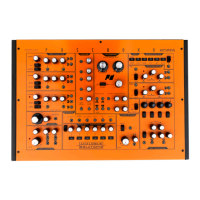

 To Next Page