7
2.2. Cautions during Use (To Get Best Performance)
For precise and accurate weighing, please take notice of the following.
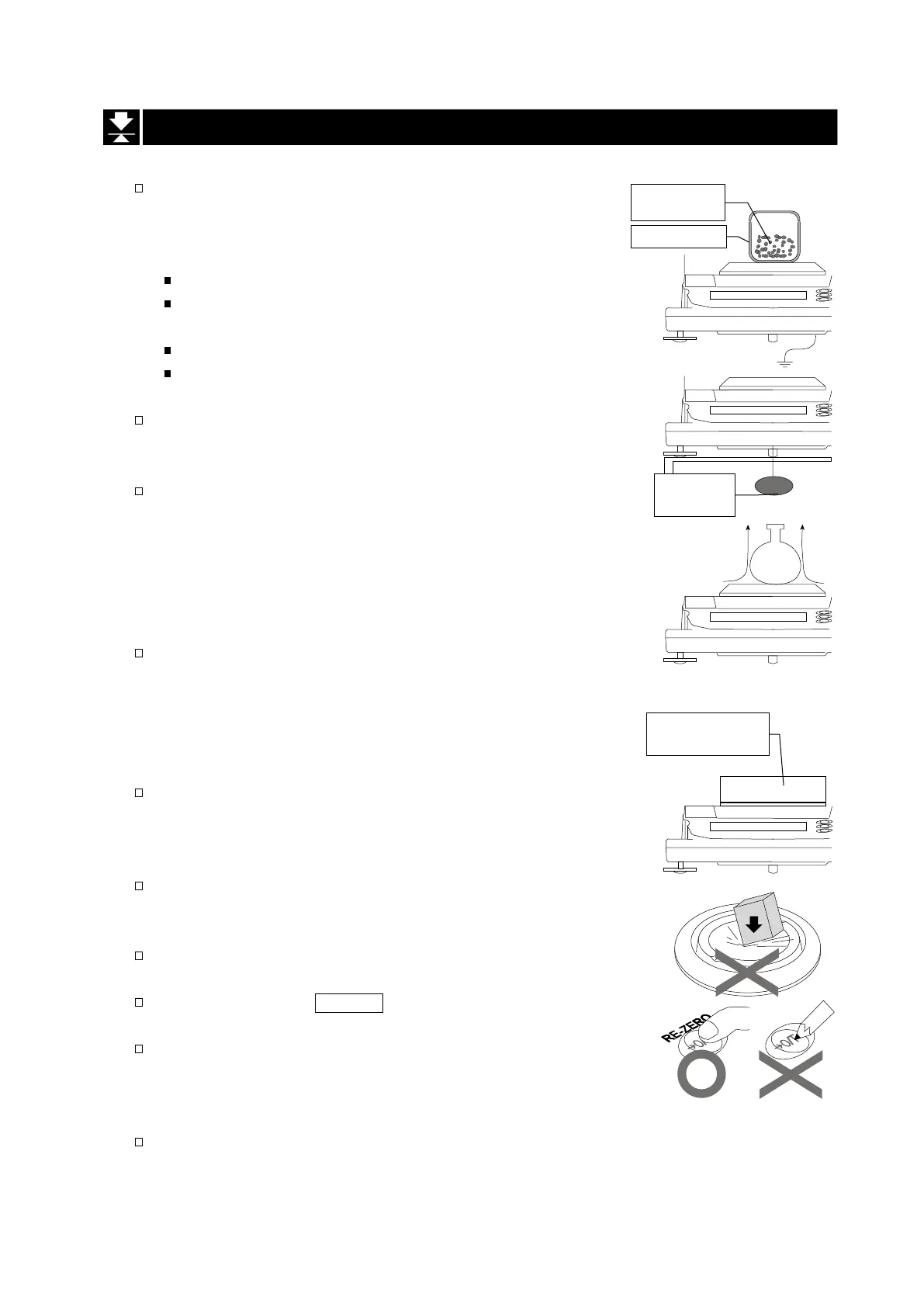
Weighing errors may occur due to the influence of static electricity.
Note that if the ambient humidity drops below 45%RH, insulators
such as plastics are liable to have static electricity. Ground the
balance and perform the following as needed.
Eliminate the static electricity using the optional AD-1683A.
Increase the relative humidity at the place where the balance
is installed.
Weigh the sample in a conductive metal container or the like.
Wipe off charged materials such as plastic with a damp cloth
to suppress static electricity.
Influence of magnetism may cause weighing errors. When
measuring magnetic materials (iron, etc.), keep the sample away
from the balance main body by means such as underhook weighing.
Weighing errors may occur if there is a difference between the
ambient temperature and temperature of the sample (and the
container). For example, when the room temperature is 20°C,
convection occurs around a Petri dish or watch glass that is 40°C and
the balance displays a value lighter than the actual weight. Before
weighing the sample and the container, try to acclimatize them to the
ambient temperature. Use tweezers when handling the sample.
Perform the weighing operation carefully and quickly. If
measurement takes a long time, error-inducing factors will
increase due to changes in temperature and humidity in the
weighing chamber, air turbulence or reaction/humidity absorption
by the sample. It is advisable to use long tweezers to avoid
inserting your hands into the weighing chamber.
For weighing with 0.01 mg readability using the GR-202, it is
adavisable to install the fine range breeze break ring in place of the
breeze break ring. (Refer to “3. Unpacking your balance”.) By installing
it, the influence of air flow can be minimized.
When placing a sample on the weighing pan, do not drop it, or do not
place a sample greater than the balance weighing capacity. Place the
sample in the center of the weighing pan.
When pressing keys, do not press with a sharp object such as a pen.
Instead, press the center of the key with your finger.
Be sure to press the RE-ZERO key before weighing in order to
eliminate measurement errors.
Measurement results include error from air buoyancy. The buoyancy
of air varies depending on the sample volume, atmospheric pressure,
temperature, and humidity. Correct the buoyancy for the most precise
measurement.
Prevent foreign substances such as powder, liquid, and metal pieces
from entering the balance.
40°C
20°C


 To Next Page