Need help?
Do you have a question about the ARB DELUXE BULL BAR and is the answer not in the manual?
Crucial safety notice regarding the front protection bar's impact on SRS airbag operation when installed correctly.
Key rules for installation, including using supplied hardware, not using for other vehicles, and not modifying the product.
Detailed list of parts included in the bull bar fitting kit for various vehicle applications and mounting points.
List of essential tools for correctly fitting the bull bar, including basic toolkit, drill, and socket extension.
Instructions for fitting impact absorbers to chassis rails and attaching bull bar braces to tow hook mounting points.
Steps for mounting the number plate and fitting rubber buffers to the bull bar using supplied hardware.
Procedures for correctly rotating the winch gearbox and motor for optimal installation positioning.
Steps to attach the winch control box bracket and prepare the roller fairlead for mounting.
Instructions for lifting and loosely bolting the bull bar to the impact absorbers and braces.
Steps for fitting the stone tray and adjusting the bull bar for uniform gaps to the vehicle.
Connecting the bull bar's turn signal indicator looms to the vehicle's existing wiring and testing functionality.
Securing winch cables safely and trimming vehicle inner guards and panels for clearance.
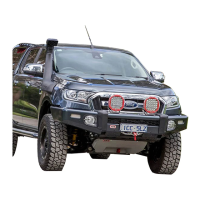
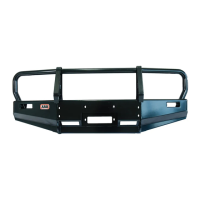
This document outlines the fitting instructions for the ARB Deluxe Bull Bar, designed specifically for the Mazda Bravo and Ford Courier models from 1999 onwards. The bull bar is available in two part numbers: 32/3440050 for models without flares and 32/3440060 for models with flares. This accessory serves as a front protection bar, enhancing the vehicle's robustness and aesthetic appeal while offering practical benefits for off-road enthusiasts and those seeking additional front-end protection.
The ARB Deluxe Bull Bar is engineered to provide superior front-end protection for the specified vehicle models. Its primary function is to safeguard the vehicle's front components, such as the radiator, headlights, and grille, from impacts with wildlife, debris, or other obstacles encountered during driving, particularly in off-road or rural environments. Beyond protection, the bull bar also serves as a sturdy platform for mounting various accessories, including winches, driving lights, and communication antennas, thereby expanding the vehicle's utility and capability.
For vehicles equipped with an SRS Airbag system, a crucial safety feature of this bull bar is its design to ensure that the installation, when performed according to these instructions, does not interfere with the proper operation of the SRS Airbag. This is a critical consideration, as improper installation could compromise the vehicle's safety systems. The bull bar is constructed from durable materials, typically high-strength steel, to withstand significant impacts and provide long-lasting performance. Its design integrates seamlessly with the vehicle's chassis, distributing impact forces effectively to minimize damage to the vehicle's frame.
The bull bar also incorporates provisions for turn signal indicators, ensuring that essential vehicle lighting functions are maintained and visible after installation. For winch-compatible models, it provides a robust mounting point for an 8000 or 9000 lb winch, transforming the vehicle into a more capable recovery platform. The design includes specific instructions for rotating the winch gearbox and motor to optimize the clutch handle and cable spooling direction, ensuring ergonomic access and efficient operation. Furthermore, a stone tray is included to protect the underside of the vehicle's front end from road debris, complementing the overall protective function of the bull bar.
The ARB Deluxe Bull Bar is designed for straightforward installation, although it requires a basic tool kit, including a long socket extension, drill, and 10mm drill bits. The fitting procedure begins with the removal of the original bumper bar and tow hooks, making way for the new protective structure. Impact absorbers are then fitted to the chassis rails, providing the critical connection points for the bull bar. These absorbers are initially finger-tightened to allow for precise alignment, ensuring that the bull bar sits correctly and maintains the specified distance between components. The recommended distance between the outside edges of the impact absorbers is 815mm, which is crucial for proper fitment and airbag compatibility.
Once the impact absorbers are aligned and tightened, the bull bar braces are attached to the vehicle's tow hook mounting positions using the original bolts. These braces provide additional structural support and rigidity to the bull bar assembly. The bull bar itself is then lifted onto the impact absorbers and loosely bolted into place, allowing for final adjustments. A key step in the installation is adjusting the bull bar until a uniform gap is achieved between it and the mudguards and grille. This not only ensures a neat appearance but also prevents rubbing and potential damage to the vehicle's bodywork. Once aligned, all bolts are securely tightened to ensure the bull bar is firmly affixed.
For models that include a stone tray, it is fitted to the vehicle using multiple bolts, flat washers, and flange nuts, providing additional underbody protection. The bull bar also accommodates turn signal indicators, which are supplied with the kit. These indicators are fitted into the bull bar, and their looms are connected to the existing vehicle wiring using Scotchloks, followed by a functional test to ensure correct operation. A minor modification to the vehicle's plastic inner guard and metal panel may be required, involving trimming them back to align with the bull bar's line.
For winch-equipped bull bars, the installation process includes specific steps for integrating an 8000 or 9000 lb winch. This involves modifying the winch's control box by replacing cables with supplied ones and then mounting the control box to a dedicated bracket on the bull bar. To optimize the winch's functionality and user access, the gearbox and motor may need to be rotated. The gearbox is rotated 72 degrees clockwise (viewed from the gearbox end) to position the clutch handle conveniently, while the motor is rotated 90 degrees anti-clockwise (viewed from the motor end) for optimal cable spooling. These rotations require careful handling to avoid damaging internal gaskets. After these adjustments, the roller fairlead is drilled and assembled into the bull bar, and the winch is lifted into place and securely bolted, ensuring the winch cable spools from the bottom. Winch wiring is then routed according to Warn fitting instructions, taking care to avoid sharp edges, hot surfaces, or moving objects, and secured with cable ties.
The ARB Deluxe Bull Bar is designed for minimal maintenance once properly installed. The robust construction and durable materials used in its manufacture ensure longevity and resistance to the elements. Regular visual inspections are recommended to ensure all bolts remain tight and secure, especially after off-road excursions or impacts. Over time, vibrations and stress can cause fasteners to loosen, so periodic checks and re-tightening, if necessary, will help maintain the bull bar's structural integrity and safety.
Cleaning the bull bar is straightforward, typically requiring only soap and water to remove dirt, mud, and grime. For painted or powder-coated surfaces, using non-abrasive cleaning agents will help preserve the finish and prevent corrosion. Any chips or scratches in the paintwork should be touched up promptly to prevent rust formation, particularly in areas exposed to harsh weather conditions or road salt.
For winch-equipped bull bars, maintenance extends to the winch itself. Following the winch manufacturer's maintenance guidelines is crucial for ensuring reliable operation. This typically includes regular inspection of the winch cable for fraying or damage, lubrication of moving parts, and checking electrical connections for corrosion or looseness. The control box and its wiring should also be inspected periodically for any signs of wear or damage.
It is important to note that the bull bar's design explicitly states that it, or its fixings, must not be modified in any way. This is a critical maintenance and safety instruction, as unauthorized modifications could compromise the bull bar's structural integrity, its ability to protect the vehicle, or its compatibility with the SRS Airbag system. Similarly, removing any labels from the bull bar is discouraged, as these often contain important safety or product information. Should any queries arise regarding the installation or maintenance of the product, contacting the distributor or an ARB office is recommended to ensure proper guidance and support. Adhering to these simple maintenance practices will ensure the ARB Deluxe Bull Bar continues to provide effective protection and functionality throughout its lifespan.
 General
| Material | Steel |
|---|---|
| Finish | Powder-coated |
| Weight | Varies by model |
| Installation | Professional installation recommended |
| Compatibility | Varies by vehicle model |
| Winch Compatibility | Yes |
| Airbag Compatibility | Yes, designed to be airbag compatible |
| Features | Integrated recovery points |

 To Next Page